 |
eVision C++ API 26.10.0-beta.2.dev
|
|
eVision C++ API 26.10.0-beta.2.dev
|
Temporal integration of a number of images to reduce noise. More...
#include <eVision/EasyImage/EMovingAverage.h>
Public Member Functions | |
| EMovingAverage () | |
| Constructs an EMovingAverage object. | |
| EMovingAverage (uint32_t period, int32_t width, int32_t height, bool internalAllocationScheme) | |
| Constructs an EMovingAverage object. | |
| EMovingAverage (uint32_t period, int32_t width, int32_t height) | |
| Constructs an EMovingAverage object. | |
| virtual | ~EMovingAverage () throw () |
| void | SetSize (uint32_t numberOfImages, int32_t imageWidth, int32_t imageHeight, bool internalAllocationScheme) |
| Initializes a moving average context with appropriate parameters. | |
| void | SetSize (uint32_t numberOfImages, int32_t imageWidth, int32_t imageHeight) |
| Initializes a moving average context with appropriate parameters. | |
| void | GetSize (uint32_t &numberOfImages, int32_t &imageWidth, int32_t &imageHeight, bool &internalAllocationScheme) |
| Queries a moving average context for the current parameter settings. | |
| uint32_t | GetNumberOfImages () const |
| Gets the number of images on which to integrate. | |
| int32_t | GetImageWidth () const |
| Gets the image width;. | |
| int32_t | GetImageHeight () const |
| Gets the image height. | |
| bool | GetInternalAllocationScheme () const |
| Gets the buffer allocation scheme. When true, the moving average context provides the image to be acquired into (see member EMovingAverage::GetSrcImage). | |
| void | Reset () |
| Restarts the average process as if no image had ever been handed to the EMovingAverage object. | |
| eVision::EImageBW8 * | GetSrcImage () |
| Returns the image in which you must store the next image to be averaged. | |
| void | Average (eVision::EROIBW8 *destinationImage) |
| Performs averaging of the source image with the preceding ones, and computes the de-noised image. | |
| void | Average (eVision::EROIBW8 *sourceImage, eVision::EROIBW8 *destinationImage) |
| Performs averaging of the source image with the preceding ones, and computes the de-noised image. | |
| EMovingAverage (CppWrapperInternal::InternalConstructor) | |
Public Attributes | |
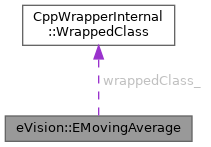
| CppWrapperInternal::WrappedClass | wrappedClass_ |
Temporal integration of a number of images to reduce noise.
License(s): EasyImage
| eVision::EMovingAverage::EMovingAverage | ( | ) |
Constructs an EMovingAverage object.
The default constructor constructs a void moving average context. A void moving average context has no internal buffers allocated and cannot be used for integration. Use the EMovingAverage::SetSize member after construction, or the initializing constructor instead. The sizing constructor constructs and initializes a moving average context.
| eVision::EMovingAverage::EMovingAverage | ( | uint32_t | period, |
| int32_t | width, | ||
| int32_t | height, | ||
| bool | internalAllocationScheme ) |
Constructs an EMovingAverage object.
| period | Number of images on which to integrate. A power of 2 is recommended. |
| width | Image width (all images used for averaging must be of the same size). |
| height | Image height (all images used for averaging must be of the same size). |
| internalAllocationScheme | Buffer allocation scheme. When true, the moving average context provides the image to be acquired into (see member EMovingAverage::GetSrcImage). |
The default constructor constructs a void moving average context. A void moving average context has no internal buffers allocated and cannot be used for integration. Use the EMovingAverage::SetSize member after construction, or the initializing constructor instead. The sizing constructor constructs and initializes a moving average context.
| eVision::EMovingAverage::EMovingAverage | ( | uint32_t | period, |
| int32_t | width, | ||
| int32_t | height ) |
Constructs an EMovingAverage object.
| period | Number of images on which to integrate. A power of 2 is recommended. |
| width | Image width (all images used for averaging must be of the same size). |
| height | Image height (all images used for averaging must be of the same size). |
The default constructor constructs a void moving average context. A void moving average context has no internal buffers allocated and cannot be used for integration. Use the EMovingAverage::SetSize member after construction, or the initializing constructor instead. The sizing constructor constructs and initializes a moving average context.
|
virtual | ||||||||||||
| eVision::EMovingAverage::EMovingAverage | ( | CppWrapperInternal::InternalConstructor | ) |
| void eVision::EMovingAverage::Average | ( | eVision::EROIBW8 * | destinationImage | ) |
Performs averaging of the source image with the preceding ones, and computes the de-noised image.
| destinationImage | Pointer to the destination image. |
The overload with only the destinationImage may be used only when the buffer allocation scheme has been set to internal (see EMovingAverage::SetSize or EMovingAverage::EMovingAverage)
| void eVision::EMovingAverage::Average | ( | eVision::EROIBW8 * | sourceImage, |
| eVision::EROIBW8 * | destinationImage ) |
Performs averaging of the source image with the preceding ones, and computes the de-noised image.
| sourceImage | Pointer to the source image. |
| destinationImage | Pointer to the destination image. |
The overload with only the destinationImage may be used only when the buffer allocation scheme has been set to internal (see EMovingAverage::SetSize or EMovingAverage::EMovingAverage)
| int32_t eVision::EMovingAverage::GetImageHeight | ( | ) | const |
Gets the image height.
| int32_t eVision::EMovingAverage::GetImageWidth | ( | ) | const |
Gets the image width;.
| bool eVision::EMovingAverage::GetInternalAllocationScheme | ( | ) | const |
Gets the buffer allocation scheme. When true, the moving average context provides the image to be acquired into (see member EMovingAverage::GetSrcImage).
| uint32_t eVision::EMovingAverage::GetNumberOfImages | ( | ) | const |
Gets the number of images on which to integrate.
| void eVision::EMovingAverage::GetSize | ( | uint32_t & | numberOfImages, |
| int32_t & | imageWidth, | ||
| int32_t & | imageHeight, | ||
| bool & | internalAllocationScheme ) |
Queries a moving average context for the current parameter settings.
| numberOfImages | Number of images on which to integrate. |
| imageWidth | Image width (all images used for averaging must be of the same size). |
| imageHeight | Image height (all images used for averaging must be of the same size). |
| internalAllocationScheme | Buffer allocation scheme. When true, the moving average context provides the image to be acquired into (see member EMovingAverage::GetSrcImage). |
Use EMovingAverage::GetNumberOfImages, EMovingAverage::GetImageWidth, EMovingAverage::GetImageHeight or EMovingAverage::GetInternalAllocationScheme instead.
Deprecated in version 24.6. Scheduled to be removed in version 27.6.
| eVision::EImageBW8 * eVision::EMovingAverage::GetSrcImage | ( | ) |
Returns the image in which you must store the next image to be averaged.
This method may be used only when the buffer allocation scheme has been set to internal (see EMovingAverage::SetSize or EMovingAverage::EMovingAverage)
| void eVision::EMovingAverage::Reset | ( | ) |
Restarts the average process as if no image had ever been handed to the EMovingAverage object.
The behavior is thus the same as after a EMovingAverage::SetSize operation.
| void eVision::EMovingAverage::SetSize | ( | uint32_t | numberOfImages, |
| int32_t | imageWidth, | ||
| int32_t | imageHeight ) |
Initializes a moving average context with appropriate parameters.
| numberOfImages | Number of images on which to integrate. A power of 2 is recommended. |
| imageWidth | Image width. |
| imageHeight | Image height. |
| void eVision::EMovingAverage::SetSize | ( | uint32_t | numberOfImages, |
| int32_t | imageWidth, | ||
| int32_t | imageHeight, | ||
| bool | internalAllocationScheme ) |
Initializes a moving average context with appropriate parameters.
| numberOfImages | Number of images on which to integrate. A power of 2 is recommended. |
| imageWidth | Image width. |
| imageHeight | Image height. |
| internalAllocationScheme | Buffer allocation scheme. When true, the moving average context provides the image to be acquired into (see member EMovingAverage::GetSrcImage). |
| CppWrapperInternal::WrappedClass eVision::EMovingAverage::wrappedClass_ |
 1.17.0