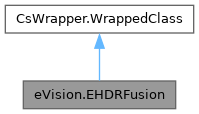
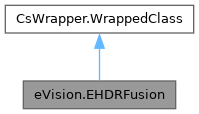
Utility class containing two configurable algorithms to display HDR images on standard display monitors while conserving details and visual quality of the input image. The fusion method takes multiple color images as input and the exposure times of each image. The fusion is performed in three steps:
More...
|
| | EHDRFusion (eVision.EMergerParameters mergerParams, eVision.EToneMapperParameters toneMapperParams) |
| | Creates a HDR fusion with the specified merger and tone-mapper. Every merger are compatible with every tone-mapper.
|
| | EHDRFusion () |
| | Creates a HDR fusion with the specified merger and tone-mapper. Every merger are compatible with every tone-mapper.
|
| | EHDRFusion (eVision.EHDRFusion other) |
| | Copy operator.
|
| void | Fuse (eVision.EImageC24[] inputs, eVision.EImageC24 output, float[] exposureTimes) |
| | If the merger type is not Mertens, the number of inputs image must match the number of exposure times. Otherwise, the number of exposure times must be null. The output image and all input images must have the same dimensions. When using the Debevec or Robertson algorithm, the response of the camera is computed by a preleminary calibration. This operation is expensive and if next calls are applied on the same number of images, with the same dimension and the same exposure times, it will not be computed again. Otherwise, the calibration is done again.
|
| void | Fuse (eVision.EImageC24[] inputs, eVision.EImageC24 output) |
| | If the merger type is not Mertens, the number of inputs image must match the number of exposure times. Otherwise, the number of exposure times must be null. The output image and all input images must have the same dimensions. When using the Debevec or Robertson algorithm, the response of the camera is computed by a preleminary calibration. This operation is expensive and if next calls are applied on the same number of images, with the same dimension and the same exposure times, it will not be computed again. Otherwise, the calibration is done again.
|
| void | Fuse (eVision.EImageBW8[] inputs, eVision.EImageBW8 output, float[] exposureTimes) |
| | If the merger type is not Mertens, the number of inputs image must match the number of exposure times. Otherwise, the number of exposure times must be null. The output image and all input images must have the same dimensions. When using the Debevec or Robertson algorithm, the response of the camera is computed by a preleminary calibration. This operation is expensive and if next calls are applied on the same number of images, with the same dimension and the same exposure times, it will not be computed again. Otherwise, the calibration is done again.
|
| void | Fuse (eVision.EImageBW8[] inputs, eVision.EImageBW8 output) |
| | If the merger type is not Mertens, the number of inputs image must match the number of exposure times. Otherwise, the number of exposure times must be null. The output image and all input images must have the same dimensions. When using the Debevec or Robertson algorithm, the response of the camera is computed by a preleminary calibration. This operation is expensive and if next calls are applied on the same number of images, with the same dimension and the same exposure times, it will not be computed again. Otherwise, the calibration is done again.
|
| void | Save (string path) |
| | Saves the EHDRFusion. The given ESerializer must have been created for writing.
|
| void | Save (eVision.ESerializer serializer) |
| | Saves the EHDRFusion. The given ESerializer must have been created for writing.
|
| void | Load (string path) |
| | Loads the EHDRFusion. The given ESerializer must have been created for reading.
|
| void | Load (eVision.ESerializer serializer) |
| | Loads the EHDRFusion. The given ESerializer must have been created for reading.
|
Utility class containing two configurable algorithms to display HDR images on standard display monitors while conserving details and visual quality of the input image. The fusion method takes multiple color images as input and the exposure times of each image. The fusion is performed in three steps:
- A calibration of the camera response is applied on the input images (if the merger is of type Debevec or Robertson.
- The merger computes an HDR image with the input images.
- The tone-mapper computes an image that can be displayed on standard display monitors.
License(s): EasyImage
If the merger type is not Mertens, the number of inputs image must match the number of exposure times. Otherwise, the number of exposure times must be null. The output image and all input images must have the same dimensions. When using the Debevec or Robertson algorithm, the response of the camera is computed by a preleminary calibration. This operation is expensive and if next calls are applied on the same number of images, with the same dimension and the same exposure times, it will not be computed again. Otherwise, the calibration is done again.
- Parameters
-
| inputs | Input images. |
| output | Output image. |
| exposureTimes | Exposure times in seconds, can be empty if the merger type is Mertens. |
If the merger type is not Mertens, the number of inputs image must match the number of exposure times. Otherwise, the number of exposure times must be null. The output image and all input images must have the same dimensions. When using the Debevec or Robertson algorithm, the response of the camera is computed by a preleminary calibration. This operation is expensive and if next calls are applied on the same number of images, with the same dimension and the same exposure times, it will not be computed again. Otherwise, the calibration is done again.
- Parameters
-
| inputs | Input images. |
| output | Output image. |
| exposureTimes | Exposure times in seconds, can be empty if the merger type is Mertens. |

 1.17.0