 |
eVision .NET API
|
|
eVision .NET API
|
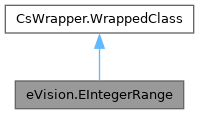
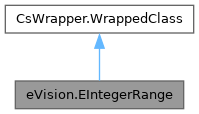
Represents a range of integer values. More...
Public Member Functions | |
| EIntegerRange () | |
| Creates an EIntegerRange.EIntegerRange object. | |
| EIntegerRange (int min, int max) | |
| Creates an EIntegerRange.EIntegerRange object. | |
| EIntegerRange (eVision.EIntegerRange range) | |
| Creates an EIntegerRange.EIntegerRange object. | |
| void | SetBounds (int min, int max) |
| Sets the bounds of the range. | |
| void | SetFromBaseAndAbsoluteTolerance (int baseValue, int tolerance) |
| Sets the bounds of the range from a base value and an absolute tolerance from this base value. | |
| void | SetFromBaseAndRelativeTolerance (int baseValue, float tolerance) |
| Sets the bounds of the range from a base value and a relative tolerance from this base value. | |
| void | Update (int value) |
| Updates the range. If the value passed is outside of the range bounds, they are modified so they include the value. | |
| bool | IsInRange (int value, bool lowerBoundInclusive, bool upperBoundInclusive) |
| Checks if a value is inside the range. | |
| bool | IsInRange (int value, bool lowerBoundInclusive) |
| Checks if a value is inside the range. | |
| bool | IsInRange (int value) |
| Checks if a value is inside the range. | |
| bool | IsInRange (float value, bool lowerBoundInclusive, bool upperBoundInclusive) |
| Checks if a value is inside the range. | |
| bool | IsInRange (float value, bool lowerBoundInclusive) |
| Checks if a value is inside the range. | |
| bool | IsInRange (float value) |
| Checks if a value is inside the range. | |
Properties | |
| int | LowerBound [get] |
| Lower bound of the range. | |
| int | UpperBound [get] |
| Upper bound of the range. | |
| int | Center [get] |
| Center of the range. | |
| int | Size [get] |
| Size of the range. | |
Represents a range of integer values.
License(s): BasicTypes
| eVision.EIntegerRange.EIntegerRange | ( | ) |
Creates an EIntegerRange.EIntegerRange object.
| eVision.EIntegerRange.EIntegerRange | ( | int | min, |
| int | max ) |
Creates an EIntegerRange.EIntegerRange object.
| min | Lower bound of the range. |
| max | Upper bound of the range. |
| eVision.EIntegerRange.EIntegerRange | ( | eVision.EIntegerRange | range | ) |
Creates an EIntegerRange.EIntegerRange object.
| range | Range to copy. |
| bool eVision.EIntegerRange.IsInRange | ( | float | value | ) |
Checks if a value is inside the range.
| value | Value to test. |
| bool eVision.EIntegerRange.IsInRange | ( | float | value, |
| bool | lowerBoundInclusive ) |
Checks if a value is inside the range.
| value | Value to test. |
| lowerBoundInclusive | Indicates if the lower bound should be considered inside the range (true) or outside (false). |
| bool eVision.EIntegerRange.IsInRange | ( | float | value, |
| bool | lowerBoundInclusive, | ||
| bool | upperBoundInclusive ) |
Checks if a value is inside the range.
| value | Value to test. |
| lowerBoundInclusive | Indicates if the lower bound should be considered inside the range (true) or outside (false). |
| upperBoundInclusive | Indicates if the upper bound should be considered inside the range (true) or outside (false). |
| bool eVision.EIntegerRange.IsInRange | ( | int | value | ) |
Checks if a value is inside the range.
| value | Value to test. |
| bool eVision.EIntegerRange.IsInRange | ( | int | value, |
| bool | lowerBoundInclusive ) |
Checks if a value is inside the range.
| value | Value to test. |
| lowerBoundInclusive | Indicates if the lower bound should be considered inside the range (true) or outside (false). |
| bool eVision.EIntegerRange.IsInRange | ( | int | value, |
| bool | lowerBoundInclusive, | ||
| bool | upperBoundInclusive ) |
Checks if a value is inside the range.
| value | Value to test. |
| lowerBoundInclusive | Indicates if the lower bound should be considered inside the range (true) or outside (false). |
| upperBoundInclusive | Indicates if the upper bound should be considered inside the range (true) or outside (false). |
| void eVision.EIntegerRange.SetBounds | ( | int | min, |
| int | max ) |
Sets the bounds of the range.
| min | Lower bound of the range. |
| max | Upper bound of the range. |
| void eVision.EIntegerRange.SetFromBaseAndAbsoluteTolerance | ( | int | baseValue, |
| int | tolerance ) |
Sets the bounds of the range from a base value and an absolute tolerance from this base value.
| baseValue | Base value. |
| tolerance | Absolute tolerance around the base value. Must be positive. |
The range will be set with a lower bound of (base - tolerance) and an upper bound of (base + tolerance).
| void eVision.EIntegerRange.SetFromBaseAndRelativeTolerance | ( | int | baseValue, |
| float | tolerance ) |
Sets the bounds of the range from a base value and a relative tolerance from this base value.
| baseValue | Base value. |
| tolerance | Relative tolerance around the base value. Must be positive. |
The range will be set with a lower bound of (base - (base * tolerance)) and an upper bound of (base + (base * tolerance)).
| void eVision.EIntegerRange.Update | ( | int | value | ) |
Updates the range. If the value passed is outside of the range bounds, they are modified so they include the value.
| value | Value to be included in the range. |
|
get |
Center of the range.
|
get |
Lower bound of the range.
|
get |
Size of the range.
|
get |
Upper bound of the range.
 1.17.0