 |
eVision Python API
|
|
eVision Python API
|
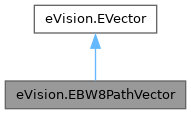
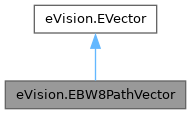
Vector objects are used to store 1-dimensional data. More...
Public Member Functions | |
| None | __init__ (self) |
| Constructs a vector. | |
| None | __init__ (self, int maxNumberOfElements) |
| Constructs a vector. | |
| None | __init__ (self, eVision.EBW8PathVector other) |
| Constructs a vector. | |
| None | AddElement (self, eVision.EBW8Path element) |
| Appends (adds at the tail) an element to the vector. | |
| eVision.EBW8Path | GetElement (self, int index) |
| Returns the vector element at the given index. | |
| None | SetElement (self, int index, eVision.EBW8Path value) |
| Modifies the vector element at the given index by the given value. | |
| None | Draw (self, eVision.EDrawAdapter|None graphicContext, float zoomX, float zoomY, float originX, float originY) |
| Draws the path. | |
| None | Draw (self, eVision.EDrawAdapter|None graphicContext, float zoomX, float zoomY, float originX) |
| Draws the path. | |
| None | Draw (self, eVision.EDrawAdapter|None graphicContext, float zoomX, float zoomY) |
| Draws the path. | |
| None | Draw (self, eVision.EDrawAdapter|None graphicContext, float zoomX) |
| Draws the path. | |
| None | Draw (self, eVision.EDrawAdapter|None graphicContext) |
| Draws the path. | |
| None | Draw (self, eVision.EDrawAdapter|None graphicContext, eVision.EPathVectorDrawOption drawOption, float zoomX, float zoomY, float originX, float originY) |
| Draws the path. | |
| None | Draw (self, eVision.EDrawAdapter|None graphicContext, eVision.EPathVectorDrawOption drawOption, float zoomX, float zoomY, float originX) |
| Draws the path. | |
| None | Draw (self, eVision.EDrawAdapter|None graphicContext, eVision.EPathVectorDrawOption drawOption, float zoomX, float zoomY) |
| Draws the path. | |
| None | Draw (self, eVision.EDrawAdapter|None graphicContext, eVision.EPathVectorDrawOption drawOption, float zoomX) |
| Draws the path. | |
| None | Draw (self, eVision.EDrawAdapter|None graphicContext, eVision.EPathVectorDrawOption drawOption) |
| Draws the path. | |
| None | DrawClosedContour (self, eVision.EDrawAdapter|None graphicContext, eVision.EContourMode contourMode, float zoomX, float zoomY, float originX, float originY) |
| Draws the path vector as the closed contour of an object or a blob. | |
| None | DrawClosedContour (self, eVision.EDrawAdapter|None graphicContext, eVision.EContourMode contourMode, float zoomX, float zoomY, float originX) |
| Draws the path vector as the closed contour of an object or a blob. | |
| None | DrawClosedContour (self, eVision.EDrawAdapter|None graphicContext, eVision.EContourMode contourMode, float zoomX, float zoomY) |
| Draws the path vector as the closed contour of an object or a blob. | |
| None | DrawClosedContour (self, eVision.EDrawAdapter|None graphicContext, eVision.EContourMode contourMode, float zoomX) |
| Draws the path vector as the closed contour of an object or a blob. | |
| None | DrawClosedContour (self, eVision.EDrawAdapter|None graphicContext, eVision.EContourMode contourMode) |
| Draws the path vector as the closed contour of an object or a blob. | |
| eVision.EBW8Path | IndexOperator_Getter (self, int index) |
| None | IndexOperator_Setter (self, int index, eVision.EBW8Path value) |
| ctypes.c_void_p | RawDataPtr (self) |
| Pointer to the vector data. | |
| bool | Closed (self) |
| Flag indicating whether the shape built with eVision.EasyImage.Contour must be closed or not. | |
| Closed (self, bool value) | |
| Flag indicating whether the shape built with eVision.EasyImage.Contour must be closed or not. | |
| Public Member Functions inherited from eVision.EVector | |
| None | Empty (self) |
| Resets the number of elements to 0. | |
| None | RemoveElement (self, int index) |
| Removes the element at the specified position. | |
| None | Save (self, str path) |
| Saves the eVision.EVector object with all its attributes. | |
| None | Save (self, eVision.ESerializer|None serializer) |
| Saves the eVision.EVector object with all its attributes. | |
| None | Save (self, str path, int un32Version) |
| Saves the eVision.EVector object with all its attributes. | |
| None | Save (self, eVision.ESerializer|None serializer, int un32Version) |
| Saves the eVision.EVector object with all its attributes. | |
| None | Load (self, str path) |
| Loads the eVision.EVector object with all its attributes. | |
| None | Load (self, eVision.ESerializer|None serializer) |
| Loads the eVision.EVector object with all its attributes. | |
| None | Load (self, str path, int un32Version) |
| Loads the eVision.EVector object with all its attributes. | |
| None | Load (self, eVision.ESerializer|None serializer, int un32Version) |
| Loads the eVision.EVector object with all its attributes. | |
| int | NumElements (self) |
| Number of elements in the vector. | |
| NumElements (self, int value) | |
| Number of elements in the vector. | |
Vector objects are used to store 1-dimensional data.
Remarks:
Using vectors is very similar to using 1-dimensional arrays, except that the size can vary at runtime. Memory allocation is handled internally.
License(s): BasicTypes
| None eVision.EBW8PathVector.__init__ | ( | self | ) |
Constructs a vector.
| None eVision.EBW8PathVector.__init__ | ( | self, | |
| int | maxNumberOfElements ) |
Constructs a vector.
| maxNumberOfElements | Optionally, memory can be pre-allocated to accommodate a given number of elements. |
| None eVision.EBW8PathVector.__init__ | ( | self, | |
| eVision.EBW8PathVector | other ) |
Constructs a vector.
| other | eVision.EBW8PathVector object to be copied |
| None eVision.EBW8PathVector.AddElement | ( | self, | |
| eVision.EBW8Path | element ) |
Appends (adds at the tail) an element to the vector.
| element | The element to be added. |
| bool eVision.EBW8PathVector.Closed | ( | self | ) |
Flag indicating whether the shape built with eVision.EasyImage.Contour must be closed or not.
| eVision.EBW8PathVector.Closed | ( | self, | |
| bool | value ) |
Flag indicating whether the shape built with eVision.EasyImage.Contour must be closed or not.
| None eVision.EBW8PathVector.Draw | ( | self, | |
| eVision.EDrawAdapter | None | graphicContext ) |
Draws the path.
By default, the path is drawn by connecting the centers of all the pixels in the path. Using the drawOption argument, you can also connect all the top left corners of the pixels (EPathVectorDrawOption_TopLeft) in the path or fill all the pixels in the path (EPathVectorDrawOption_Fill).
| graphicContext | Handle of the device context on which to draw. |
| None eVision.EBW8PathVector.Draw | ( | self, | |
| eVision.EDrawAdapter | None | graphicContext, | ||
| eVision.EPathVectorDrawOption | drawOption ) |
Draws the path.
By default, the path is drawn by connecting the centers of all the pixels in the path. Using the drawOption argument, you can also connect all the top left corners of the pixels (EPathVectorDrawOption_TopLeft) in the path or fill all the pixels in the path (EPathVectorDrawOption_Fill).
| graphicContext | Handle of the device context on which to draw. |
| drawOption | Option for how to draw the path vector |
| None eVision.EBW8PathVector.Draw | ( | self, | |
| eVision.EDrawAdapter | None | graphicContext, | ||
| eVision.EPathVectorDrawOption | drawOption, | ||
| float | zoomX ) |
Draws the path.
By default, the path is drawn by connecting the centers of all the pixels in the path. Using the drawOption argument, you can also connect all the top left corners of the pixels (EPathVectorDrawOption_TopLeft) in the path or fill all the pixels in the path (EPathVectorDrawOption_Fill).
| graphicContext | Handle of the device context on which to draw. |
| drawOption | Option for how to draw the path vector |
| zoomX | Zooming factor along the X axis (1.0f means no zoom). |
| None eVision.EBW8PathVector.Draw | ( | self, | |
| eVision.EDrawAdapter | None | graphicContext, | ||
| eVision.EPathVectorDrawOption | drawOption, | ||
| float | zoomX, | ||
| float | zoomY ) |
Draws the path.
By default, the path is drawn by connecting the centers of all the pixels in the path. Using the drawOption argument, you can also connect all the top left corners of the pixels (EPathVectorDrawOption_TopLeft) in the path or fill all the pixels in the path (EPathVectorDrawOption_Fill).
| graphicContext | Handle of the device context on which to draw. |
| drawOption | Option for how to draw the path vector |
| zoomX | Zooming factor along the X axis (1.0f means no zoom). |
| zoomY | Zooming factor along the Y axis (1.0f means no zoom). |
| None eVision.EBW8PathVector.Draw | ( | self, | |
| eVision.EDrawAdapter | None | graphicContext, | ||
| eVision.EPathVectorDrawOption | drawOption, | ||
| float | zoomX, | ||
| float | zoomY, | ||
| float | originX ) |
Draws the path.
By default, the path is drawn by connecting the centers of all the pixels in the path. Using the drawOption argument, you can also connect all the top left corners of the pixels (EPathVectorDrawOption_TopLeft) in the path or fill all the pixels in the path (EPathVectorDrawOption_Fill).
| graphicContext | Handle of the device context on which to draw. |
| drawOption | Option for how to draw the path vector |
| zoomX | Zooming factor along the X axis (1.0f means no zoom). |
| zoomY | Zooming factor along the Y axis (1.0f means no zoom). |
| originX | Abscissa of the upper left corner of the plot's bounding rectangle, in pixels. By default, the upper left corner of the window is used. |
| None eVision.EBW8PathVector.Draw | ( | self, | |
| eVision.EDrawAdapter | None | graphicContext, | ||
| eVision.EPathVectorDrawOption | drawOption, | ||
| float | zoomX, | ||
| float | zoomY, | ||
| float | originX, | ||
| float | originY ) |
Draws the path.
By default, the path is drawn by connecting the centers of all the pixels in the path. Using the drawOption argument, you can also connect all the top left corners of the pixels (EPathVectorDrawOption_TopLeft) in the path or fill all the pixels in the path (EPathVectorDrawOption_Fill).
| graphicContext | Handle of the device context on which to draw. |
| drawOption | Option for how to draw the path vector |
| zoomX | Zooming factor along the X axis (1.0f means no zoom). |
| zoomY | Zooming factor along the Y axis (1.0f means no zoom). |
| originX | Abscissa of the upper left corner of the plot's bounding rectangle, in pixels. By default, the upper left corner of the window is used. |
| originY | Ordinate of the upper left corner of the plot's bounding rectangle, in pixels. By default, the upper left corner of the window is used. |
| None eVision.EBW8PathVector.Draw | ( | self, | |
| eVision.EDrawAdapter | None | graphicContext, | ||
| float | zoomX ) |
Draws the path.
By default, the path is drawn by connecting the centers of all the pixels in the path. Using the drawOption argument, you can also connect all the top left corners of the pixels (EPathVectorDrawOption_TopLeft) in the path or fill all the pixels in the path (EPathVectorDrawOption_Fill).
| graphicContext | Handle of the device context on which to draw. |
| zoomX | Zooming factor along the X axis (1.0f means no zoom). |
| None eVision.EBW8PathVector.Draw | ( | self, | |
| eVision.EDrawAdapter | None | graphicContext, | ||
| float | zoomX, | ||
| float | zoomY ) |
Draws the path.
By default, the path is drawn by connecting the centers of all the pixels in the path. Using the drawOption argument, you can also connect all the top left corners of the pixels (EPathVectorDrawOption_TopLeft) in the path or fill all the pixels in the path (EPathVectorDrawOption_Fill).
| graphicContext | Handle of the device context on which to draw. |
| zoomX | Zooming factor along the X axis (1.0f means no zoom). |
| zoomY | Zooming factor along the Y axis (1.0f means no zoom). |
| None eVision.EBW8PathVector.Draw | ( | self, | |
| eVision.EDrawAdapter | None | graphicContext, | ||
| float | zoomX, | ||
| float | zoomY, | ||
| float | originX ) |
Draws the path.
By default, the path is drawn by connecting the centers of all the pixels in the path. Using the drawOption argument, you can also connect all the top left corners of the pixels (EPathVectorDrawOption_TopLeft) in the path or fill all the pixels in the path (EPathVectorDrawOption_Fill).
| graphicContext | Handle of the device context on which to draw. |
| zoomX | Zooming factor along the X axis (1.0f means no zoom). |
| zoomY | Zooming factor along the Y axis (1.0f means no zoom). |
| originX | Abscissa of the upper left corner of the plot's bounding rectangle, in pixels. By default, the upper left corner of the window is used. |
| None eVision.EBW8PathVector.Draw | ( | self, | |
| eVision.EDrawAdapter | None | graphicContext, | ||
| float | zoomX, | ||
| float | zoomY, | ||
| float | originX, | ||
| float | originY ) |
Draws the path.
By default, the path is drawn by connecting the centers of all the pixels in the path. Using the drawOption argument, you can also connect all the top left corners of the pixels (EPathVectorDrawOption_TopLeft) in the path or fill all the pixels in the path (EPathVectorDrawOption_Fill).
| graphicContext | Handle of the device context on which to draw. |
| zoomX | Zooming factor along the X axis (1.0f means no zoom). |
| zoomY | Zooming factor along the Y axis (1.0f means no zoom). |
| originX | Abscissa of the upper left corner of the plot's bounding rectangle, in pixels. By default, the upper left corner of the window is used. |
| originY | Ordinate of the upper left corner of the plot's bounding rectangle, in pixels. By default, the upper left corner of the window is used. |
| None eVision.EBW8PathVector.DrawClosedContour | ( | self, | |
| eVision.EDrawAdapter | None | graphicContext, | ||
| eVision.EContourMode | contourMode ) |
Draws the path vector as the closed contour of an object or a blob.
The contour mode used to compute the path must be passed as argument to draw the contour correctly. This method only supports the closed contour modes eVision.EContourMode.ClockwiseAlwaysClosed and eVision.EContourMode.AnticlockwiseAlwaysClosed.
| graphicContext | Handle of the device context on which to draw. |
| contourMode | Contour mode used to get this path vector used to draw the external boundary of the contour. |
| None eVision.EBW8PathVector.DrawClosedContour | ( | self, | |
| eVision.EDrawAdapter | None | graphicContext, | ||
| eVision.EContourMode | contourMode, | ||
| float | zoomX ) |
Draws the path vector as the closed contour of an object or a blob.
The contour mode used to compute the path must be passed as argument to draw the contour correctly. This method only supports the closed contour modes eVision.EContourMode.ClockwiseAlwaysClosed and eVision.EContourMode.AnticlockwiseAlwaysClosed.
| graphicContext | Handle of the device context on which to draw. |
| contourMode | Contour mode used to get this path vector used to draw the external boundary of the contour. |
| zoomX | Zooming factor along the X axis (1.0f means no zoom). |
| None eVision.EBW8PathVector.DrawClosedContour | ( | self, | |
| eVision.EDrawAdapter | None | graphicContext, | ||
| eVision.EContourMode | contourMode, | ||
| float | zoomX, | ||
| float | zoomY ) |
Draws the path vector as the closed contour of an object or a blob.
The contour mode used to compute the path must be passed as argument to draw the contour correctly. This method only supports the closed contour modes eVision.EContourMode.ClockwiseAlwaysClosed and eVision.EContourMode.AnticlockwiseAlwaysClosed.
| graphicContext | Handle of the device context on which to draw. |
| contourMode | Contour mode used to get this path vector used to draw the external boundary of the contour. |
| zoomX | Zooming factor along the X axis (1.0f means no zoom). |
| zoomY | Zooming factor along the Y axis (1.0f means no zoom). |
| None eVision.EBW8PathVector.DrawClosedContour | ( | self, | |
| eVision.EDrawAdapter | None | graphicContext, | ||
| eVision.EContourMode | contourMode, | ||
| float | zoomX, | ||
| float | zoomY, | ||
| float | originX ) |
Draws the path vector as the closed contour of an object or a blob.
The contour mode used to compute the path must be passed as argument to draw the contour correctly. This method only supports the closed contour modes eVision.EContourMode.ClockwiseAlwaysClosed and eVision.EContourMode.AnticlockwiseAlwaysClosed.
| graphicContext | Handle of the device context on which to draw. |
| contourMode | Contour mode used to get this path vector used to draw the external boundary of the contour. |
| zoomX | Zooming factor along the X axis (1.0f means no zoom). |
| zoomY | Zooming factor along the Y axis (1.0f means no zoom). |
| originX | Abscissa of the upper left corner of the plot's bounding rectangle, in pixels. By default, the upper left corner of the window is used. |
| None eVision.EBW8PathVector.DrawClosedContour | ( | self, | |
| eVision.EDrawAdapter | None | graphicContext, | ||
| eVision.EContourMode | contourMode, | ||
| float | zoomX, | ||
| float | zoomY, | ||
| float | originX, | ||
| float | originY ) |
Draws the path vector as the closed contour of an object or a blob.
The contour mode used to compute the path must be passed as argument to draw the contour correctly. This method only supports the closed contour modes eVision.EContourMode.ClockwiseAlwaysClosed and eVision.EContourMode.AnticlockwiseAlwaysClosed.
| graphicContext | Handle of the device context on which to draw. |
| contourMode | Contour mode used to get this path vector used to draw the external boundary of the contour. |
| zoomX | Zooming factor along the X axis (1.0f means no zoom). |
| zoomY | Zooming factor along the Y axis (1.0f means no zoom). |
| originX | Abscissa of the upper left corner of the plot's bounding rectangle, in pixels. By default, the upper left corner of the window is used. |
| originY | Ordinate of the upper left corner of the plot's bounding rectangle, in pixels. By default, the upper left corner of the window is used. |
| eVision.EBW8Path eVision.EBW8PathVector.GetElement | ( | self, | |
| int | index ) |
Returns the vector element at the given index.
Remarks:
If the given index is outside the bounds of the vector, the error code eVision.EError.Parameter1OutOfRange is set.
| index | Index, between 0 and eVision.EVector.NumElements (excluded) of the element to be accessed. |
| eVision.EBW8Path eVision.EBW8PathVector.IndexOperator_Getter | ( | self, | |
| int | index ) |
| None eVision.EBW8PathVector.IndexOperator_Setter | ( | self, | |
| int | index, | ||
| eVision.EBW8Path | value ) |
| ctypes.c_void_p eVision.EBW8PathVector.RawDataPtr | ( | self | ) |
Pointer to the vector data.
| None eVision.EBW8PathVector.SetElement | ( | self, | |
| int | index, | ||
| eVision.EBW8Path | value ) |
Modifies the vector element at the given index by the given value.
Remarks:
If the given index is outside the bounds of the vector, the error code eVision.EError.Parameter1OutOfRange is set.
| index | Index, between 0 and eVision.EVector.NumElements (excluded), of the element to be modified. |
| value | The new value for the element. |
 1.17.0