 |
eVision C++ API 26.10.0-beta.2.dev
|
|
eVision C++ API 26.10.0-beta.2.dev
|
Manages a complete context for the reading or verification of bar codes in EasyBarCode. More...
#include <eVision/EasyBarCode/EasyBarCode1/EBarCode.h>
Public Member Functions | |
| EBarCode () | |
| Creates an EBarCode::EBarCode object. | |
| virtual | ~EBarCode () throw () |
| void | SetRectangle (const eVision::Legacy::ERectangle &rectangle) |
| Sets the nominal position (center coordinates), size and rotation angle of the symbol bounding box according to a known rectangle. | |
| void | SetReadingCenter (float relativeX, float relativeY) |
| Sets the reading area center coordinates, relative to the symbol position and extent. | |
| void | SetReadingSize (float relativeSizeX, float relativeSizeY) |
| Sets the reading area size, relative to the symbol extent. | |
| float | GetRelativeReadingX () const |
| Reading area abscissa, relative to the symbol position. | |
| float | GetRelativeReadingY () const |
| Reading area ordinate, relative to the symbol position. | |
| float | GetRelativeReadingSizeX () const |
| Reading area width, relative to the symbol extent. | |
| float | GetRelativeReadingSizeY () const |
| Reading area height, relative to the symbol extent. | |
| float | GetModule () const |
| Module value. | |
| void | SetModule (float f32Module) |
| Module value. | |
| float | GetThicknessRatio () const |
| Bars thickness ratio. | |
| void | SetThicknessRatio (float f32ThicknessRatio) |
| Bars thickness ratio. | |
| bool | GetKnownLocation () const |
| Flag indicating whether the symbol location is known or not. | |
| void | SetKnownLocation (bool bKnownLocation) |
| Flag indicating whether the symbol location is known or not. | |
| bool | GetKnownModule () const |
| Flag indicating whether the symbol module is known or not. | |
| void | SetKnownModule (bool bKnownModule) |
| Flag indicating whether the symbol module is known or not. | |
| bool | GetVerifyChecksum () const |
| "VerifyChecksum" mode. | |
| void | SetVerifyChecksum (bool bVerifyChecksum) |
| "VerifyChecksum" mode. | |
| void | Detect (eVision::EROIBW8 *sourceImage) |
| Processes the image, reads the possible contents of the bar code corresponding to all enabled symbologies and rates their likeliness. | |
| std::string | Decode (eVision::ESymbologies symbology) |
| Provides the decoded information (or a reading error code) corresponding to the specified symbology. | |
| std::string | Read (eVision::EROIBW8 *sourceImage) |
| Processes the image, reads the possible contents of the bar code and returns the single possible decoding (mono-symbology) or the most likely one (multi-symbology) or a reading error code. | |
| void | GetDecodedDirection (bool &directEncoding) |
| Returns the encoding direction of the bar code, pertaining to the specified symbology, or, at least, to the most likely symbology. | |
| void | GetDecodedDirection (eVision::ESymbologies symbology, bool &directEncoding) |
| Returns the encoding direction of the bar code, pertaining to the specified symbology, or, at least, to the most likely symbology. | |
| void | GetDecodedAngle (float &decodedAngle) |
| Allows retrieving the bar code reading angle, pertaining to the specified symbology, or, at least, to the most likely symbology. | |
| void | GetDecodedAngle (float &decodedAngle, float cutAngle) |
| Allows retrieving the bar code reading angle, pertaining to the specified symbology, or, at least, to the most likely symbology. | |
| void | GetDecodedAngle (eVision::ESymbologies symbology, float &decodedAngle) |
| Allows retrieving the bar code reading angle, pertaining to the specified symbology, or, at least, to the most likely symbology. | |
| void | GetDecodedAngle (eVision::ESymbologies symbology, float &decodedAngle, float cutAngle) |
| Allows retrieving the bar code reading angle, pertaining to the specified symbology, or, at least, to the most likely symbology. | |
| void | GetDecodedRectangle (eVision::Legacy::ERectangle &rect) |
| Allows retrieving the bar code reading rectangle, pertaining to the specified symbology, or, at least, to the most likely symbology. | |
| void | GetDecodedRectangle (eVision::ESymbologies symbology, eVision::Legacy::ERectangle &rect) |
| Allows retrieving the bar code reading rectangle, pertaining to the specified symbology, or, at least, to the most likely symbology. | |
| uint32_t | GetNumEnabledSymbologies () const |
| Number of enabled symbologies. | |
| uint32_t | GetNumDecodedSymbologies () const |
| Number of symbologies (among the enabled ones) for which the decoding process was successful. | |
| eVision::ESymbologies | GetDecodedSymbology (uint32_t index) |
| Returns the identifier of one of the symbologies that were successfully decoded. | |
| uint32_t | GetStandardSymbologies () const |
| Enabled symbologies belonging to the group of standard symbologies. | |
| void | SetStandardSymbologies (uint32_t un32StandardSymbologies) |
| Enabled symbologies belonging to the group of standard symbologies. | |
| uint32_t | GetAdditionalSymbologies () const |
| Enabled symbologies belonging to the group of additional symbologies. | |
| void | SetAdditionalSymbologies (uint32_t un32AdditionalSymbologies) |
| Enabled symbologies belonging to the group of additional symbologies. | |
| void | Draw (eVision::EDrawAdapter *graphicContext, eVision::EDrawingMode drawingMode, bool daughters) |
| Draws the symbol bounding box. | |
| void | Draw (eVision::EDrawAdapter *graphicContext, eVision::EDrawingMode drawingMode) |
| Draws the symbol bounding box. | |
| void | Draw (eVision::EDrawAdapter *graphicContext) |
| Draws the symbol bounding box. | |
| void | Draw (HDC graphicContext, eVision::EDrawingMode drawingMode, bool daughters) |
| Draws the symbol bounding box. | |
| void | Draw (HDC graphicContext, eVision::EDrawingMode drawingMode) |
| Draws the symbol bounding box. | |
| void | Draw (HDC graphicContext) |
| Draws the symbol bounding box. | |
| void | Draw (HDC graphicContext, const eVision::ERGBColor &color, eVision::EDrawingMode drawingMode, bool daughters) |
| Draws the symbol bounding box. | |
| void | Draw (HDC graphicContext, const eVision::ERGBColor &color, eVision::EDrawingMode drawingMode) |
| Draws the symbol bounding box. | |
| void | Draw (HDC graphicContext, const eVision::ERGBColor &color) |
| Draws the symbol bounding box. | |
| void | DrawWithCurrentPen (HDC graphicContext, eVision::EDrawingMode drawingMode, bool daughters) |
| Draws the symbol bounding box. | |
| void | DrawWithCurrentPen (HDC graphicContext, eVision::EDrawingMode drawingMode) |
| Draws the symbol bounding box. | |
| void | DrawWithCurrentPen (HDC graphicContext) |
| Draws the symbol bounding box. | |
| bool | HitTest (bool daughters) |
| Checks whether the cursor is positioned over a handle (true) or not (false). | |
| bool | HitTest () |
| Checks whether the cursor is positioned over a handle (true) or not (false). | |
| void | Drag (int32_t cursorX, int32_t cursorY) |
| Moves a handle to a new position and updates the position parameters of the symbol bounding box. | |
| float | GetCenterX () const |
| Abscissa of the origin point of the EBarCode. | |
| float | GetCenterY () const |
| Ordinate of the origin point of the EBarCode. | |
| eVision::EPoint | GetCenter () const |
| Center point of the EBarCode. | |
| void | SetCenter (const eVision::EPoint ¢er) |
| Center point of the EBarCode. | |
| float | GetSizeX () const |
| X size of the EBarCode. | |
| float | GetSizeY () const |
| Y size of the EBarCode. | |
| float | GetAngle () const |
| Orientation of the shape. | |
| void | SetAngle (float f32Angle) |
| Orientation of the shape. | |
| void | SetSize (float sizeX, float sizeY) |
| Sets the size of a EBarCode object. | |
| void | SetCenterXY (float centerX, float centerY) |
| Sets the center coordinates of a EBarCode object. | |
| const eVision::Legacy::ERectangleShape & | GetRectangleShape () const |
| Get the rectangle shape associated with the EBarCode. | |
| eVision::Legacy::ERectangleShape & | GetRectangleShape () |
| Get the rectangle shape associated with the EBarCode. | |
| std::string | GetSymbologyName (eVision::ESymbologies symbology) |
| Retrieves the name of given symbology as a string. | |
| void | Save (const std::string &path, bool daughters) |
| Loads an EBarCode.The given EBarCode must have been created for writing. | |
| void | Save (const std::string &path) |
| Loads an EBarCode.The given EBarCode must have been created for writing. | |
| void | Save (eVision::ESerializer *serializer, bool daughters) |
| Loads an EBarCode.The given EBarCode must have been created for writing. | |
| void | Save (eVision::ESerializer *serializer) |
| Loads an EBarCode.The given EBarCode must have been created for writing. | |
| void | Load (const std::string &path, bool daughters) |
| Loads an EBarCode.The given EBarCode must have been created for reading. | |
| void | Load (const std::string &path) |
| Loads an EBarCode.The given EBarCode must have been created for reading. | |
| void | Load (eVision::ESerializer *serializer, bool daughters) |
| Loads an EBarCode.The given EBarCode must have been created for reading. | |
| void | Load (eVision::ESerializer *serializer) |
| Loads an EBarCode.The given EBarCode must have been created for reading. | |
| EBarCode (CppWrapperInternal::InternalConstructor) | |
Public Attributes | |
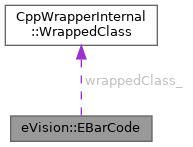
| CppWrapperInternal::WrappedClass | wrappedClass_ |
Manages a complete context for the reading or verification of bar codes in EasyBarCode.
License(s): EasyBarCode
Deprecated, use EBarCodeReader instead.
Deprecated in version 23.12. Scheduled to be removed in version 27.6.
| eVision::EBarCode::EBarCode | ( | ) |
Creates an EBarCode::EBarCode object.
|
virtual | ||||||||||||
| eVision::EBarCode::EBarCode | ( | CppWrapperInternal::InternalConstructor | ) |
| std::string eVision::EBarCode::Decode | ( | eVision::ESymbologies | symbology | ) |
Provides the decoded information (or a reading error code) corresponding to the specified symbology.
| symbology | Specified symbology, as defined by ESymbologies this symbology must have been enabled). |
Before calling EBarCode::Decode, an EBarCode::Detect operation must have been performed. In case of the mono-symbology mode, or if only the most likely decoding matters, the EBarCode::Read method should be used.
| void eVision::EBarCode::Detect | ( | eVision::EROIBW8 * | sourceImage | ) |
Processes the image, reads the possible contents of the bar code corresponding to all enabled symbologies and rates their likeliness.
| sourceImage | Pointer to the image containing the bar code. |
Processing the image means finding the symbol (in case of automatic location mode) and retrieving its descriptive parameters. The decoded information corresponding to a specific symbology is provided by the decode function. The symbologies that were successfully decoded are ranked by decreasing likeliness (range 0 to NumDecodedSymbologies-1). In case of the mono-symbology mode or if only the most likely decoding matters, the Read function should be used.
| void eVision::EBarCode::Drag | ( | int32_t | cursorX, |
| int32_t | cursorY ) |
Moves a handle to a new position and updates the position parameters of the symbol bounding box.
| cursorX | Cursor current coordinates. |
| cursorY | Cursor current coordinates. |
| void eVision::EBarCode::Draw | ( | eVision::EDrawAdapter * | graphicContext | ) |
Draws the symbol bounding box.
| graphicContext | Handle of the device context on which to draw. |
The bounding box corresponds to the nominal position of the bar code (EDrawingMode::EDrawingMode_Nominal), in case this information has been explicitly provided, and to the actual position (EDrawingMode::EDrawingMode_Actual) if it has been determined by image analysis.
| void eVision::EBarCode::Draw | ( | eVision::EDrawAdapter * | graphicContext, |
| eVision::EDrawingMode | drawingMode ) |
Draws the symbol bounding box.
| graphicContext | Handle of the device context on which to draw. |
| drawingMode | Indicates how the symbol bounding box must be displayed, as defined by EDrawingMode. |
The bounding box corresponds to the nominal position of the bar code (EDrawingMode::EDrawingMode_Nominal), in case this information has been explicitly provided, and to the actual position (EDrawingMode::EDrawingMode_Actual) if it has been determined by image analysis.
| void eVision::EBarCode::Draw | ( | eVision::EDrawAdapter * | graphicContext, |
| eVision::EDrawingMode | drawingMode, | ||
| bool | daughters ) |
Draws the symbol bounding box.
| graphicContext | Handle of the device context on which to draw. |
| drawingMode | Indicates how the symbol bounding box must be displayed, as defined by EDrawingMode. |
| daughters | true if the shapes attached to the symbol bounding box are to be displayed as well. |
The bounding box corresponds to the nominal position of the bar code (EDrawingMode::EDrawingMode_Nominal), in case this information has been explicitly provided, and to the actual position (EDrawingMode::EDrawingMode_Actual) if it has been determined by image analysis.
| void eVision::EBarCode::Draw | ( | HDC | graphicContext | ) |
Draws the symbol bounding box.
| graphicContext | Handle of the device context on which to draw. |
The bounding box corresponds to the nominal position of the bar code (EDrawingMode::EDrawingMode_Nominal), in case this information has been explicitly provided, and to the actual position (EDrawingMode::EDrawingMode_Actual) if it has been determined by image analysis.
Use the overload taking an EDrawAdapter by using an instance of EWindowsDrawAdapter.
Deprecated in version 23.12. Scheduled to be removed in version 27.6.
| void eVision::EBarCode::Draw | ( | HDC | graphicContext, |
| const eVision::ERGBColor & | color ) |
Draws the symbol bounding box.
| graphicContext | Handle of the device context on which to draw. |
| color | The color in which to draw the overlay. |
The bounding box corresponds to the nominal position of the bar code (EDrawingMode::EDrawingMode_Nominal), in case this information has been explicitly provided, and to the actual position (EDrawingMode::EDrawingMode_Actual) if it has been determined by image analysis.
Use the overload taking an EDrawAdapter by using an instance of EWindowsDrawAdapter.
Deprecated in version 23.12. Scheduled to be removed in version 27.6.
| void eVision::EBarCode::Draw | ( | HDC | graphicContext, |
| const eVision::ERGBColor & | color, | ||
| eVision::EDrawingMode | drawingMode ) |
Draws the symbol bounding box.
| graphicContext | Handle of the device context on which to draw. |
| color | The color in which to draw the overlay. |
| drawingMode | Indicates how the symbol bounding box must be displayed, as defined by EDrawingMode. |
The bounding box corresponds to the nominal position of the bar code (EDrawingMode::EDrawingMode_Nominal), in case this information has been explicitly provided, and to the actual position (EDrawingMode::EDrawingMode_Actual) if it has been determined by image analysis.
Use the overload taking an EDrawAdapter by using an instance of EWindowsDrawAdapter.
Deprecated in version 23.12. Scheduled to be removed in version 27.6.
| void eVision::EBarCode::Draw | ( | HDC | graphicContext, |
| const eVision::ERGBColor & | color, | ||
| eVision::EDrawingMode | drawingMode, | ||
| bool | daughters ) |
Draws the symbol bounding box.
| graphicContext | Handle of the device context on which to draw. |
| color | The color in which to draw the overlay. |
| drawingMode | Indicates how the symbol bounding box must be displayed, as defined by EDrawingMode. |
| daughters | true if the shapes attached to the symbol bounding box are to be displayed as well. |
The bounding box corresponds to the nominal position of the bar code (EDrawingMode::EDrawingMode_Nominal), in case this information has been explicitly provided, and to the actual position (EDrawingMode::EDrawingMode_Actual) if it has been determined by image analysis.
Use the overload taking an EDrawAdapter by using an instance of EWindowsDrawAdapter.
Deprecated in version 23.12. Scheduled to be removed in version 27.6.
| void eVision::EBarCode::Draw | ( | HDC | graphicContext, |
| eVision::EDrawingMode | drawingMode ) |
Draws the symbol bounding box.
| graphicContext | Handle of the device context on which to draw. |
| drawingMode | Indicates how the symbol bounding box must be displayed, as defined by EDrawingMode. |
The bounding box corresponds to the nominal position of the bar code (EDrawingMode::EDrawingMode_Nominal), in case this information has been explicitly provided, and to the actual position (EDrawingMode::EDrawingMode_Actual) if it has been determined by image analysis.
Use the overload taking an EDrawAdapter by using an instance of EWindowsDrawAdapter.
Deprecated in version 23.12. Scheduled to be removed in version 27.6.
| void eVision::EBarCode::Draw | ( | HDC | graphicContext, |
| eVision::EDrawingMode | drawingMode, | ||
| bool | daughters ) |
Draws the symbol bounding box.
| graphicContext | Handle of the device context on which to draw. |
| drawingMode | Indicates how the symbol bounding box must be displayed, as defined by EDrawingMode. |
| daughters | true if the shapes attached to the symbol bounding box are to be displayed as well. |
The bounding box corresponds to the nominal position of the bar code (EDrawingMode::EDrawingMode_Nominal), in case this information has been explicitly provided, and to the actual position (EDrawingMode::EDrawingMode_Actual) if it has been determined by image analysis.
Use the overload taking an EDrawAdapter by using an instance of EWindowsDrawAdapter.
Deprecated in version 23.12. Scheduled to be removed in version 27.6.
| void eVision::EBarCode::DrawWithCurrentPen | ( | HDC | graphicContext | ) |
Draws the symbol bounding box.
| graphicContext | Handle of the device context on which to draw. |
The bounding box corresponds to the nominal position of the bar code (EDrawingMode::EDrawingMode_Nominal), in case this information has been explicitly provided, and to the actual position (EDrawingMode::EDrawingMode_Actual) if it has been determined by image analysis.
Use the overload of EBarCode::Draw taking an EDrawAdapter by using an instance of EWindowsDrawAdapter.
Deprecated in version 23.12. Scheduled to be removed in version 27.6.
| void eVision::EBarCode::DrawWithCurrentPen | ( | HDC | graphicContext, |
| eVision::EDrawingMode | drawingMode ) |
Draws the symbol bounding box.
| graphicContext | Handle of the device context on which to draw. |
| drawingMode | Indicates how the symbol bounding box must be displayed, as defined by EDrawingMode. |
The bounding box corresponds to the nominal position of the bar code (EDrawingMode::EDrawingMode_Nominal), in case this information has been explicitly provided, and to the actual position (EDrawingMode::EDrawingMode_Actual) if it has been determined by image analysis.
Use the overload of EBarCode::Draw taking an EDrawAdapter by using an instance of EWindowsDrawAdapter.
Deprecated in version 23.12. Scheduled to be removed in version 27.6.
| void eVision::EBarCode::DrawWithCurrentPen | ( | HDC | graphicContext, |
| eVision::EDrawingMode | drawingMode, | ||
| bool | daughters ) |
Draws the symbol bounding box.
| graphicContext | Handle of the device context on which to draw. |
| drawingMode | Indicates how the symbol bounding box must be displayed, as defined by EDrawingMode. |
| daughters | true if the shapes attached to the symbol bounding box are to be displayed as well. |
The bounding box corresponds to the nominal position of the bar code (EDrawingMode::EDrawingMode_Nominal), in case this information has been explicitly provided, and to the actual position (EDrawingMode::EDrawingMode_Actual) if it has been determined by image analysis.
Use the overload of EBarCode::Draw taking an EDrawAdapter by using an instance of EWindowsDrawAdapter.
Deprecated in version 23.12. Scheduled to be removed in version 27.6.
| uint32_t eVision::EBarCode::GetAdditionalSymbologies | ( | ) | const |
Enabled symbologies belonging to the group of additional symbologies.
Due to the large number of supported symbologies, they have been gathered in two groups. For more information about these groups, see ESymbologies.
| float eVision::EBarCode::GetAngle | ( | ) | const |
Orientation of the shape.
| eVision::EPoint eVision::EBarCode::GetCenter | ( | ) | const |
Center point of the EBarCode.
| float eVision::EBarCode::GetCenterX | ( | ) | const |
Abscissa of the origin point of the EBarCode.
| float eVision::EBarCode::GetCenterY | ( | ) | const |
Ordinate of the origin point of the EBarCode.
| void eVision::EBarCode::GetDecodedAngle | ( | eVision::ESymbologies | symbology, |
| float & | decodedAngle ) |
Allows retrieving the bar code reading angle, pertaining to the specified symbology, or, at least, to the most likely symbology.
| symbology | Specified symbology, as defined by ESymbologies (this symbology must have been enabled). |
| decodedAngle | Returned bar code reading angle value. |
| void eVision::EBarCode::GetDecodedAngle | ( | eVision::ESymbologies | symbology, |
| float & | decodedAngle, | ||
| float | cutAngle ) |
Allows retrieving the bar code reading angle, pertaining to the specified symbology, or, at least, to the most likely symbology.
| symbology | Specified symbology, as defined by ESymbologies (this symbology must have been enabled). |
| decodedAngle | Returned bar code reading angle value. |
| cutAngle | Cut angle value (degrees) defining the allowed range for the bar code reading angle ([cutAngle, cutAngle + 360]). By default, the cut angle equals -45. |
| void eVision::EBarCode::GetDecodedAngle | ( | float & | decodedAngle | ) |
Allows retrieving the bar code reading angle, pertaining to the specified symbology, or, at least, to the most likely symbology.
| decodedAngle | Returned bar code reading angle value. |
| void eVision::EBarCode::GetDecodedAngle | ( | float & | decodedAngle, |
| float | cutAngle ) |
Allows retrieving the bar code reading angle, pertaining to the specified symbology, or, at least, to the most likely symbology.
| decodedAngle | Returned bar code reading angle value. |
| cutAngle | Cut angle value (degrees) defining the allowed range for the bar code reading angle ([cutAngle, cutAngle + 360]). By default, the cut angle equals -45. |
| void eVision::EBarCode::GetDecodedDirection | ( | bool & | directEncoding | ) |
Returns the encoding direction of the bar code, pertaining to the specified symbology, or, at least, to the most likely symbology.
| directEncoding | Boolean holding the encoding direction status. |
The encoding direction of the bar code is "Direct" or "Inverse". The encoding direction is said to be "Direct" when the bar code longitudinal axis falls in the range [-45 degrees, 135]. Conversely, when the bar code longitudinal axis doesn't fall in the previous range, the encoding direction is said to be "Inverse".
| void eVision::EBarCode::GetDecodedDirection | ( | eVision::ESymbologies | symbology, |
| bool & | directEncoding ) |
Returns the encoding direction of the bar code, pertaining to the specified symbology, or, at least, to the most likely symbology.
| symbology | Specified symbology, as defined by ESymbologies (this symbology must have been enabled). |
| directEncoding | Boolean holding the encoding direction status. |
The encoding direction of the bar code is "Direct" or "Inverse". The encoding direction is said to be "Direct" when the bar code longitudinal axis falls in the range [-45 degrees, 135]. Conversely, when the bar code longitudinal axis doesn't fall in the previous range, the encoding direction is said to be "Inverse".
| void eVision::EBarCode::GetDecodedRectangle | ( | eVision::ESymbologies | symbology, |
| eVision::Legacy::ERectangle & | rect ) |
Allows retrieving the bar code reading rectangle, pertaining to the specified symbology, or, at least, to the most likely symbology.
| symbology | Specified symbology, as defined by ESymbologies (this symbology must have been enabled). |
| rect | Returned bar code reading rectangle. |
| void eVision::EBarCode::GetDecodedRectangle | ( | eVision::Legacy::ERectangle & | rect | ) |
Allows retrieving the bar code reading rectangle, pertaining to the specified symbology, or, at least, to the most likely symbology.
| rect | Returned bar code reading rectangle. |
| eVision::ESymbologies eVision::EBarCode::GetDecodedSymbology | ( | uint32_t | index | ) |
Returns the identifier of one of the symbologies that were successfully decoded.
| index | Index of the specified symbology (range 0 to NumDecodedSymbologies-1). |
The desired symbology is specified by its ranking index (range 0 to NumDecodedSymbologies-1). The symbologies that were successfully decoded are ranked by decreasing likeliness.
| bool eVision::EBarCode::GetKnownLocation | ( | ) | const |
Flag indicating whether the symbol location is known or not.
In case of known location, use EBarCode::SetRectangle to adjust a rectangle around the symbol.
| bool eVision::EBarCode::GetKnownModule | ( | ) | const |
Flag indicating whether the symbol module is known or not.
If true, it is also necessary to get the EBarCode::GetModule and EBarCode::GetThicknessRatio properties in order to specify the requested module and thickness ratio.
| float eVision::EBarCode::GetModule | ( | ) | const |
Module value.
The module value is a descriptive parameter participating in the encoding; it corresponds to the thinner bar width. Symbols whose bars thickness can take two values, the module and V times the module (where V runs from 1.5 to 3), are called binary bar codes. When the bars thickness are small integer multiples (1 to 4 or 5) of a module, the symbols are called modular bar codes.
| uint32_t eVision::EBarCode::GetNumDecodedSymbologies | ( | ) | const |
Number of symbologies (among the enabled ones) for which the decoding process was successful.
| uint32_t eVision::EBarCode::GetNumEnabledSymbologies | ( | ) | const |
Number of enabled symbologies.
| eVision::Legacy::ERectangleShape & eVision::EBarCode::GetRectangleShape | ( | ) |
Get the rectangle shape associated with the EBarCode.
| const eVision::Legacy::ERectangleShape & eVision::EBarCode::GetRectangleShape | ( | ) | const |
Get the rectangle shape associated with the EBarCode.
| float eVision::EBarCode::GetRelativeReadingSizeX | ( | ) | const |
Reading area width, relative to the symbol extent.
| float eVision::EBarCode::GetRelativeReadingSizeY | ( | ) | const |
Reading area height, relative to the symbol extent.
| float eVision::EBarCode::GetRelativeReadingX | ( | ) | const |
Reading area abscissa, relative to the symbol position.
| float eVision::EBarCode::GetRelativeReadingY | ( | ) | const |
Reading area ordinate, relative to the symbol position.
| float eVision::EBarCode::GetSizeX | ( | ) | const |
X size of the EBarCode.
| float eVision::EBarCode::GetSizeY | ( | ) | const |
Y size of the EBarCode.
| uint32_t eVision::EBarCode::GetStandardSymbologies | ( | ) | const |
Enabled symbologies belonging to the group of standard symbologies.
Due to the large number of supported symbologies, they have been gathered in two groups. For more information about these groups, see ESymbologies.
| std::string eVision::EBarCode::GetSymbologyName | ( | eVision::ESymbologies | symbology | ) |
Retrieves the name of given symbology as a string.
| symbology | Symbology. |
| float eVision::EBarCode::GetThicknessRatio | ( | ) | const |
Bars thickness ratio.
This property is relevant in case of binary codes only. It corresponds to the ratio of a thin bar width over a thick bar width, and should range from 1.5 to 3.
| bool eVision::EBarCode::GetVerifyChecksum | ( | ) | const |
"VerifyChecksum" mode.
The "VerifyChecksum" mode enables or disables verification of the checksum character. That verification mode is set in the same way for all enabled symbologies. It is worth noting that checksum may be present or not in the bar code, and the user may verify or not checksum validity. These two circumstances are independent, and give rise to four modes of operation. The verification process will return an "invalid checksum" error in case of bad checksum character. This error can also be generated if there is no checksum in the bar code. In the other case, when checksum are not verified, no error will occur, and the process will continue silently. When the "VerifyChecksum" mode is enabled, the returned decoded string does not contain the checksum character(s). Conversely, when the verification process is disabled, the checksum character(s) are concatenated to the encoded information.
| bool eVision::EBarCode::HitTest | ( | ) |
Checks whether the cursor is positioned over a handle (true) or not (false).
| bool eVision::EBarCode::HitTest | ( | bool | daughters | ) |
Checks whether the cursor is positioned over a handle (true) or not (false).
| daughters | true if the handles of the shapes attached to the symbol bounding box have to be considered as well. |
| void eVision::EBarCode::Load | ( | const std::string & | path | ) |
| void eVision::EBarCode::Load | ( | const std::string & | path, |
| bool | daughters ) |
| void eVision::EBarCode::Load | ( | eVision::ESerializer * | serializer | ) |
Loads an EBarCode.The given EBarCode must have been created for reading.
| serializer | Pointer to the ESerializer created for reading. |
| void eVision::EBarCode::Load | ( | eVision::ESerializer * | serializer, |
| bool | daughters ) |
Loads an EBarCode.The given EBarCode must have been created for reading.
| serializer | Pointer to the ESerializer created for reading. |
| daughters | Indicates if the load must be done on the whole hierarchy or just this object. |
| std::string eVision::EBarCode::Read | ( | eVision::EROIBW8 * | sourceImage | ) |
Processes the image, reads the possible contents of the bar code and returns the single possible decoding (mono-symbology) or the most likely one (multi-symbology) or a reading error code.
| sourceImage | The image containing the bar code. |
Processing the image means finding the symbol (in case of automatic location mode) and retrieving its descriptive parameters. When decoding other than the most likely one are also required, a call to the EBarCode::Detect function followed by a EBarCode::Decode should be used.
| void eVision::EBarCode::Save | ( | const std::string & | path | ) |
| void eVision::EBarCode::Save | ( | const std::string & | path, |
| bool | daughters ) |
| void eVision::EBarCode::Save | ( | eVision::ESerializer * | serializer | ) |
Loads an EBarCode.The given EBarCode must have been created for writing.
| serializer | Pointer to the ESerializer created for writing. |
| void eVision::EBarCode::Save | ( | eVision::ESerializer * | serializer, |
| bool | daughters ) |
Loads an EBarCode.The given EBarCode must have been created for writing.
| serializer | Pointer to the ESerializer created for writing. |
| daughters | Indicates if the save must be done on the whole hierarchy or just this object. |
| void eVision::EBarCode::SetAdditionalSymbologies | ( | uint32_t | un32AdditionalSymbologies | ) |
Enabled symbologies belonging to the group of additional symbologies.
Due to the large number of supported symbologies, they have been gathered in two groups. For more information about these groups, see ESymbologies.
| void eVision::EBarCode::SetAngle | ( | float | f32Angle | ) |
Orientation of the shape.
| void eVision::EBarCode::SetCenter | ( | const eVision::EPoint & | center | ) |
Center point of the EBarCode.
| void eVision::EBarCode::SetCenterXY | ( | float | centerX, |
| float | centerY ) |
| void eVision::EBarCode::SetKnownLocation | ( | bool | bKnownLocation | ) |
Flag indicating whether the symbol location is known or not.
In case of known location, use EBarCode::SetRectangle to adjust a rectangle around the symbol.
| void eVision::EBarCode::SetKnownModule | ( | bool | bKnownModule | ) |
Flag indicating whether the symbol module is known or not.
If true, it is also necessary to get the EBarCode::GetModule and EBarCode::GetThicknessRatio properties in order to specify the requested module and thickness ratio.
| void eVision::EBarCode::SetModule | ( | float | f32Module | ) |
Module value.
The module value is a descriptive parameter participating in the encoding; it corresponds to the thinner bar width. Symbols whose bars thickness can take two values, the module and V times the module (where V runs from 1.5 to 3), are called binary bar codes. When the bars thickness are small integer multiples (1 to 4 or 5) of a module, the symbols are called modular bar codes.
| void eVision::EBarCode::SetReadingCenter | ( | float | relativeX, |
| float | relativeY ) |
Sets the reading area center coordinates, relative to the symbol position and extent.
| relativeX | Reading area center abscissa, relative to the symbol position and extent. |
| relativeY | Reading area center ordinate, relative to the symbol position and extent. |
| void eVision::EBarCode::SetReadingSize | ( | float | relativeSizeX, |
| float | relativeSizeY ) |
Sets the reading area size, relative to the symbol extent.
| relativeSizeX | Reading area width, relative to the symbol extent. |
| relativeSizeY | Reading area height, relative to the symbol extent. |
| void eVision::EBarCode::SetRectangle | ( | const eVision::Legacy::ERectangle & | rectangle | ) |
Sets the nominal position (center coordinates), size and rotation angle of the symbol bounding box according to a known rectangle.
| rectangle | Rectangle of known position (center coordinates), size and rotation angle. |
An ERectangle object is characterized by its center coordinates, its size and its rotation angle.
| void eVision::EBarCode::SetSize | ( | float | sizeX, |
| float | sizeY ) |
Sets the size of a EBarCode object.
| sizeX | Nominal size X of the EBarCode object. Default values is 100. |
| sizeY | Nominal size Y of the EBarCode object. Default values is 100. |
A EBarCode object is fully defined knowing its nominal position (given by the coordinates of its center), its nominal size, its rotation angle and its outline tolerance. By default, the width and height values are 100, which means 100 pixels when the field of view is not calibrated and 100 "units" in case of a calibrated field of view.
| void eVision::EBarCode::SetStandardSymbologies | ( | uint32_t | un32StandardSymbologies | ) |
Enabled symbologies belonging to the group of standard symbologies.
Due to the large number of supported symbologies, they have been gathered in two groups. For more information about these groups, see ESymbologies.
| void eVision::EBarCode::SetThicknessRatio | ( | float | f32ThicknessRatio | ) |
Bars thickness ratio.
This property is relevant in case of binary codes only. It corresponds to the ratio of a thin bar width over a thick bar width, and should range from 1.5 to 3.
| void eVision::EBarCode::SetVerifyChecksum | ( | bool | bVerifyChecksum | ) |
"VerifyChecksum" mode.
The "VerifyChecksum" mode enables or disables verification of the checksum character. That verification mode is set in the same way for all enabled symbologies. It is worth noting that checksum may be present or not in the bar code, and the user may verify or not checksum validity. These two circumstances are independent, and give rise to four modes of operation. The verification process will return an "invalid checksum" error in case of bad checksum character. This error can also be generated if there is no checksum in the bar code. In the other case, when checksum are not verified, no error will occur, and the process will continue silently. When the "VerifyChecksum" mode is enabled, the returned decoded string does not contain the checksum character(s). Conversely, when the verification process is disabled, the checksum character(s) are concatenated to the encoded information.
| CppWrapperInternal::WrappedClass eVision::EBarCode::wrappedClass_ |
 1.17.0