 |
eVision C++ API 26.10.0-beta.2.dev
|
|
eVision C++ API 26.10.0-beta.2.dev
|
Holds all information related to a single character, such as nominal and average position, reference quality indicators,... During the learning phases, it also keeps the list of its constituent blobs. More...
#include <eVision/EasyOcv/EOCVChar.h>
Public Member Functions | |
| EOCVChar () | |
| Constructs an OCVChar context. | |
| EOCVChar (const eVision::EOCVChar &other) | |
| Constructs an OCVChar context. | |
| virtual | ~EOCVChar () throw () |
| eVision::EOCVChar & | operator= (const eVision::EOCVChar &other) |
| Copies all the data from another EOCVChar object into the current EOCVChar object. | |
| void | ResetParameters () |
| Sets all character parameters to the undefined value for use before a EOCV::SetTextCharParameters or EOCV::ScatterTextsCharsParameters operation. | |
| bool | GetWhiteOnBlack () const |
| Character contrast: true for light characters on a dark background. | |
| void | SetWhiteOnBlack (bool val) |
| Character contrast: true for light characters on a dark background. | |
| int | GetSelected () const |
| Selection state: TRUE when selected. | |
| void | SetSelected (int val) |
| Selection state: TRUE when selected. | |
| uint32_t | GetNumContourPoints () const |
| Number of contour points of this character used for location. | |
| void | SetNumContourPoints (uint32_t val) |
| Number of contour points of this character used for location. | |
| float | GetTemplateLocationScore () const |
| Value of the location score measured on the template during learning. | |
| void | SetTemplateLocationScore (float val) |
| Value of the location score measured on the template during learning. | |
| float | GetSampleLocationScore () const |
| Value of the location score measured on the sample during inspection. | |
| void | SetSampleLocationScore (float val) |
| Value of the location score measured on the sample during inspection. | |
| float | GetLocationScoreTolerance () const |
| Allowed absolute difference between the template and sample scores. | |
| void | SetLocationScoreTolerance (float val) |
| Allowed absolute difference between the template and sample scores. | |
| float | GetShiftX () const |
| Measured horizontal translation. | |
| void | SetShiftX (float val) |
| Measured horizontal translation. | |
| float | GetShiftXBias () const |
| Horizontal translation bias. | |
| void | SetShiftXBias (float val) |
| Horizontal translation bias. | |
| float | GetShiftXTolerance () const |
| Horizontal translation tolerance. | |
| void | SetShiftXTolerance (float val) |
| Horizontal translation tolerance. | |
| uint32_t | GetShiftXStride () const |
| First pass stride for the horizontal translation. | |
| void | SetShiftXStride (uint32_t val) |
| First pass stride for the horizontal translation. | |
| float | GetShiftY () const |
| Measured vertical translation. | |
| void | SetShiftY (float val) |
| Measured vertical translation. | |
| float | GetShiftYBias () const |
| Vertical translation bias. 0 corresponds to the nominal position. | |
| void | SetShiftYBias (float val) |
| Vertical translation bias. 0 corresponds to the nominal position. | |
| float | GetShiftYTolerance () const |
| Vertical translation tolerance. | |
| void | SetShiftYTolerance (float val) |
| Vertical translation tolerance. | |
| uint32_t | GetShiftYStride () const |
| First pass stride for the vertical translation. | |
| void | SetShiftYStride (uint32_t val) |
| First pass stride for the vertical translation. | |
| uint32_t | GetDiagnostics () const |
| Logical combination (bitwise OR) of defects. | |
| void | SetDiagnostics (uint32_t val) |
| Logical combination (bitwise OR) of defects. | |
| uint32_t | GetMarginWidth () const |
| Width of the extra space to be used around the characters bounding box (on all four sides) when computing a quality indicator. | |
| void | SetMarginWidth (uint32_t val) |
| Width of the extra space to be used around the characters bounding box (on all four sides) when computing a quality indicator. | |
| uint32_t | GetTemplateForegroundArea () const |
| Number of pixels in the template foreground of this character. | |
| void | SetTemplateForegroundArea (uint32_t val) |
| Number of pixels in the template foreground of this character. | |
| uint32_t | GetSampleForegroundArea () const |
| Number of foreground pixels of this character corresponding to a foreground pixel of the template character. | |
| void | SetSampleForegroundArea (uint32_t val) |
| Number of foreground pixels of this character corresponding to a foreground pixel of the template character. | |
| uint32_t | GetForegroundAreaTolerance () const |
| Maximum allowed difference between the sample and template foreground areas. | |
| void | SetForegroundAreaTolerance (uint32_t val) |
| Maximum allowed difference between the sample and template foreground areas. | |
| uint32_t | GetTemplateBackgroundArea () const |
| Number of pixels in the background of this character. | |
| void | SetTemplateBackgroundArea (uint32_t val) |
| Number of pixels in the background of this character. | |
| uint32_t | GetSampleBackgroundArea () const |
| Number of background pixels of this character corresponding to a background pixel of the template character. | |
| void | SetSampleBackgroundArea (uint32_t val) |
| Number of background pixels of this character corresponding to a background pixel of the template character. | |
| uint32_t | GetBackgroundAreaTolerance () const |
| Maximum allowed difference between the sample and template background areas. | |
| void | SetBackgroundAreaTolerance (uint32_t val) |
| Maximum allowed difference between the sample and template background areas. | |
| float | GetTemplateForegroundSum () const |
| Sum of the normalized gray-level values of the foreground pixels of this character. | |
| void | SetTemplateForegroundSum (float val) |
| Sum of the normalized gray-level values of the foreground pixels of this character. | |
| float | GetSampleForegroundSum () const |
| Sum of the normalized gray-level values of the pixels of this character corresponding to a foreground pixel of the template character. | |
| void | SetSampleForegroundSum (float val) |
| Sum of the normalized gray-level values of the pixels of this character corresponding to a foreground pixel of the template character. | |
| float | GetForegroundSumTolerance () const |
| Maximum allowed difference between the sample and template foreground sums. | |
| void | SetForegroundSumTolerance (float val) |
| Maximum allowed difference between the sample and template foreground sums. | |
| float | GetTemplateBackgroundSum () const |
| Sum of the normalized gray-level values of the background pixels of this character. | |
| void | SetTemplateBackgroundSum (float val) |
| Sum of the normalized gray-level values of the background pixels of this character. | |
| float | GetSampleBackgroundSum () const |
| Sum of the normalized gray-level values of the pixels of this character corresponding to a background pixel of the template character. | |
| void | SetSampleBackgroundSum (float val) |
| Sum of the normalized gray-level values of the pixels of this character corresponding to a background pixel of the template character. | |
| float | GetBackgroundSumTolerance () const |
| Maximum allowed difference between the sample and template background sums. | |
| void | SetBackgroundSumTolerance (float val) |
| Maximum allowed difference between the sample and template background sums. | |
| float | GetCorrelation () const |
| Normalized correlation involving the template and sample character images. | |
| void | SetCorrelation (float val) |
| Normalized correlation involving the template and sample character images. | |
| float | GetCorrelationTolerance () const |
| Maximum allowed difference between the normalized correlation and unity. | |
| void | SetCorrelationTolerance (float val) |
| Maximum allowed difference between the normalized correlation and unity. | |
| float | GetLocationScoreAverage () const |
| Location score average. | |
| void | SetLocationScoreAverage (float val) |
| Location score average. | |
| float | GetLocationScoreDeviation () const |
| Location score standard deviation. | |
| void | SetLocationScoreDeviation (float val) |
| Location score standard deviation. | |
| float | GetShiftXAverage () const |
| Shift X average. | |
| void | SetShiftXAverage (float val) |
| Shift X average. | |
| float | GetShiftXDeviation () const |
| Shift X standard deviation. | |
| void | SetShiftXDeviation (float val) |
| Shift X standard deviation. | |
| float | GetShiftXMin () const |
| Minimum Shift X. | |
| void | SetShiftXMin (float val) |
| Minimum Shift X. | |
| float | GetShiftXMax () const |
| Maximum Shift X. | |
| void | SetShiftXMax (float val) |
| Maximum Shift X. | |
| float | GetShiftYAverage () const |
| Shift Y average. | |
| void | SetShiftYAverage (float val) |
| Shift Y average. | |
| float | GetShiftYDeviation () const |
| Shift Y standard deviation. | |
| void | SetShiftYDeviation (float val) |
| Shift Y standard deviation. | |
| float | GetShiftYMin () const |
| Minimum Shift Y. | |
| void | SetShiftYMin (float val) |
| Minimum Shift Y. | |
| float | GetShiftYMax () const |
| Maximum Shift Y. | |
| void | SetShiftYMax (float val) |
| Maximum Shift Y. | |
| float | GetForegroundAreaAverage () const |
| Foreground area average. | |
| void | SetForegroundAreaAverage (float val) |
| Foreground area average. | |
| float | GetForegroundAreaDeviation () const |
| Foreground area standard deviation. | |
| void | SetForegroundAreaDeviation (float val) |
| Foreground area standard deviation. | |
| float | GetBackgroundAreaAverage () const |
| Background area average. | |
| void | SetBackgroundAreaAverage (float val) |
| Background area average. | |
| float | GetBackgroundAreaDeviation () const |
| Background area standard deviation. | |
| void | SetBackgroundAreaDeviation (float val) |
| Background area standard deviation. | |
| float | GetForegroundSumAverage () const |
| Foreground sum average. | |
| void | SetForegroundSumAverage (float val) |
| Foreground sum average. | |
| float | GetForegroundSumDeviation () const |
| Foreground sum standard deviation. | |
| void | SetForegroundSumDeviation (float val) |
| Foreground sum standard deviation. | |
| float | GetBackgroundSumAverage () const |
| Background sum average. | |
| void | SetBackgroundSumAverage (float val) |
| Background sum average. | |
| float | GetBackgroundSumDeviation () const |
| Background sum standard deviation. | |
| void | SetBackgroundSumDeviation (float val) |
| Background sum standard deviation. | |
| float | GetCorrelationAverage () const |
| Correlation average. | |
| void | SetCorrelationAverage (float val) |
| Correlation average. | |
| float | GetCorrelationDeviation () const |
| Correlation standard deviation. | |
| void | SetCorrelationDeviation (float val) |
| Correlation standard deviation. | |
| EOCVChar (CppWrapperInternal::InternalConstructor) | |
Public Attributes | |
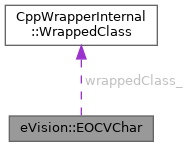
| CppWrapperInternal::WrappedClass | wrappedClass_ |
Holds all information related to a single character, such as nominal and average position, reference quality indicators,... During the learning phases, it also keeps the list of its constituent blobs.
The statistics available for each character are the average, standard deviation (unbiased), minimum and maximum computed on the corresponding parameters for all images for which EOCV::UpdateStatistics has been invoked after inspection. The average is only available when at least one set of results has been accumulated. The standard deviation is only available when at least two sets of results have been accumulated.
License(s): EasyOCV
| eVision::EOCVChar::EOCVChar | ( | ) |
Constructs an OCVChar context.
Default and copy constructors.
| eVision::EOCVChar::EOCVChar | ( | const eVision::EOCVChar & | other | ) |
Constructs an OCVChar context.
| other | EOCVChar object to be copied. |
Default and copy constructors.
|
virtual | ||||||||||||
| eVision::EOCVChar::EOCVChar | ( | CppWrapperInternal::InternalConstructor | ) |
| float eVision::EOCVChar::GetBackgroundAreaAverage | ( | ) | const |
Background area average.
| float eVision::EOCVChar::GetBackgroundAreaDeviation | ( | ) | const |
Background area standard deviation.
| uint32_t eVision::EOCVChar::GetBackgroundAreaTolerance | ( | ) | const |
Maximum allowed difference between the sample and template background areas.
| float eVision::EOCVChar::GetBackgroundSumAverage | ( | ) | const |
Background sum average.
| float eVision::EOCVChar::GetBackgroundSumDeviation | ( | ) | const |
Background sum standard deviation.
| float eVision::EOCVChar::GetBackgroundSumTolerance | ( | ) | const |
Maximum allowed difference between the sample and template background sums.
| float eVision::EOCVChar::GetCorrelation | ( | ) | const |
Normalized correlation involving the template and sample character images.
| float eVision::EOCVChar::GetCorrelationAverage | ( | ) | const |
Correlation average.
| float eVision::EOCVChar::GetCorrelationDeviation | ( | ) | const |
Correlation standard deviation.
| float eVision::EOCVChar::GetCorrelationTolerance | ( | ) | const |
Maximum allowed difference between the normalized correlation and unity.
| uint32_t eVision::EOCVChar::GetDiagnostics | ( | ) | const |
Logical combination (bitwise OR) of defects.
After inspection, each character is tagged with a logical combination of diagnostics, each corresponding to a kind of defect.
| float eVision::EOCVChar::GetForegroundAreaAverage | ( | ) | const |
Foreground area average.
| float eVision::EOCVChar::GetForegroundAreaDeviation | ( | ) | const |
Foreground area standard deviation.
| uint32_t eVision::EOCVChar::GetForegroundAreaTolerance | ( | ) | const |
Maximum allowed difference between the sample and template foreground areas.
| float eVision::EOCVChar::GetForegroundSumAverage | ( | ) | const |
Foreground sum average.
| float eVision::EOCVChar::GetForegroundSumDeviation | ( | ) | const |
Foreground sum standard deviation.
| float eVision::EOCVChar::GetForegroundSumTolerance | ( | ) | const |
Maximum allowed difference between the sample and template foreground sums.
| float eVision::EOCVChar::GetLocationScoreAverage | ( | ) | const |
Location score average.
| float eVision::EOCVChar::GetLocationScoreDeviation | ( | ) | const |
Location score standard deviation.
| float eVision::EOCVChar::GetLocationScoreTolerance | ( | ) | const |
Allowed absolute difference between the template and sample scores.
When the sample value lies outside the acceptance interval, a character not found diagnostic is issued. During the location phase, a score is computed on the sample image. During learning, the same score is measured on the template image to serve as a reference. The closer the template and sample scores, the more successful the location. The location score is a first indication on the conformance of the inspected sample. In particular, a very small sample score may indicate that the character is absent.
| uint32_t eVision::EOCVChar::GetMarginWidth | ( | ) | const |
Width of the extra space to be used around the characters bounding box (on all four sides) when computing a quality indicator.
| uint32_t eVision::EOCVChar::GetNumContourPoints | ( | ) | const |
Number of contour points of this character used for location.
The location process relies on points from the external contours of the character constituent blobs. The number of points to be used can be adjusted. The smaller this value, the faster the location, but a too small value can cause mismatches.
| uint32_t eVision::EOCVChar::GetSampleBackgroundArea | ( | ) | const |
Number of background pixels of this character corresponding to a background pixel of the template character.
| float eVision::EOCVChar::GetSampleBackgroundSum | ( | ) | const |
Sum of the normalized gray-level values of the pixels of this character corresponding to a background pixel of the template character.
| uint32_t eVision::EOCVChar::GetSampleForegroundArea | ( | ) | const |
Number of foreground pixels of this character corresponding to a foreground pixel of the template character.
| float eVision::EOCVChar::GetSampleForegroundSum | ( | ) | const |
Sum of the normalized gray-level values of the pixels of this character corresponding to a foreground pixel of the template character.
| float eVision::EOCVChar::GetSampleLocationScore | ( | ) | const |
Value of the location score measured on the sample during inspection.
During the location phase, a score is computed on the sample image. During learning, the same score is measured on the template image to serve as a reference. The closer the template and sample scores, the more successful the location. The location score is a first indication on the conformance of the inspected sample. In particular, a very small sample score may indicate that the character is absent.
| int eVision::EOCVChar::GetSelected | ( | ) | const |
Selection state: TRUE when selected.
| float eVision::EOCVChar::GetShiftX | ( | ) | const |
Measured horizontal translation.
| float eVision::EOCVChar::GetShiftXAverage | ( | ) | const |
Shift X average.
| float eVision::EOCVChar::GetShiftXBias | ( | ) | const |
Horizontal translation bias.
0 corresponds to the nominal position.
| float eVision::EOCVChar::GetShiftXDeviation | ( | ) | const |
Shift X standard deviation.
| float eVision::EOCVChar::GetShiftXMax | ( | ) | const |
Maximum Shift X.
| float eVision::EOCVChar::GetShiftXMin | ( | ) | const |
Minimum Shift X.
| uint32_t eVision::EOCVChar::GetShiftXStride | ( | ) | const |
First pass stride for the horizontal translation.
| float eVision::EOCVChar::GetShiftXTolerance | ( | ) | const |
Horizontal translation tolerance.
| float eVision::EOCVChar::GetShiftY | ( | ) | const |
Measured vertical translation.
| float eVision::EOCVChar::GetShiftYAverage | ( | ) | const |
Shift Y average.
| float eVision::EOCVChar::GetShiftYBias | ( | ) | const |
Vertical translation bias. 0 corresponds to the nominal position.
| float eVision::EOCVChar::GetShiftYDeviation | ( | ) | const |
Shift Y standard deviation.
| float eVision::EOCVChar::GetShiftYMax | ( | ) | const |
Maximum Shift Y.
| float eVision::EOCVChar::GetShiftYMin | ( | ) | const |
Minimum Shift Y.
| uint32_t eVision::EOCVChar::GetShiftYStride | ( | ) | const |
First pass stride for the vertical translation.
| float eVision::EOCVChar::GetShiftYTolerance | ( | ) | const |
Vertical translation tolerance.
| uint32_t eVision::EOCVChar::GetTemplateBackgroundArea | ( | ) | const |
Number of pixels in the background of this character.
| float eVision::EOCVChar::GetTemplateBackgroundSum | ( | ) | const |
Sum of the normalized gray-level values of the background pixels of this character.
| uint32_t eVision::EOCVChar::GetTemplateForegroundArea | ( | ) | const |
Number of pixels in the template foreground of this character.
| float eVision::EOCVChar::GetTemplateForegroundSum | ( | ) | const |
Sum of the normalized gray-level values of the foreground pixels of this character.
| float eVision::EOCVChar::GetTemplateLocationScore | ( | ) | const |
Value of the location score measured on the template during learning.
If necessary, this value may be set explicitly. During the location phase, a score is computed on the sample image. During learning, the same score is measured on the template image to serve as a reference. The closer the template and sample scores, the more successful the location. The location score is a first indication on the conformance of the inspected sample. In particular, a very small sample score may indicate that the character is absent.
| bool eVision::EOCVChar::GetWhiteOnBlack | ( | ) | const |
Character contrast: true for light characters on a dark background.
| eVision::EOCVChar & eVision::EOCVChar::operator= | ( | const eVision::EOCVChar & | other | ) |
| void eVision::EOCVChar::ResetParameters | ( | ) |
Sets all character parameters to the undefined value for use before a EOCV::SetTextCharParameters or EOCV::ScatterTextsCharsParameters operation.
| void eVision::EOCVChar::SetBackgroundAreaAverage | ( | float | val | ) |
Background area average.
| void eVision::EOCVChar::SetBackgroundAreaDeviation | ( | float | val | ) |
Background area standard deviation.
| void eVision::EOCVChar::SetBackgroundAreaTolerance | ( | uint32_t | val | ) |
Maximum allowed difference between the sample and template background areas.
| void eVision::EOCVChar::SetBackgroundSumAverage | ( | float | val | ) |
Background sum average.
| void eVision::EOCVChar::SetBackgroundSumDeviation | ( | float | val | ) |
Background sum standard deviation.
| void eVision::EOCVChar::SetBackgroundSumTolerance | ( | float | val | ) |
Maximum allowed difference between the sample and template background sums.
| void eVision::EOCVChar::SetCorrelation | ( | float | val | ) |
Normalized correlation involving the template and sample character images.
| void eVision::EOCVChar::SetCorrelationAverage | ( | float | val | ) |
Correlation average.
| void eVision::EOCVChar::SetCorrelationDeviation | ( | float | val | ) |
Correlation standard deviation.
| void eVision::EOCVChar::SetCorrelationTolerance | ( | float | val | ) |
Maximum allowed difference between the normalized correlation and unity.
| void eVision::EOCVChar::SetDiagnostics | ( | uint32_t | val | ) |
Logical combination (bitwise OR) of defects.
After inspection, each character is tagged with a logical combination of diagnostics, each corresponding to a kind of defect.
| void eVision::EOCVChar::SetForegroundAreaAverage | ( | float | val | ) |
Foreground area average.
| void eVision::EOCVChar::SetForegroundAreaDeviation | ( | float | val | ) |
Foreground area standard deviation.
| void eVision::EOCVChar::SetForegroundAreaTolerance | ( | uint32_t | val | ) |
Maximum allowed difference between the sample and template foreground areas.
| void eVision::EOCVChar::SetForegroundSumAverage | ( | float | val | ) |
Foreground sum average.
| void eVision::EOCVChar::SetForegroundSumDeviation | ( | float | val | ) |
Foreground sum standard deviation.
| void eVision::EOCVChar::SetForegroundSumTolerance | ( | float | val | ) |
Maximum allowed difference between the sample and template foreground sums.
| void eVision::EOCVChar::SetLocationScoreAverage | ( | float | val | ) |
Location score average.
| void eVision::EOCVChar::SetLocationScoreDeviation | ( | float | val | ) |
Location score standard deviation.
| void eVision::EOCVChar::SetLocationScoreTolerance | ( | float | val | ) |
Allowed absolute difference between the template and sample scores.
When the sample value lies outside the acceptance interval, a character not found diagnostic is issued. During the location phase, a score is computed on the sample image. During learning, the same score is measured on the template image to serve as a reference. The closer the template and sample scores, the more successful the location. The location score is a first indication on the conformance of the inspected sample. In particular, a very small sample score may indicate that the character is absent.
| void eVision::EOCVChar::SetMarginWidth | ( | uint32_t | val | ) |
Width of the extra space to be used around the characters bounding box (on all four sides) when computing a quality indicator.
| void eVision::EOCVChar::SetNumContourPoints | ( | uint32_t | val | ) |
Number of contour points of this character used for location.
The location process relies on points from the external contours of the character constituent blobs. The number of points to be used can be adjusted. The smaller this value, the faster the location, but a too small value can cause mismatches.
| void eVision::EOCVChar::SetSampleBackgroundArea | ( | uint32_t | val | ) |
Number of background pixels of this character corresponding to a background pixel of the template character.
| void eVision::EOCVChar::SetSampleBackgroundSum | ( | float | val | ) |
Sum of the normalized gray-level values of the pixels of this character corresponding to a background pixel of the template character.
| void eVision::EOCVChar::SetSampleForegroundArea | ( | uint32_t | val | ) |
Number of foreground pixels of this character corresponding to a foreground pixel of the template character.
| void eVision::EOCVChar::SetSampleForegroundSum | ( | float | val | ) |
Sum of the normalized gray-level values of the pixels of this character corresponding to a foreground pixel of the template character.
| void eVision::EOCVChar::SetSampleLocationScore | ( | float | val | ) |
Value of the location score measured on the sample during inspection.
During the location phase, a score is computed on the sample image. During learning, the same score is measured on the template image to serve as a reference. The closer the template and sample scores, the more successful the location. The location score is a first indication on the conformance of the inspected sample. In particular, a very small sample score may indicate that the character is absent.
| void eVision::EOCVChar::SetSelected | ( | int | val | ) |
Selection state: TRUE when selected.
| void eVision::EOCVChar::SetShiftX | ( | float | val | ) |
Measured horizontal translation.
| void eVision::EOCVChar::SetShiftXAverage | ( | float | val | ) |
Shift X average.
| void eVision::EOCVChar::SetShiftXBias | ( | float | val | ) |
Horizontal translation bias.
0 corresponds to the nominal position.
| void eVision::EOCVChar::SetShiftXDeviation | ( | float | val | ) |
Shift X standard deviation.
| void eVision::EOCVChar::SetShiftXMax | ( | float | val | ) |
Maximum Shift X.
| void eVision::EOCVChar::SetShiftXMin | ( | float | val | ) |
Minimum Shift X.
| void eVision::EOCVChar::SetShiftXStride | ( | uint32_t | val | ) |
First pass stride for the horizontal translation.
| void eVision::EOCVChar::SetShiftXTolerance | ( | float | val | ) |
Horizontal translation tolerance.
| void eVision::EOCVChar::SetShiftY | ( | float | val | ) |
Measured vertical translation.
| void eVision::EOCVChar::SetShiftYAverage | ( | float | val | ) |
Shift Y average.
| void eVision::EOCVChar::SetShiftYBias | ( | float | val | ) |
Vertical translation bias. 0 corresponds to the nominal position.
| void eVision::EOCVChar::SetShiftYDeviation | ( | float | val | ) |
Shift Y standard deviation.
| void eVision::EOCVChar::SetShiftYMax | ( | float | val | ) |
Maximum Shift Y.
| void eVision::EOCVChar::SetShiftYMin | ( | float | val | ) |
Minimum Shift Y.
| void eVision::EOCVChar::SetShiftYStride | ( | uint32_t | val | ) |
First pass stride for the vertical translation.
| void eVision::EOCVChar::SetShiftYTolerance | ( | float | val | ) |
Vertical translation tolerance.
| void eVision::EOCVChar::SetTemplateBackgroundArea | ( | uint32_t | val | ) |
Number of pixels in the background of this character.
| void eVision::EOCVChar::SetTemplateBackgroundSum | ( | float | val | ) |
Sum of the normalized gray-level values of the background pixels of this character.
| void eVision::EOCVChar::SetTemplateForegroundArea | ( | uint32_t | val | ) |
Number of pixels in the template foreground of this character.
| void eVision::EOCVChar::SetTemplateForegroundSum | ( | float | val | ) |
Sum of the normalized gray-level values of the foreground pixels of this character.
| void eVision::EOCVChar::SetTemplateLocationScore | ( | float | val | ) |
Value of the location score measured on the template during learning.
If necessary, this value may be set explicitly. During the location phase, a score is computed on the sample image. During learning, the same score is measured on the template image to serve as a reference. The closer the template and sample scores, the more successful the location. The location score is a first indication on the conformance of the inspected sample. In particular, a very small sample score may indicate that the character is absent.
| void eVision::EOCVChar::SetWhiteOnBlack | ( | bool | val | ) |
Character contrast: true for light characters on a dark background.
| CppWrapperInternal::WrappedClass eVision::EOCVChar::wrappedClass_ |
 1.17.0