 |
eVision C++ API 26.10.0-beta.2.dev
|
|
eVision C++ API 26.10.0-beta.2.dev
|
Manages a complete finding context in EasyFind. More...
#include <eVision/EasyFind/EPatternFinder.h>
Public Member Functions | |
| EPatternFinder () | |
| Constructs a EPatternFinder::EPatternFinder context. | |
| EPatternFinder (const eVision::EPatternFinder &other) | |
| Constructs a EPatternFinder::EPatternFinder context. | |
| virtual | ~EPatternFinder () throw () |
| eVision::EPatternFinder & | operator= (const eVision::EPatternFinder &other) |
| Assignment operator. | |
| void | Learn (const eVision::EROIBW8 *pattern) |
| Learns a given pattern and stores it in the EPatternFinder::EPatternFinder object. | |
| void | Learn (const eVision::EROIBW8 *pattern, const eVision::ERegion ®ion) |
| Learns a given pattern and stores it in the EPatternFinder::EPatternFinder object. | |
| void | Learn (const eVision::EROIBW8 *pattern, const eVision::ERegion ®ion, const eVision::EFrame &frame) |
| Learns a given pattern and stores it in the EPatternFinder::EPatternFinder object. | |
| void | Learn (const eVision::EROIBW8 *pattern, const eVision::EFrame &frame) |
| Learns a given pattern and stores it in the EPatternFinder::EPatternFinder object. | |
| void | Learn (eVision::EVectorModel &model) |
| Learns a given pattern and stores it in the EPatternFinder::EPatternFinder object. | |
| void | Learn (const eVision::EROIBW8 *pattern, eVision::EROIBW8 *dontCare) |
| Learns a given pattern and stores it in the EPatternFinder::EPatternFinder object. | |
| void | LearnPatterns (const std::vector< eVision::EROIBW8 > &patterns) |
| Learns multiple (at least two) patterns. | |
| void | LearnPatterns (const std::vector< eVision::EROIBW8 > &patterns, const std::vector< eVision::ERegion > ®ions) |
| Learns multiple (at least two) patterns. | |
| void | LearnPatterns (const std::vector< eVision::EROIBW8 > &patterns, const std::vector< eVision::ERegion > ®ions, const eVision::EFrame &frame) |
| Learns multiple (at least two) patterns. | |
| void | LearnPatterns (const std::vector< eVision::EROIBW8 > &patterns, const eVision::EFrame &frame) |
| Learns multiple (at least two) patterns. | |
| void | LearnPatterns (const std::vector< eVision::EImageBW8 > &patterns) |
| Learns multiple (at least two) patterns. | |
| void | LearnPatterns (const std::vector< eVision::EImageBW8 > &patterns, const std::vector< eVision::ERegion > ®ions) |
| Learns multiple (at least two) patterns. | |
| void | LearnPatterns (const std::vector< eVision::EImageBW8 > &patterns, const std::vector< eVision::ERegion > ®ions, const eVision::EFrame &frame) |
| Learns multiple (at least two) patterns. | |
| void | LearnPatterns (const std::vector< eVision::EImageBW8 > &patterns, const eVision::EFrame &frame) |
| Learns multiple (at least two) patterns. | |
| void | LearnPatterns (const std::vector< eVision::EROIBW8 * > &patterns) |
| Learns multiple (at least two) patterns. | |
| void | LearnPatterns (const std::vector< eVision::EROIBW8 * > &patterns, const std::vector< eVision::ERegion * > ®ions) |
| Learns multiple (at least two) patterns. | |
| void | LearnPatterns (const std::vector< eVision::EROIBW8 * > &patterns, const std::vector< eVision::ERegion * > ®ions, const eVision::EFrame &frame) |
| Learns multiple (at least two) patterns. | |
| void | LearnPatterns (const std::vector< eVision::EROIBW8 * > &patterns, const eVision::EFrame &frame) |
| Learns multiple (at least two) patterns. | |
| uint32_t | GetNumLearnedPatterns () const |
| Indicates the number of patterns learnt. 0 is returned if no learning was performed. | |
| bool | GetLearningDone () const |
| Indicates whether a pattern has already been learned. | |
| bool | GetLearningHasRegion () const |
| Indicates whether a ERegion was used alongside the learned pattern. Returns false if no learning was performed. | |
| void | CopyLearntPattern (eVision::EImageBW8 &image, bool maskWithDontCare, uint32_t learntPatternIndex) const |
| Copies the learned pattern in the supplied image. If no pattern has been learned, an exception with code EError::EError_NoPatternLearnt will be thrown. | |
| void | CopyLearntPattern (eVision::EImageBW8 &image, bool maskWithDontCare) const |
| Copies the learned pattern in the supplied image. If no pattern has been learned, an exception with code EError::EError_NoPatternLearnt will be thrown. | |
| void | CopyLearntPattern (eVision::EImageBW8 &image) const |
| Copies the learned pattern in the supplied image. If no pattern has been learned, an exception with code EError::EError_NoPatternLearnt will be thrown. | |
| std::vector< eVision::EFoundPattern > | Find (eVision::EROIBW8 *source) |
| Locates a set of possible occurrences of the learned pattern in the supplied search field. | |
| std::vector< eVision::EFoundPattern > | Find (eVision::EROIBW8 *source, const eVision::ERegion ®ion) |
| Locates a set of possible occurrences of the learned pattern in the supplied search field. | |
| std::vector< eVision::EFoundPattern > | Find (eVision::EROIBW8 *source, const eVision::ERegion ®ion, const eVision::EFrame &frame) |
| Locates a set of possible occurrences of the learned pattern in the supplied search field. | |
| std::vector< eVision::EFoundPattern > | Find (eVision::EROIBW8 *source, const eVision::EFrame &frame) |
| Locates a set of possible occurrences of the learned pattern in the supplied search field. | |
| float | GetAngleBias () const |
| Angle bias, expressed in the current angle unit. | |
| void | SetAngleBias (float angleBias) |
| Angle bias, expressed in the current angle unit. | |
| float | GetAngleTolerance () const |
| Angle tolerance, expressed in the current angle unit. | |
| void | SetAngleTolerance (float angleTolerance) |
| Angle tolerance, expressed in the current angle unit. | |
| float | GetScaleBias () const |
| Scale bias, expressed in units (not in percent). | |
| void | SetScaleBias (float scaleBias) |
| Scale bias, expressed in units (not in percent). | |
| float | GetMaxOverlap () const |
| Overlapping tolerance. | |
| void | SetMaxOverlap (float maxOverlap) |
| Overlapping tolerance. | |
| float | GetMaximumOverlapping () const |
| void | SetMaximumOverlapping (float maximumOverlapping) |
| float | GetScaleTolerance () const |
| Scale tolerance, expressed in units (not in percent). | |
| void | SetScaleTolerance (float scaleTolerance) |
| Scale tolerance, expressed in units (not in percent). | |
| bool | GetInterpolate () const |
| Whether interpolation is performed when searching for a pattern occurrence. | |
| void | SetInterpolate (bool interpolate) |
| Whether interpolation is performed when searching for a pattern occurrence. | |
| bool | GetComputePerFeaturePointScore () const |
| Whether the EPatternFinder should compute a score for each feature point. The scores are then displayed as a Red-Yellow-Green colormap by EFoundPattern::Draw. Note that the scores correspond to the Point-By-Point variants of EPatternFinder::GetContrastMode, so if EPatternFinder::GetContrastMode is not a Point-By-Point variant, EFoundPattern::GetScore isn't exactly the average of the displayed scores for each feature point. | |
| void | SetComputePerFeaturePointScore (bool compute) |
| Whether the EPatternFinder should compute a score for each feature point. The scores are then displayed as a Red-Yellow-Green colormap by EFoundPattern::Draw. Note that the scores correspond to the Point-By-Point variants of EPatternFinder::GetContrastMode, so if EPatternFinder::GetContrastMode is not a Point-By-Point variant, EFoundPattern::GetScore isn't exactly the average of the displayed scores for each feature point. | |
| eVision::EFindContrastMode | GetContrastMode () const |
| Contrast of the instance, as defined in EFindContrastMode. | |
| void | SetContrastMode (eVision::EFindContrastMode eContrastMode) |
| Contrast of the instance, as defined in EFindContrastMode. | |
| eVision::EReductionMode | GetReductionMode () const |
| The reduction mode that is to be used when learning the model (automatic or manual), as defined in EReductionMode. | |
| void | SetReductionMode (eVision::EReductionMode eReductionMode) |
| The reduction mode that is to be used when learning the model (automatic or manual), as defined in EReductionMode. | |
| void | SetLocalSearchMode (eVision::ELocalSearchMode eLocalSearchMode) |
| Sets the local search mode. | |
| eVision::ELocalSearchMode | GetLocalSearchMode () const |
| Sets the local search mode. | |
| void | SetAngleSearchExtent (int32_t extent) |
| The angular extension of the search neighborhood. Only odd values are allowed for this parameter. See the EPatternFinder::SetLocalSearchMode property description for further details. | |
| int32_t | GetAngleSearchExtent () const |
| The angular extension of the search neighborhood. Only odd values are allowed for this parameter. See the EPatternFinder::SetLocalSearchMode property description for further details. | |
| void | SetScaleSearchExtent (int32_t extent) |
| The scaling extension of the search neighborhood. Only odd values are allowed for this parameter. See the EPatternFinder::SetLocalSearchMode property description for further details. | |
| int32_t | GetScaleSearchExtent () const |
| The scaling extension of the search neighborhood. Only odd values are allowed for this parameter. See the EPatternFinder::SetLocalSearchMode property description for further details. | |
| void | SetXSearchExtent (int32_t extent) |
| The X-axis extension of the search neighborhood. Only odd values are allowed for this parameter. See the EPatternFinder::SetLocalSearchMode property description for further details. | |
| int32_t | GetXSearchExtent () const |
| The X-axis extension of the search neighborhood. Only odd values are allowed for this parameter. See the EPatternFinder::SetLocalSearchMode property description for further details. | |
| void | SetYSearchExtent (int32_t extent) |
| The Y-axis extension of the search neighborhood. Only odd values are allowed for this parameter. See the EPatternFinder::SetLocalSearchMode property description for further details. | |
| int32_t | GetYSearchExtent () const |
| The Y-axis extension of the search neighborhood. Only odd values are allowed for this parameter. See the EPatternFinder::SetLocalSearchMode property description for further details. | |
| uint32_t | GetMaxInstances () const |
| Maximum number of instances to be found. | |
| void | SetMaxInstances (uint32_t maxInstances) |
| Maximum number of instances to be found. | |
| uint32_t | GetMaxInitialCandidates () const |
| Maximum number of initial candidates. | |
| void | SetMaxInitialCandidates (uint32_t maxCandidate) |
| Maximum number of initial candidates. | |
| float | GetMinScore () const |
| Minimum score of found instances, between [-1.0, 1.0]. | |
| void | SetMinScore (float minScore) |
| Minimum score of found instances, between [-1.0, 1.0]. | |
| float | GetReductionStrength () const |
| The reduction strength that is to be used when learning the model, between 0 and 1. | |
| void | SetReductionStrength (float reductionStrength) |
| The reduction strength that is to be used when learning the model, between 0 and 1. | |
| uint32_t | GetMinFeaturePoints () const |
| Minimum number of feature points at the coarse stage. | |
| void | SetMinFeaturePoints (uint32_t minFeaturePoints) |
| Minimum number of feature points at the coarse stage. | |
| uint32_t | GetMaxFeaturePoints () const |
| Maximum number of feature points at the fine stage. | |
| void | SetMaxFeaturePoints (uint32_t maxFeaturePoints) |
| Maximum number of feature points at the fine stage. | |
| eVision::EPatternType | GetPatternType () const |
| Pattern type, as defined in EPatternType. | |
| void | SetPatternType (eVision::EPatternType patternType) |
| Pattern type, as defined in EPatternType. | |
| int32_t | GetFindExtension () const |
| Extension value, that is the pattern margin size (in pixels) that is allowed to go out of the search field. | |
| void | SetFindExtension (int32_t extension) |
| Extension value, that is the pattern margin size (in pixels) that is allowed to go out of the search field. | |
| void | SetLightBalance (float lightBalance) |
| Light balance, between [-1.0, 1.0]. | |
| float | GetLightBalance () const |
| Light balance, between [-1.0, 1.0]. | |
| void | SetThinStructureMode (eVision::EThinStructureMode thinStructureMode) |
| Mode for EPatternType::EPatternType_ThinStructure, as defined in EThinStructureMode. | |
| eVision::EThinStructureMode | GetThinStructureMode () const |
| Mode for EPatternType::EPatternType_ThinStructure, as defined in EThinStructureMode. | |
| void | DrawModel (eVision::EDrawAdapter *graphicContext, float zoomX, float zoomY, float panX, float panY) const |
| Draws the model features with an overlay in image coordinates. Image coordinates means that we expect to draw in the parent image of the roi given in EPatternFinder::Learn or EPatternFinder::LearnPatterns. | |
| void | DrawModel (eVision::EDrawAdapter *graphicContext, float zoomX, float zoomY, float panX) const |
| Draws the model features with an overlay in image coordinates. Image coordinates means that we expect to draw in the parent image of the roi given in EPatternFinder::Learn or EPatternFinder::LearnPatterns. | |
| void | DrawModel (eVision::EDrawAdapter *graphicContext, float zoomX, float zoomY) const |
| Draws the model features with an overlay in image coordinates. Image coordinates means that we expect to draw in the parent image of the roi given in EPatternFinder::Learn or EPatternFinder::LearnPatterns. | |
| void | DrawModel (eVision::EDrawAdapter *graphicContext, float zoomX) const |
| Draws the model features with an overlay in image coordinates. Image coordinates means that we expect to draw in the parent image of the roi given in EPatternFinder::Learn or EPatternFinder::LearnPatterns. | |
| void | DrawModel (eVision::EDrawAdapter *graphicContext) const |
| Draws the model features with an overlay in image coordinates. Image coordinates means that we expect to draw in the parent image of the roi given in EPatternFinder::Learn or EPatternFinder::LearnPatterns. | |
| void | DrawModel (eVision::EDrawAdapter *graphicContext, uint32_t learntPatternIndex, float zoomX, float zoomY, float panX, float panY) const |
| Draws the model features with an overlay in image coordinates. Image coordinates means that we expect to draw in the parent image of the roi given in EPatternFinder::Learn or EPatternFinder::LearnPatterns. | |
| void | DrawModel (eVision::EDrawAdapter *graphicContext, uint32_t learntPatternIndex, float zoomX, float zoomY, float panX) const |
| Draws the model features with an overlay in image coordinates. Image coordinates means that we expect to draw in the parent image of the roi given in EPatternFinder::Learn or EPatternFinder::LearnPatterns. | |
| void | DrawModel (eVision::EDrawAdapter *graphicContext, uint32_t learntPatternIndex, float zoomX, float zoomY) const |
| Draws the model features with an overlay in image coordinates. Image coordinates means that we expect to draw in the parent image of the roi given in EPatternFinder::Learn or EPatternFinder::LearnPatterns. | |
| void | DrawModel (eVision::EDrawAdapter *graphicContext, uint32_t learntPatternIndex, float zoomX) const |
| Draws the model features with an overlay in image coordinates. Image coordinates means that we expect to draw in the parent image of the roi given in EPatternFinder::Learn or EPatternFinder::LearnPatterns. | |
| void | DrawModel (eVision::EDrawAdapter *graphicContext, uint32_t learntPatternIndex) const |
| Draws the model features with an overlay in image coordinates. Image coordinates means that we expect to draw in the parent image of the roi given in EPatternFinder::Learn or EPatternFinder::LearnPatterns. | |
| void | DrawModel (HDC graphicContext, float zoomX, float zoomY, float panX, float panY) const |
| Draws the model features with an overlay in image coordinates. Image coordinates means that we expect to draw in the parent image of the roi given in EPatternFinder::Learn or EPatternFinder::LearnPatterns. | |
| void | DrawModel (HDC graphicContext, float zoomX, float zoomY, float panX) const |
| Draws the model features with an overlay in image coordinates. Image coordinates means that we expect to draw in the parent image of the roi given in EPatternFinder::Learn or EPatternFinder::LearnPatterns. | |
| void | DrawModel (HDC graphicContext, float zoomX, float zoomY) const |
| Draws the model features with an overlay in image coordinates. Image coordinates means that we expect to draw in the parent image of the roi given in EPatternFinder::Learn or EPatternFinder::LearnPatterns. | |
| void | DrawModel (HDC graphicContext, float zoomX) const |
| Draws the model features with an overlay in image coordinates. Image coordinates means that we expect to draw in the parent image of the roi given in EPatternFinder::Learn or EPatternFinder::LearnPatterns. | |
| void | DrawModel (HDC graphicContext) const |
| Draws the model features with an overlay in image coordinates. Image coordinates means that we expect to draw in the parent image of the roi given in EPatternFinder::Learn or EPatternFinder::LearnPatterns. | |
| void | DrawModel (HDC graphicContext, const eVision::ERGBColor &color, float zoomX, float zoomY, float panX, float panY) const |
| Draws the model features with an overlay in image coordinates. Image coordinates means that we expect to draw in the parent image of the roi given in EPatternFinder::Learn or EPatternFinder::LearnPatterns. | |
| void | DrawModel (HDC graphicContext, const eVision::ERGBColor &color, float zoomX, float zoomY, float panX) const |
| Draws the model features with an overlay in image coordinates. Image coordinates means that we expect to draw in the parent image of the roi given in EPatternFinder::Learn or EPatternFinder::LearnPatterns. | |
| void | DrawModel (HDC graphicContext, const eVision::ERGBColor &color, float zoomX, float zoomY) const |
| Draws the model features with an overlay in image coordinates. Image coordinates means that we expect to draw in the parent image of the roi given in EPatternFinder::Learn or EPatternFinder::LearnPatterns. | |
| void | DrawModel (HDC graphicContext, const eVision::ERGBColor &color, float zoomX) const |
| Draws the model features with an overlay in image coordinates. Image coordinates means that we expect to draw in the parent image of the roi given in EPatternFinder::Learn or EPatternFinder::LearnPatterns. | |
| void | DrawModel (HDC graphicContext, const eVision::ERGBColor &color) const |
| Draws the model features with an overlay in image coordinates. Image coordinates means that we expect to draw in the parent image of the roi given in EPatternFinder::Learn or EPatternFinder::LearnPatterns. | |
| void | DrawModelWithCurrentPen (HDC graphicContext, float zoomX, float zoomY, float panX, float panY) const |
| Draws the model features with an overlay in image coordinates. Image coordinates means that we expect to draw in the parent image of the roi given in EPatternFinder::Learn or EPatternFinder::LearnPatterns. | |
| void | DrawModelWithCurrentPen (HDC graphicContext, float zoomX, float zoomY, float panX) const |
| Draws the model features with an overlay in image coordinates. Image coordinates means that we expect to draw in the parent image of the roi given in EPatternFinder::Learn or EPatternFinder::LearnPatterns. | |
| void | DrawModelWithCurrentPen (HDC graphicContext, float zoomX, float zoomY) const |
| Draws the model features with an overlay in image coordinates. Image coordinates means that we expect to draw in the parent image of the roi given in EPatternFinder::Learn or EPatternFinder::LearnPatterns. | |
| void | DrawModelWithCurrentPen (HDC graphicContext, float zoomX) const |
| Draws the model features with an overlay in image coordinates. Image coordinates means that we expect to draw in the parent image of the roi given in EPatternFinder::Learn or EPatternFinder::LearnPatterns. | |
| void | DrawModelWithCurrentPen (HDC graphicContext) const |
| Draws the model features with an overlay in image coordinates. Image coordinates means that we expect to draw in the parent image of the roi given in EPatternFinder::Learn or EPatternFinder::LearnPatterns. | |
| std::vector< eVision::EFindFeaturePoint > | GetFeaturePoints () const |
| The feature points used by the model. | |
| std::vector< eVision::EFindFeaturePoint > | GetFeaturePoints (uint32_t learntPatternIndex) const |
| The feature points used by the model. | |
| eVision::EPoint | GetPivot () const |
| Reference point in the model. | |
| void | SetPivot (const eVision::EPoint &pivot) |
| Reference point in the model. | |
| uint64_t | GetLearnTimeOut () const |
| Time-out for the EPatternFinder::Learn and EPatternFinder::LearnPatterns methods. | |
| void | SetLearnTimeOut (uint64_t value) |
| Time-out for the EPatternFinder::Learn and EPatternFinder::LearnPatterns methods. | |
| uint64_t | GetFindTimeOut () const |
| Time-out for the EPatternFinder::Find method. | |
| void | SetFindTimeOut (uint64_t value) |
| Time-out for the EPatternFinder::Find method. | |
| void | Save (const std::string &path) |
| Loads an EPatternFinder.The given EPatternFinder must have been created for writing. | |
| void | Save (eVision::ESerializer *serializer) |
| Loads an EPatternFinder.The given EPatternFinder must have been created for writing. | |
| void | Load (const std::string &path) |
| Loads an EPatternFinder.The given EPatternFinder must have been created for reading. | |
| void | Load (eVision::ESerializer *serializer) |
| Loads an EPatternFinder.The given EPatternFinder must have been created for reading. | |
| EPatternFinder (CppWrapperInternal::InternalConstructor) | |
Public Attributes | |
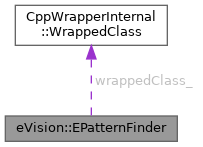
| CppWrapperInternal::WrappedClass | wrappedClass_ |
Manages a complete finding context in EasyFind.
License(s): EasyFind
| eVision::EPatternFinder::EPatternFinder | ( | ) |
Constructs a EPatternFinder::EPatternFinder context.
All properties are initialized to their respective default values.
| eVision::EPatternFinder::EPatternFinder | ( | const eVision::EPatternFinder & | other | ) |
Constructs a EPatternFinder::EPatternFinder context.
| other | Another EPatternFinder object to be copied in the new EPatternFinder object. |
All properties are initialized to their respective default values.
|
virtual | ||||||||||||
| eVision::EPatternFinder::EPatternFinder | ( | CppWrapperInternal::InternalConstructor | ) |
| void eVision::EPatternFinder::CopyLearntPattern | ( | eVision::EImageBW8 & | image | ) | const |
Copies the learned pattern in the supplied image. If no pattern has been learned, an exception with code EError::EError_NoPatternLearnt will be thrown.
| image | Pointer to the image in which the learned pattern will be returned. |
| void eVision::EPatternFinder::CopyLearntPattern | ( | eVision::EImageBW8 & | image, |
| bool | maskWithDontCare ) const |
Copies the learned pattern in the supplied image. If no pattern has been learned, an exception with code EError::EError_NoPatternLearnt will be thrown.
| image | Pointer to the image in which the learned pattern will be returned. |
| maskWithDontCare | If true and a don't care Area or Region was used when learning, masked pixels will be displayed in black. Default: false. |
| void eVision::EPatternFinder::CopyLearntPattern | ( | eVision::EImageBW8 & | image, |
| bool | maskWithDontCare, | ||
| uint32_t | learntPatternIndex ) const |
Copies the learned pattern in the supplied image. If no pattern has been learned, an exception with code EError::EError_NoPatternLearnt will be thrown.
| image | Pointer to the image in which the learned pattern will be returned. |
| maskWithDontCare | If true and a don't care Area or Region was used when learning, masked pixels will be displayed in black. Default: false. |
| learntPatternIndex | Index of the learnt pattern. Default: 0. |
| void eVision::EPatternFinder::DrawModel | ( | eVision::EDrawAdapter * | graphicContext | ) | const |
Draws the model features with an overlay in image coordinates. Image coordinates means that we expect to draw in the parent image of the roi given in EPatternFinder::Learn or EPatternFinder::LearnPatterns.
| graphicContext | Handle to the device context of the destination windows. |
| void eVision::EPatternFinder::DrawModel | ( | eVision::EDrawAdapter * | graphicContext, |
| float | zoomX ) const |
Draws the model features with an overlay in image coordinates. Image coordinates means that we expect to draw in the parent image of the roi given in EPatternFinder::Learn or EPatternFinder::LearnPatterns.
| graphicContext | Handle to the device context of the destination windows. |
| zoomX | Horizontal zooming factor. |
| void eVision::EPatternFinder::DrawModel | ( | eVision::EDrawAdapter * | graphicContext, |
| float | zoomX, | ||
| float | zoomY ) const |
Draws the model features with an overlay in image coordinates. Image coordinates means that we expect to draw in the parent image of the roi given in EPatternFinder::Learn or EPatternFinder::LearnPatterns.
| graphicContext | Handle to the device context of the destination windows. |
| zoomX | Horizontal zooming factor. |
| zoomY | Vertical zooming factor. If set to 0, the horizontal zooming factor will be used for isotropic zooming. |
| void eVision::EPatternFinder::DrawModel | ( | eVision::EDrawAdapter * | graphicContext, |
| float | zoomX, | ||
| float | zoomY, | ||
| float | panX ) const |
Draws the model features with an overlay in image coordinates. Image coordinates means that we expect to draw in the parent image of the roi given in EPatternFinder::Learn or EPatternFinder::LearnPatterns.
| graphicContext | Handle to the device context of the destination windows. |
| zoomX | Horizontal zooming factor. |
| zoomY | Vertical zooming factor. If set to 0, the horizontal zooming factor will be used for isotropic zooming. |
| panX | Horizontal panning value expressed in pixels. By default, no panning occurs. |
| void eVision::EPatternFinder::DrawModel | ( | eVision::EDrawAdapter * | graphicContext, |
| float | zoomX, | ||
| float | zoomY, | ||
| float | panX, | ||
| float | panY ) const |
Draws the model features with an overlay in image coordinates. Image coordinates means that we expect to draw in the parent image of the roi given in EPatternFinder::Learn or EPatternFinder::LearnPatterns.
| graphicContext | Handle to the device context of the destination windows. |
| zoomX | Horizontal zooming factor. |
| zoomY | Vertical zooming factor. If set to 0, the horizontal zooming factor will be used for isotropic zooming. |
| panX | Horizontal panning value expressed in pixels. By default, no panning occurs. |
| panY | Vertical panning value expressed in pixels. By default, no panning occurs. |
| void eVision::EPatternFinder::DrawModel | ( | eVision::EDrawAdapter * | graphicContext, |
| uint32_t | learntPatternIndex ) const |
Draws the model features with an overlay in image coordinates. Image coordinates means that we expect to draw in the parent image of the roi given in EPatternFinder::Learn or EPatternFinder::LearnPatterns.
| graphicContext | Handle to the device context of the destination windows. |
| learntPatternIndex | Index of the learnt pattern. Defaults to 0. |
| void eVision::EPatternFinder::DrawModel | ( | eVision::EDrawAdapter * | graphicContext, |
| uint32_t | learntPatternIndex, | ||
| float | zoomX ) const |
Draws the model features with an overlay in image coordinates. Image coordinates means that we expect to draw in the parent image of the roi given in EPatternFinder::Learn or EPatternFinder::LearnPatterns.
| graphicContext | Handle to the device context of the destination windows. |
| learntPatternIndex | Index of the learnt pattern. Defaults to 0. |
| zoomX | Horizontal zooming factor. |
| void eVision::EPatternFinder::DrawModel | ( | eVision::EDrawAdapter * | graphicContext, |
| uint32_t | learntPatternIndex, | ||
| float | zoomX, | ||
| float | zoomY ) const |
Draws the model features with an overlay in image coordinates. Image coordinates means that we expect to draw in the parent image of the roi given in EPatternFinder::Learn or EPatternFinder::LearnPatterns.
| graphicContext | Handle to the device context of the destination windows. |
| learntPatternIndex | Index of the learnt pattern. Defaults to 0. |
| zoomX | Horizontal zooming factor. |
| zoomY | Vertical zooming factor. If set to 0, the horizontal zooming factor will be used for isotropic zooming. |
| void eVision::EPatternFinder::DrawModel | ( | eVision::EDrawAdapter * | graphicContext, |
| uint32_t | learntPatternIndex, | ||
| float | zoomX, | ||
| float | zoomY, | ||
| float | panX ) const |
Draws the model features with an overlay in image coordinates. Image coordinates means that we expect to draw in the parent image of the roi given in EPatternFinder::Learn or EPatternFinder::LearnPatterns.
| graphicContext | Handle to the device context of the destination windows. |
| learntPatternIndex | Index of the learnt pattern. Defaults to 0. |
| zoomX | Horizontal zooming factor. |
| zoomY | Vertical zooming factor. If set to 0, the horizontal zooming factor will be used for isotropic zooming. |
| panX | Horizontal panning value expressed in pixels. By default, no panning occurs. |
| void eVision::EPatternFinder::DrawModel | ( | eVision::EDrawAdapter * | graphicContext, |
| uint32_t | learntPatternIndex, | ||
| float | zoomX, | ||
| float | zoomY, | ||
| float | panX, | ||
| float | panY ) const |
Draws the model features with an overlay in image coordinates. Image coordinates means that we expect to draw in the parent image of the roi given in EPatternFinder::Learn or EPatternFinder::LearnPatterns.
| graphicContext | Handle to the device context of the destination windows. |
| learntPatternIndex | Index of the learnt pattern. Defaults to 0. |
| zoomX | Horizontal zooming factor. |
| zoomY | Vertical zooming factor. If set to 0, the horizontal zooming factor will be used for isotropic zooming. |
| panX | Horizontal panning value expressed in pixels. By default, no panning occurs. |
| panY | Vertical panning value expressed in pixels. By default, no panning occurs. |
| void eVision::EPatternFinder::DrawModel | ( | HDC | graphicContext | ) | const |
Draws the model features with an overlay in image coordinates. Image coordinates means that we expect to draw in the parent image of the roi given in EPatternFinder::Learn or EPatternFinder::LearnPatterns.
| graphicContext | Handle to the device context of the destination windows. |
Use the overload taking an EDrawAdapter by using an instance of EWindowsDrawAdapter.
Deprecated in version 23.12. Scheduled to be removed in version 27.6.
| void eVision::EPatternFinder::DrawModel | ( | HDC | graphicContext, |
| const eVision::ERGBColor & | color ) const |
Draws the model features with an overlay in image coordinates. Image coordinates means that we expect to draw in the parent image of the roi given in EPatternFinder::Learn or EPatternFinder::LearnPatterns.
| graphicContext | Handle to the device context of the destination windows. |
| color | The color in which to draw the overlay. |
Use the overload taking an EDrawAdapter by using an instance of EWindowsDrawAdapter.
Deprecated in version 23.12. Scheduled to be removed in version 27.6.
| void eVision::EPatternFinder::DrawModel | ( | HDC | graphicContext, |
| const eVision::ERGBColor & | color, | ||
| float | zoomX ) const |
Draws the model features with an overlay in image coordinates. Image coordinates means that we expect to draw in the parent image of the roi given in EPatternFinder::Learn or EPatternFinder::LearnPatterns.
| graphicContext | Handle to the device context of the destination windows. |
| color | The color in which to draw the overlay. |
| zoomX | Horizontal zooming factor. |
Use the overload taking an EDrawAdapter by using an instance of EWindowsDrawAdapter.
Deprecated in version 23.12. Scheduled to be removed in version 27.6.
| void eVision::EPatternFinder::DrawModel | ( | HDC | graphicContext, |
| const eVision::ERGBColor & | color, | ||
| float | zoomX, | ||
| float | zoomY ) const |
Draws the model features with an overlay in image coordinates. Image coordinates means that we expect to draw in the parent image of the roi given in EPatternFinder::Learn or EPatternFinder::LearnPatterns.
| graphicContext | Handle to the device context of the destination windows. |
| color | The color in which to draw the overlay. |
| zoomX | Horizontal zooming factor. |
| zoomY | Vertical zooming factor. If set to 0, the horizontal zooming factor will be used for isotropic zooming. |
Use the overload taking an EDrawAdapter by using an instance of EWindowsDrawAdapter.
Deprecated in version 23.12. Scheduled to be removed in version 27.6.
| void eVision::EPatternFinder::DrawModel | ( | HDC | graphicContext, |
| const eVision::ERGBColor & | color, | ||
| float | zoomX, | ||
| float | zoomY, | ||
| float | panX ) const |
Draws the model features with an overlay in image coordinates. Image coordinates means that we expect to draw in the parent image of the roi given in EPatternFinder::Learn or EPatternFinder::LearnPatterns.
| graphicContext | Handle to the device context of the destination windows. |
| color | The color in which to draw the overlay. |
| zoomX | Horizontal zooming factor. |
| zoomY | Vertical zooming factor. If set to 0, the horizontal zooming factor will be used for isotropic zooming. |
| panX | Horizontal panning value expressed in pixels. By default, no panning occurs. |
Use the overload taking an EDrawAdapter by using an instance of EWindowsDrawAdapter.
Deprecated in version 23.12. Scheduled to be removed in version 27.6.
| void eVision::EPatternFinder::DrawModel | ( | HDC | graphicContext, |
| const eVision::ERGBColor & | color, | ||
| float | zoomX, | ||
| float | zoomY, | ||
| float | panX, | ||
| float | panY ) const |
Draws the model features with an overlay in image coordinates. Image coordinates means that we expect to draw in the parent image of the roi given in EPatternFinder::Learn or EPatternFinder::LearnPatterns.
| graphicContext | Handle to the device context of the destination windows. |
| color | The color in which to draw the overlay. |
| zoomX | Horizontal zooming factor. |
| zoomY | Vertical zooming factor. If set to 0, the horizontal zooming factor will be used for isotropic zooming. |
| panX | Horizontal panning value expressed in pixels. By default, no panning occurs. |
| panY | Vertical panning value expressed in pixels. By default, no panning occurs. |
Use the overload taking an EDrawAdapter by using an instance of EWindowsDrawAdapter.
Deprecated in version 23.12. Scheduled to be removed in version 27.6.
| void eVision::EPatternFinder::DrawModel | ( | HDC | graphicContext, |
| float | zoomX ) const |
Draws the model features with an overlay in image coordinates. Image coordinates means that we expect to draw in the parent image of the roi given in EPatternFinder::Learn or EPatternFinder::LearnPatterns.
| graphicContext | Handle to the device context of the destination windows. |
| zoomX | Horizontal zooming factor. |
Use the overload taking an EDrawAdapter by using an instance of EWindowsDrawAdapter.
Deprecated in version 23.12. Scheduled to be removed in version 27.6.
| void eVision::EPatternFinder::DrawModel | ( | HDC | graphicContext, |
| float | zoomX, | ||
| float | zoomY ) const |
Draws the model features with an overlay in image coordinates. Image coordinates means that we expect to draw in the parent image of the roi given in EPatternFinder::Learn or EPatternFinder::LearnPatterns.
| graphicContext | Handle to the device context of the destination windows. |
| zoomX | Horizontal zooming factor. |
| zoomY | Vertical zooming factor. If set to 0, the horizontal zooming factor will be used for isotropic zooming. |
Use the overload taking an EDrawAdapter by using an instance of EWindowsDrawAdapter.
Deprecated in version 23.12. Scheduled to be removed in version 27.6.
| void eVision::EPatternFinder::DrawModel | ( | HDC | graphicContext, |
| float | zoomX, | ||
| float | zoomY, | ||
| float | panX ) const |
Draws the model features with an overlay in image coordinates. Image coordinates means that we expect to draw in the parent image of the roi given in EPatternFinder::Learn or EPatternFinder::LearnPatterns.
| graphicContext | Handle to the device context of the destination windows. |
| zoomX | Horizontal zooming factor. |
| zoomY | Vertical zooming factor. If set to 0, the horizontal zooming factor will be used for isotropic zooming. |
| panX | Horizontal panning value expressed in pixels. By default, no panning occurs. |
Use the overload taking an EDrawAdapter by using an instance of EWindowsDrawAdapter.
Deprecated in version 23.12. Scheduled to be removed in version 27.6.
| void eVision::EPatternFinder::DrawModel | ( | HDC | graphicContext, |
| float | zoomX, | ||
| float | zoomY, | ||
| float | panX, | ||
| float | panY ) const |
Draws the model features with an overlay in image coordinates. Image coordinates means that we expect to draw in the parent image of the roi given in EPatternFinder::Learn or EPatternFinder::LearnPatterns.
| graphicContext | Handle to the device context of the destination windows. |
| zoomX | Horizontal zooming factor. |
| zoomY | Vertical zooming factor. If set to 0, the horizontal zooming factor will be used for isotropic zooming. |
| panX | Horizontal panning value expressed in pixels. By default, no panning occurs. |
| panY | Vertical panning value expressed in pixels. By default, no panning occurs. |
Use the overload taking an EDrawAdapter by using an instance of EWindowsDrawAdapter.
Deprecated in version 23.12. Scheduled to be removed in version 27.6.
| void eVision::EPatternFinder::DrawModelWithCurrentPen | ( | HDC | graphicContext | ) | const |
Draws the model features with an overlay in image coordinates. Image coordinates means that we expect to draw in the parent image of the roi given in EPatternFinder::Learn or EPatternFinder::LearnPatterns.
| graphicContext | Handle to the device context of the destination windows. |
| void eVision::EPatternFinder::DrawModelWithCurrentPen | ( | HDC | graphicContext, |
| float | zoomX ) const |
Draws the model features with an overlay in image coordinates. Image coordinates means that we expect to draw in the parent image of the roi given in EPatternFinder::Learn or EPatternFinder::LearnPatterns.
| graphicContext | Handle to the device context of the destination windows. |
| zoomX | Horizontal zooming factor. |
| void eVision::EPatternFinder::DrawModelWithCurrentPen | ( | HDC | graphicContext, |
| float | zoomX, | ||
| float | zoomY ) const |
Draws the model features with an overlay in image coordinates. Image coordinates means that we expect to draw in the parent image of the roi given in EPatternFinder::Learn or EPatternFinder::LearnPatterns.
| graphicContext | Handle to the device context of the destination windows. |
| zoomX | Horizontal zooming factor. |
| zoomY | Vertical zooming factor. If set to 0, the horizontal zooming factor will be used for isotropic zooming. |
| void eVision::EPatternFinder::DrawModelWithCurrentPen | ( | HDC | graphicContext, |
| float | zoomX, | ||
| float | zoomY, | ||
| float | panX ) const |
Draws the model features with an overlay in image coordinates. Image coordinates means that we expect to draw in the parent image of the roi given in EPatternFinder::Learn or EPatternFinder::LearnPatterns.
| graphicContext | Handle to the device context of the destination windows. |
| zoomX | Horizontal zooming factor. |
| zoomY | Vertical zooming factor. If set to 0, the horizontal zooming factor will be used for isotropic zooming. |
| panX | Horizontal panning value expressed in pixels. By default, no panning occurs. |
| void eVision::EPatternFinder::DrawModelWithCurrentPen | ( | HDC | graphicContext, |
| float | zoomX, | ||
| float | zoomY, | ||
| float | panX, | ||
| float | panY ) const |
Draws the model features with an overlay in image coordinates. Image coordinates means that we expect to draw in the parent image of the roi given in EPatternFinder::Learn or EPatternFinder::LearnPatterns.
| graphicContext | Handle to the device context of the destination windows. |
| zoomX | Horizontal zooming factor. |
| zoomY | Vertical zooming factor. If set to 0, the horizontal zooming factor will be used for isotropic zooming. |
| panX | Horizontal panning value expressed in pixels. By default, no panning occurs. |
| panY | Vertical panning value expressed in pixels. By default, no panning occurs. |
| std::vector< eVision::EFoundPattern > eVision::EPatternFinder::Find | ( | eVision::EROIBW8 * | source | ) |
Locates a set of possible occurrences of the learned pattern in the supplied search field.
| source | Image or part of an image in which the learned model has to be searched for. |
This method will fail if no pattern has been learned previously. The result is a vector of EFoundPattern objects. EFoundPattern instances can be retrieved by using the Vector<>::operator[] method.
| std::vector< eVision::EFoundPattern > eVision::EPatternFinder::Find | ( | eVision::EROIBW8 * | source, |
| const eVision::EFrame & | frame ) |
Locates a set of possible occurrences of the learned pattern in the supplied search field.
| source | Image or part of an image in which the learned model has to be searched for. |
| frame | Frame of the input image. |
This method will fail if no pattern has been learned previously. The result is a vector of EFoundPattern objects. EFoundPattern instances can be retrieved by using the Vector<>::operator[] method.
| std::vector< eVision::EFoundPattern > eVision::EPatternFinder::Find | ( | eVision::EROIBW8 * | source, |
| const eVision::ERegion & | region ) |
Locates a set of possible occurrences of the learned pattern in the supplied search field.
| source | Image or part of an image in which the learned model has to be searched for. |
| region | Region into the ROI where the search is performed. |
This method will fail if no pattern has been learned previously. The result is a vector of EFoundPattern objects. EFoundPattern instances can be retrieved by using the Vector<>::operator[] method.
| std::vector< eVision::EFoundPattern > eVision::EPatternFinder::Find | ( | eVision::EROIBW8 * | source, |
| const eVision::ERegion & | region, | ||
| const eVision::EFrame & | frame ) |
Locates a set of possible occurrences of the learned pattern in the supplied search field.
| source | Image or part of an image in which the learned model has to be searched for. |
| region | Region into the ROI where the search is performed. |
| frame | Frame of the input image. |
This method will fail if no pattern has been learned previously. The result is a vector of EFoundPattern objects. EFoundPattern instances can be retrieved by using the Vector<>::operator[] method.
| float eVision::EPatternFinder::GetAngleBias | ( | ) | const |
Angle bias, expressed in the current angle unit.
The AngleBias defines the angle offset between the model and the instances. Finding the pattern is performed in range AngleBias +/- EPatternFinder::GetAngleTolerance. This range should not exceed a full turn. Default: 0.0.
| int32_t eVision::EPatternFinder::GetAngleSearchExtent | ( | ) | const |
The angular extension of the search neighborhood. Only odd values are allowed for this parameter. See the EPatternFinder::SetLocalSearchMode property description for further details.
| float eVision::EPatternFinder::GetAngleTolerance | ( | ) | const |
Angle tolerance, expressed in the current angle unit.
The AngleTolerance defines the angle allowance of the instances around the EPatternFinder::GetAngleBias. Finding the pattern is performed in range EPatternFinder::GetAngleBias +/- AngleTolerance. This range should not exceed a full turn. A NULL tolerance can be set, in which case the angle bias value is assumed. Default: 0.0.
| bool eVision::EPatternFinder::GetComputePerFeaturePointScore | ( | ) | const |
Whether the EPatternFinder should compute a score for each feature point. The scores are then displayed as a Red-Yellow-Green colormap by EFoundPattern::Draw. Note that the scores correspond to the Point-By-Point variants of EPatternFinder::GetContrastMode, so if EPatternFinder::GetContrastMode is not a Point-By-Point variant, EFoundPattern::GetScore isn't exactly the average of the displayed scores for each feature point.
| eVision::EFindContrastMode eVision::EPatternFinder::GetContrastMode | ( | ) | const |
Contrast of the instance, as defined in EFindContrastMode.
This is a EPatternType::EPatternType_ConsistentEdges pattern type property. It defines the contrast of regions. Contrast can be normal (as in the model), inverse (inverse contrast of the model), or any (same or inverse contrast of the model). Default: EFindContrastMode::EFindContrastMode_Normal.
| std::vector< eVision::EFindFeaturePoint > eVision::EPatternFinder::GetFeaturePoints | ( | ) | const |
The feature points used by the model.
The feature points are expressed with respect to the parent image of the ROI given as input to the EPatternFinder::Learn method.
| std::vector< eVision::EFindFeaturePoint > eVision::EPatternFinder::GetFeaturePoints | ( | uint32_t | learntPatternIndex | ) | const |
The feature points used by the model.
| learntPatternIndex | Index of the learnt pattern. |
The feature points are expressed with respect to the parent image of the ROI given as input to the EPatternFinder::LearnPatterns method.
| int32_t eVision::EPatternFinder::GetFindExtension | ( | ) | const |
Extension value, that is the pattern margin size (in pixels) that is allowed to go out of the search field.
When a non-NULL value is attributed to the extension, the detection of instances partially out of the ROI is allowed. The extension value defines how much the ROI is extended. Default: 0.
| uint64_t eVision::EPatternFinder::GetFindTimeOut | ( | ) | const |
Time-out for the EPatternFinder::Find method.
If the processing time of one of these functions becomes longer than the set time-out, the processing is stopped and an exception is thrown. In that case, the error code of the exception is EError::EError_TimeoutReached.
The time-out is set in microseconds.
This time-out is not a real time-out. The processing is stopped as soon as possible after the time-out has been reached. This means that the time elapsed effectively in the method can be greater than the time-out itself.
| bool eVision::EPatternFinder::GetInterpolate | ( | ) | const |
Whether interpolation is performed when searching for a pattern occurrence.
By default, matching is done with a one-pixel precision for all degrees of freedom (translation, rotation and scaling). You can use an additional interpolation process to achieve sub-pixel accuracy. This generally leads to an improvement of the sub-pixel accuracy by a factor larger than 10. This is possible only when the found instances match closely the model. A score higher than 0.99 indicates that the instances are a close match of the model. In other words, the instance is considered to be more accurate when the score is higher. The added computational cost is low. Default: true.
| bool eVision::EPatternFinder::GetLearningDone | ( | ) | const |
Indicates whether a pattern has already been learned.
| bool eVision::EPatternFinder::GetLearningHasRegion | ( | ) | const |
Indicates whether a ERegion was used alongside the learned pattern. Returns false if no learning was performed.
| uint64_t eVision::EPatternFinder::GetLearnTimeOut | ( | ) | const |
Time-out for the EPatternFinder::Learn and EPatternFinder::LearnPatterns methods.
If the processing time of one of these functions becomes longer than the set time-out, the processing is stopped and an exception is thrown. In that case, the error code of the exception is EError::EError_TimeoutReached.
The time-out is set in microseconds.
This time-out is not a real time-out. The processing is stopped as soon as possible after the time-out has been reached. This means that the time elapsed effectively in the method can be greater than the time-out itself.
| float eVision::EPatternFinder::GetLightBalance | ( | ) | const |
Light balance, between [-1.0, 1.0].
In the EPatternType::EPatternType_ConsistentEdges and EPatternType::EPatternType_ThinStructure modes, the LightBalance property governs the selection of the feature points while learning the model. It drives which edge points are eligible as feature points in the model, by defining a criterion for ignoring those edge points that are not sharp enough. As a consequence, this property will influence the spatial distribution of the feature points. In the aforementioned operating modes, the feature points are the places in the image that exhibit a strong variation in the gray level signal. Mathematically, these places are those at which the magnitude of the gradient is significant. The LightBalance property defines the way the latter threshold on the magnitude of the gradient is computed, through a careful analysis of the dynamics of gradient. The more the LightBalance tends to -1, the more tolerant will be the threshold, and the more edge points will be considered as candidates for becoming feature points. Conversely, as the LightBalance property becomes close to 1, only the points with a high gradient magnitude are taken into consideration. In other words, a small LightBalance defines a loose criterion for defining what an edge point is, whereas a great value implies a conservative criterion. By default, this property is fixed to 0.0. This is an appropriate value for most images which are encountered in industrial machine vision. The LightBalance is automatically set to 0.0 after a learning process. Once the LightBalance is changed, a new learning process has to be done to take the new value into account. An efficient way to see the effect of changing this property is to use the EPatternFinder::DrawModel method.
| eVision::ELocalSearchMode eVision::EPatternFinder::GetLocalSearchMode | ( | ) | const |
Sets the local search mode.
In the multi-stage approach of EasyFind, pattern occurrence candidates are at first found at the coarsest stage. Then, at each of the following stages, their position and score are refined until the last and finest one. This refining is achieved by searching for better candidates in the neighborhood of each of the ones found in the previous stage. The local search mode allows the user to set the extent of this neighborhood. By default, the local search mode is set to ELocalSearchMode::ELocalSearchMode_Basic.
| uint32_t eVision::EPatternFinder::GetMaxFeaturePoints | ( | ) | const |
Maximum number of feature points at the fine stage.
Default: 1024. Reserved use.
| float eVision::EPatternFinder::GetMaximumOverlapping | ( | ) | const |
Use EPatternFinder::GetMaxOverlap instead.
Deprecated in version 26.6. Scheduled to be removed in version 27.6.
| uint32_t eVision::EPatternFinder::GetMaxInitialCandidates | ( | ) | const |
Maximum number of initial candidates.
During the search for matching patterns, EasyFind considers a set of candidates that it progressively refines. The maximum number of initial candidates must be greater or equal than the number of instances to be found (see EPatternFinder::GetMaxInstances). A large number of initial candidates can help finding difficult or partial match but at the cost of increasing processing time. A small number can help speeding up the find process. By default, the value for maximum number of initial candidates is 0, indicating that the value is chosen internally.
| uint32_t eVision::EPatternFinder::GetMaxInstances | ( | ) | const |
Maximum number of instances to be found.
Default: 1.
| float eVision::EPatternFinder::GetMaxOverlap | ( | ) | const |
Overlapping tolerance.
0.0 means all found patterns must be disconnected, 1.0 means they can fully overlap. Default: 1.0.
| uint32_t eVision::EPatternFinder::GetMinFeaturePoints | ( | ) | const |
Minimum number of feature points at the coarse stage.
Default: 8. Reserved use.
| float eVision::EPatternFinder::GetMinScore | ( | ) | const |
Minimum score of found instances, between [-1.0, 1.0].
Instances with a score under the MinScore will not be returned.
| uint32_t eVision::EPatternFinder::GetNumLearnedPatterns | ( | ) | const |
Indicates the number of patterns learnt. 0 is returned if no learning was performed.
| eVision::EPatternType eVision::EPatternFinder::GetPatternType | ( | ) | const |
Pattern type, as defined in EPatternType.
This property informs the EPatternFinder::EPatternFinder of the general nature of the model to be learned. Default: EPatternType::EPatternType_ConsistentEdges.
| eVision::EPoint eVision::EPatternFinder::GetPivot | ( | ) | const |
Reference point in the model.
The coordinates of the reference point are relative to the upper left corner of the model. The location of an instance (Coordinates (X,Y)) is the location of its reference point defined in the model. By default, the pivot is a EPoint set to the pattern center. EPoint is a structure that contains two x and y float values.
| eVision::EReductionMode eVision::EPatternFinder::GetReductionMode | ( | ) | const |
The reduction mode that is to be used when learning the model (automatic or manual), as defined in EReductionMode.
Specifies whether the best-guess method should be used to assert the level of reduction that will be used when learning the model. If this property is set to EReductionMode::EReductionMode_Manual, it is up to the user to provide a suitable reduction strength. This value is only used when learning the model. Default: EReductionMode::EReductionMode_Auto, which means that the best-guess algorithm is used by default.
| float eVision::EPatternFinder::GetReductionStrength | ( | ) | const |
The reduction strength that is to be used when learning the model, between 0 and 1.
Specifies the reduction strength for learning the model (encoded as a percentage). Its precise semantics depends on the reduction mode (see the EPatternFinder::GetReductionMode property):
| float eVision::EPatternFinder::GetScaleBias | ( | ) | const |
Scale bias, expressed in units (not in percent).
The ScaleBias defines the scale factor between the model and the instances. Finding the pattern is performed in range ScaleBias +/- ScaleTolerance. This range should not exceed [0.5..2.5] (50% to 250% scaling). Default: 1.0 (100%).
| int32_t eVision::EPatternFinder::GetScaleSearchExtent | ( | ) | const |
The scaling extension of the search neighborhood. Only odd values are allowed for this parameter. See the EPatternFinder::SetLocalSearchMode property description for further details.
| float eVision::EPatternFinder::GetScaleTolerance | ( | ) | const |
Scale tolerance, expressed in units (not in percent).
The ScaleTolerance defines the scale allowance of the instances around the EPatternFinder::GetScaleBias. Finding the pattern is performed in range EPatternFinder::GetScaleBias +/- ScaleTolerance. This range should not exceed [0.5..2] (50 % to 200 % scaling). A NULL tolerance can be set, in which case the scale bias value is assumed. Default: 0.0.
| eVision::EThinStructureMode eVision::EPatternFinder::GetThinStructureMode | ( | ) | const |
Mode for EPatternType::EPatternType_ThinStructure, as defined in EThinStructureMode.
EThinStructureMode informs EasyFind if thin elements in the model are darker or brighter than regions. Default: EThinStructureMode::EThinStructureMode_Auto, which detects the best mode between dark or bright.
| int32_t eVision::EPatternFinder::GetXSearchExtent | ( | ) | const |
The X-axis extension of the search neighborhood. Only odd values are allowed for this parameter. See the EPatternFinder::SetLocalSearchMode property description for further details.
| int32_t eVision::EPatternFinder::GetYSearchExtent | ( | ) | const |
The Y-axis extension of the search neighborhood. Only odd values are allowed for this parameter. See the EPatternFinder::SetLocalSearchMode property description for further details.
| void eVision::EPatternFinder::Learn | ( | const eVision::EROIBW8 * | pattern | ) |
Learns a given pattern and stores it in the EPatternFinder::EPatternFinder object.
| pattern | Model to be learned (ROI). |
Learning another pattern erases the information stored for the first one. A "don't care area" can be set as argument, allowing to mask and not take into account certain parts of the pattern while learning. The "don't care area" mask should have the same size as the pattern or as its eventual parent image. The mask should be a bi-level image with pixel - values of '0' for ignored areas and '255' otherwise.
| void eVision::EPatternFinder::Learn | ( | const eVision::EROIBW8 * | pattern, |
| const eVision::EFrame & | frame ) |
Learns a given pattern and stores it in the EPatternFinder::EPatternFinder object.
| pattern | Model to be learned (ROI). |
| frame | Reference frame of the learned image |
Learning another pattern erases the information stored for the first one. A "don't care area" can be set as argument, allowing to mask and not take into account certain parts of the pattern while learning. The "don't care area" mask should have the same size as the pattern or as its eventual parent image. The mask should be a bi-level image with pixel - values of '0' for ignored areas and '255' otherwise.
| void eVision::EPatternFinder::Learn | ( | const eVision::EROIBW8 * | pattern, |
| const eVision::ERegion & | region ) |
Learns a given pattern and stores it in the EPatternFinder::EPatternFinder object.
| pattern | Model to be learned (ROI). |
| region | Region into the ROI where the learning is performed |
Learning another pattern erases the information stored for the first one. A "don't care area" can be set as argument, allowing to mask and not take into account certain parts of the pattern while learning. The "don't care area" mask should have the same size as the pattern or as its eventual parent image. The mask should be a bi-level image with pixel - values of '0' for ignored areas and '255' otherwise.
| void eVision::EPatternFinder::Learn | ( | const eVision::EROIBW8 * | pattern, |
| const eVision::ERegion & | region, | ||
| const eVision::EFrame & | frame ) |
Learns a given pattern and stores it in the EPatternFinder::EPatternFinder object.
| pattern | Model to be learned (ROI). |
| region | Region into the ROI where the learning is performed |
| frame | Reference frame of the learned image |
Learning another pattern erases the information stored for the first one. A "don't care area" can be set as argument, allowing to mask and not take into account certain parts of the pattern while learning. The "don't care area" mask should have the same size as the pattern or as its eventual parent image. The mask should be a bi-level image with pixel - values of '0' for ignored areas and '255' otherwise.
| void eVision::EPatternFinder::Learn | ( | const eVision::EROIBW8 * | pattern, |
| eVision::EROIBW8 * | dontCare ) |
Learns a given pattern and stores it in the EPatternFinder::EPatternFinder object.
| pattern | Model to be learned (ROI). |
| dontCare | "Don't care" area mask (ROI). |
Learning another pattern erases the information stored for the first one. A "don't care area" can be set as argument, allowing to mask and not take into account certain parts of the pattern while learning. The "don't care area" mask should have the same size as the pattern or as its eventual parent image. The mask should be a bi-level image with pixel - values of '0' for ignored areas and '255' otherwise.
Use the overload taking an ERegion instead.
Deprecated in version 25.2. Scheduled to be removed in version 27.6.
| void eVision::EPatternFinder::Learn | ( | eVision::EVectorModel & | model | ) |
Learns a given pattern and stores it in the EPatternFinder::EPatternFinder object.
| model | EVectorModel to be learned. |
Learning another pattern erases the information stored for the first one. A "don't care area" can be set as argument, allowing to mask and not take into account certain parts of the pattern while learning. The "don't care area" mask should have the same size as the pattern or as its eventual parent image. The mask should be a bi-level image with pixel - values of '0' for ignored areas and '255' otherwise.
| void eVision::EPatternFinder::LearnPatterns | ( | const std::vector< eVision::EImageBW8 > & | patterns | ) |
Learns multiple (at least two) patterns.
| patterns | Vector of models to be learned (ROI). |
Learning multiple patterns is useful when your object presents slight variations: shape deformation, lighting, perspective,... Each pattern is Learned and Found independently and only the best patterns are kept. The options of the EPatternFinder are used for all of the patterns. We recommend setting a EPatternFinder::GetMaxOverlap when using this feature.
| void eVision::EPatternFinder::LearnPatterns | ( | const std::vector< eVision::EImageBW8 > & | patterns, |
| const eVision::EFrame & | frame ) |
Learns multiple (at least two) patterns.
| patterns | Vector of models to be learned (ROI). |
| frame | Reference frame of the learned image |
Learning multiple patterns is useful when your object presents slight variations: shape deformation, lighting, perspective,... Each pattern is Learned and Found independently and only the best patterns are kept. The options of the EPatternFinder are used for all of the patterns. We recommend setting a EPatternFinder::GetMaxOverlap when using this feature.
| void eVision::EPatternFinder::LearnPatterns | ( | const std::vector< eVision::EImageBW8 > & | patterns, |
| const std::vector< eVision::ERegion > & | regions ) |
Learns multiple (at least two) patterns.
| patterns | Vector of models to be learned (ROI). |
| regions | Vector of regions into the ROI where the learning is performed |
Learning multiple patterns is useful when your object presents slight variations: shape deformation, lighting, perspective,... Each pattern is Learned and Found independently and only the best patterns are kept. The options of the EPatternFinder are used for all of the patterns. We recommend setting a EPatternFinder::GetMaxOverlap when using this feature.
| void eVision::EPatternFinder::LearnPatterns | ( | const std::vector< eVision::EImageBW8 > & | patterns, |
| const std::vector< eVision::ERegion > & | regions, | ||
| const eVision::EFrame & | frame ) |
Learns multiple (at least two) patterns.
| patterns | Vector of models to be learned (ROI). |
| regions | Vector of regions into the ROI where the learning is performed |
| frame | Reference frame of the learned image |
Learning multiple patterns is useful when your object presents slight variations: shape deformation, lighting, perspective,... Each pattern is Learned and Found independently and only the best patterns are kept. The options of the EPatternFinder are used for all of the patterns. We recommend setting a EPatternFinder::GetMaxOverlap when using this feature.
| void eVision::EPatternFinder::LearnPatterns | ( | const std::vector< eVision::EROIBW8 * > & | patterns | ) |
Learns multiple (at least two) patterns.
| patterns | Vector of models to be learned (ROI). |
Learning multiple patterns is useful when your object presents slight variations: shape deformation, lighting, perspective,... Each pattern is Learned and Found independently and only the best patterns are kept. The options of the EPatternFinder are used for all of the patterns. We recommend setting a EPatternFinder::GetMaxOverlap when using this feature.
| void eVision::EPatternFinder::LearnPatterns | ( | const std::vector< eVision::EROIBW8 * > & | patterns, |
| const eVision::EFrame & | frame ) |
Learns multiple (at least two) patterns.
| patterns | Vector of models to be learned (ROI). |
| frame | Reference frame of the learned image |
Learning multiple patterns is useful when your object presents slight variations: shape deformation, lighting, perspective,... Each pattern is Learned and Found independently and only the best patterns are kept. The options of the EPatternFinder are used for all of the patterns. We recommend setting a EPatternFinder::GetMaxOverlap when using this feature.
| void eVision::EPatternFinder::LearnPatterns | ( | const std::vector< eVision::EROIBW8 * > & | patterns, |
| const std::vector< eVision::ERegion * > & | regions ) |
Learns multiple (at least two) patterns.
| patterns | Vector of models to be learned (ROI). |
| regions | Vector of regions into the ROI where the learning is performed |
Learning multiple patterns is useful when your object presents slight variations: shape deformation, lighting, perspective,... Each pattern is Learned and Found independently and only the best patterns are kept. The options of the EPatternFinder are used for all of the patterns. We recommend setting a EPatternFinder::GetMaxOverlap when using this feature.
| void eVision::EPatternFinder::LearnPatterns | ( | const std::vector< eVision::EROIBW8 * > & | patterns, |
| const std::vector< eVision::ERegion * > & | regions, | ||
| const eVision::EFrame & | frame ) |
Learns multiple (at least two) patterns.
| patterns | Vector of models to be learned (ROI). |
| regions | Vector of regions into the ROI where the learning is performed |
| frame | Reference frame of the learned image |
Learning multiple patterns is useful when your object presents slight variations: shape deformation, lighting, perspective,... Each pattern is Learned and Found independently and only the best patterns are kept. The options of the EPatternFinder are used for all of the patterns. We recommend setting a EPatternFinder::GetMaxOverlap when using this feature.
| void eVision::EPatternFinder::LearnPatterns | ( | const std::vector< eVision::EROIBW8 > & | patterns | ) |
Learns multiple (at least two) patterns.
| patterns | Vector of models to be learned (ROI). |
Learning multiple patterns is useful when your object presents slight variations: shape deformation, lighting, perspective,... Each pattern is Learned and Found independently and only the best patterns are kept. The options of the EPatternFinder are used for all of the patterns. We recommend setting a EPatternFinder::GetMaxOverlap when using this feature.
| void eVision::EPatternFinder::LearnPatterns | ( | const std::vector< eVision::EROIBW8 > & | patterns, |
| const eVision::EFrame & | frame ) |
Learns multiple (at least two) patterns.
| patterns | Vector of models to be learned (ROI). |
| frame | Reference frame of the learned image |
Learning multiple patterns is useful when your object presents slight variations: shape deformation, lighting, perspective,... Each pattern is Learned and Found independently and only the best patterns are kept. The options of the EPatternFinder are used for all of the patterns. We recommend setting a EPatternFinder::GetMaxOverlap when using this feature.
| void eVision::EPatternFinder::LearnPatterns | ( | const std::vector< eVision::EROIBW8 > & | patterns, |
| const std::vector< eVision::ERegion > & | regions ) |
Learns multiple (at least two) patterns.
| patterns | Vector of models to be learned (ROI). |
| regions | Vector of regions into the ROI where the learning is performed |
Learning multiple patterns is useful when your object presents slight variations: shape deformation, lighting, perspective,... Each pattern is Learned and Found independently and only the best patterns are kept. The options of the EPatternFinder are used for all of the patterns. We recommend setting a EPatternFinder::GetMaxOverlap when using this feature.
| void eVision::EPatternFinder::LearnPatterns | ( | const std::vector< eVision::EROIBW8 > & | patterns, |
| const std::vector< eVision::ERegion > & | regions, | ||
| const eVision::EFrame & | frame ) |
Learns multiple (at least two) patterns.
| patterns | Vector of models to be learned (ROI). |
| regions | Vector of regions into the ROI where the learning is performed |
| frame | Reference frame of the learned image |
Learning multiple patterns is useful when your object presents slight variations: shape deformation, lighting, perspective,... Each pattern is Learned and Found independently and only the best patterns are kept. The options of the EPatternFinder are used for all of the patterns. We recommend setting a EPatternFinder::GetMaxOverlap when using this feature.
| void eVision::EPatternFinder::Load | ( | const std::string & | path | ) |
Loads an EPatternFinder.The given EPatternFinder must have been created for reading.
| path | The file path. |
| void eVision::EPatternFinder::Load | ( | eVision::ESerializer * | serializer | ) |
Loads an EPatternFinder.The given EPatternFinder must have been created for reading.
| serializer | Pointer to the ESerializer created for reading. |
| eVision::EPatternFinder & eVision::EPatternFinder::operator= | ( | const eVision::EPatternFinder & | other | ) |
Assignment operator.
| other | The other EPatternFinder that we will copy into this one. |
| void eVision::EPatternFinder::Save | ( | const std::string & | path | ) |
Loads an EPatternFinder.The given EPatternFinder must have been created for writing.
| path | The file path. |
| void eVision::EPatternFinder::Save | ( | eVision::ESerializer * | serializer | ) |
Loads an EPatternFinder.The given EPatternFinder must have been created for writing.
| serializer | Pointer to the ESerializer created for writing. |
| void eVision::EPatternFinder::SetAngleBias | ( | float | angleBias | ) |
Angle bias, expressed in the current angle unit.
The AngleBias defines the angle offset between the model and the instances. Finding the pattern is performed in range AngleBias +/- EPatternFinder::GetAngleTolerance. This range should not exceed a full turn. Default: 0.0.
| void eVision::EPatternFinder::SetAngleSearchExtent | ( | int32_t | extent | ) |
The angular extension of the search neighborhood. Only odd values are allowed for this parameter. See the EPatternFinder::SetLocalSearchMode property description for further details.
| void eVision::EPatternFinder::SetAngleTolerance | ( | float | angleTolerance | ) |
Angle tolerance, expressed in the current angle unit.
The AngleTolerance defines the angle allowance of the instances around the EPatternFinder::GetAngleBias. Finding the pattern is performed in range EPatternFinder::GetAngleBias +/- AngleTolerance. This range should not exceed a full turn. A NULL tolerance can be set, in which case the angle bias value is assumed. Default: 0.0.
| void eVision::EPatternFinder::SetComputePerFeaturePointScore | ( | bool | compute | ) |
Whether the EPatternFinder should compute a score for each feature point. The scores are then displayed as a Red-Yellow-Green colormap by EFoundPattern::Draw. Note that the scores correspond to the Point-By-Point variants of EPatternFinder::GetContrastMode, so if EPatternFinder::GetContrastMode is not a Point-By-Point variant, EFoundPattern::GetScore isn't exactly the average of the displayed scores for each feature point.
| void eVision::EPatternFinder::SetContrastMode | ( | eVision::EFindContrastMode | eContrastMode | ) |
Contrast of the instance, as defined in EFindContrastMode.
This is a EPatternType::EPatternType_ConsistentEdges pattern type property. It defines the contrast of regions. Contrast can be normal (as in the model), inverse (inverse contrast of the model), or any (same or inverse contrast of the model). Default: EFindContrastMode::EFindContrastMode_Normal.
| void eVision::EPatternFinder::SetFindExtension | ( | int32_t | extension | ) |
Extension value, that is the pattern margin size (in pixels) that is allowed to go out of the search field.
When a non-NULL value is attributed to the extension, the detection of instances partially out of the ROI is allowed. The extension value defines how much the ROI is extended. Default: 0.
| void eVision::EPatternFinder::SetFindTimeOut | ( | uint64_t | value | ) |
Time-out for the EPatternFinder::Find method.
If the processing time of one of these functions becomes longer than the set time-out, the processing is stopped and an exception is thrown. In that case, the error code of the exception is EError::EError_TimeoutReached.
The time-out is set in microseconds.
This time-out is not a real time-out. The processing is stopped as soon as possible after the time-out has been reached. This means that the time elapsed effectively in the method can be greater than the time-out itself.
| void eVision::EPatternFinder::SetInterpolate | ( | bool | interpolate | ) |
Whether interpolation is performed when searching for a pattern occurrence.
By default, matching is done with a one-pixel precision for all degrees of freedom (translation, rotation and scaling). You can use an additional interpolation process to achieve sub-pixel accuracy. This generally leads to an improvement of the sub-pixel accuracy by a factor larger than 10. This is possible only when the found instances match closely the model. A score higher than 0.99 indicates that the instances are a close match of the model. In other words, the instance is considered to be more accurate when the score is higher. The added computational cost is low. Default: true.
| void eVision::EPatternFinder::SetLearnTimeOut | ( | uint64_t | value | ) |
Time-out for the EPatternFinder::Learn and EPatternFinder::LearnPatterns methods.
If the processing time of one of these functions becomes longer than the set time-out, the processing is stopped and an exception is thrown. In that case, the error code of the exception is EError::EError_TimeoutReached.
The time-out is set in microseconds.
This time-out is not a real time-out. The processing is stopped as soon as possible after the time-out has been reached. This means that the time elapsed effectively in the method can be greater than the time-out itself.
| void eVision::EPatternFinder::SetLightBalance | ( | float | lightBalance | ) |
Light balance, between [-1.0, 1.0].
In the EPatternType::EPatternType_ConsistentEdges and EPatternType::EPatternType_ThinStructure modes, the LightBalance property governs the selection of the feature points while learning the model. It drives which edge points are eligible as feature points in the model, by defining a criterion for ignoring those edge points that are not sharp enough. As a consequence, this property will influence the spatial distribution of the feature points. In the aforementioned operating modes, the feature points are the places in the image that exhibit a strong variation in the gray level signal. Mathematically, these places are those at which the magnitude of the gradient is significant. The LightBalance property defines the way the latter threshold on the magnitude of the gradient is computed, through a careful analysis of the dynamics of gradient. The more the LightBalance tends to -1, the more tolerant will be the threshold, and the more edge points will be considered as candidates for becoming feature points. Conversely, as the LightBalance property becomes close to 1, only the points with a high gradient magnitude are taken into consideration. In other words, a small LightBalance defines a loose criterion for defining what an edge point is, whereas a great value implies a conservative criterion. By default, this property is fixed to 0.0. This is an appropriate value for most images which are encountered in industrial machine vision. The LightBalance is automatically set to 0.0 after a learning process. Once the LightBalance is changed, a new learning process has to be done to take the new value into account. An efficient way to see the effect of changing this property is to use the EPatternFinder::DrawModel method.
| void eVision::EPatternFinder::SetLocalSearchMode | ( | eVision::ELocalSearchMode | eLocalSearchMode | ) |
Sets the local search mode.
In the multi-stage approach of EasyFind, pattern occurrence candidates are at first found at the coarsest stage. Then, at each of the following stages, their position and score are refined until the last and finest one. This refining is achieved by searching for better candidates in the neighborhood of each of the ones found in the previous stage. The local search mode allows the user to set the extent of this neighborhood. By default, the local search mode is set to ELocalSearchMode::ELocalSearchMode_Basic.
| void eVision::EPatternFinder::SetMaxFeaturePoints | ( | uint32_t | maxFeaturePoints | ) |
Maximum number of feature points at the fine stage.
Default: 1024. Reserved use.
| void eVision::EPatternFinder::SetMaximumOverlapping | ( | float | maximumOverlapping | ) |
Use EPatternFinder::GetMaxOverlap instead.
Deprecated in version 26.6. Scheduled to be removed in version 27.6.
| void eVision::EPatternFinder::SetMaxInitialCandidates | ( | uint32_t | maxCandidate | ) |
Maximum number of initial candidates.
| maxCandidate | The maximum number of initial candidates (default is 0). |
During the search for matching patterns, EasyFind considers a set of candidates that it progressively refines. The maximum number of initial candidates must be greater or equal than the number of instances to be found (see EPatternFinder::GetMaxInstances). A large number of initial candidates can help finding difficult or partial match but at the cost of increasing processing time. A small number can help speeding up the find process. By default, the value for maximum number of initial candidates is 0, indicating that the value is chosen internally.
| void eVision::EPatternFinder::SetMaxInstances | ( | uint32_t | maxInstances | ) |
Maximum number of instances to be found.
Default: 1.
| void eVision::EPatternFinder::SetMaxOverlap | ( | float | maxOverlap | ) |
Overlapping tolerance.
0.0 means all found patterns must be disconnected, 1.0 means they can fully overlap. Default: 1.0.
| void eVision::EPatternFinder::SetMinFeaturePoints | ( | uint32_t | minFeaturePoints | ) |
Minimum number of feature points at the coarse stage.
Default: 8. Reserved use.
| void eVision::EPatternFinder::SetMinScore | ( | float | minScore | ) |
Minimum score of found instances, between [-1.0, 1.0].
Instances with a score under the MinScore will not be returned.
| void eVision::EPatternFinder::SetPatternType | ( | eVision::EPatternType | patternType | ) |
Pattern type, as defined in EPatternType.
This property informs the EPatternFinder::EPatternFinder of the general nature of the model to be learned. Default: EPatternType::EPatternType_ConsistentEdges.
| void eVision::EPatternFinder::SetPivot | ( | const eVision::EPoint & | pivot | ) |
Reference point in the model.
The coordinates of the reference point are relative to the upper left corner of the model. The location of an instance (Coordinates (X,Y)) is the location of its reference point defined in the model. By default, the pivot is a EPoint set to the pattern center. EPoint is a structure that contains two x and y float values.
| void eVision::EPatternFinder::SetReductionMode | ( | eVision::EReductionMode | eReductionMode | ) |
The reduction mode that is to be used when learning the model (automatic or manual), as defined in EReductionMode.
Specifies whether the best-guess method should be used to assert the level of reduction that will be used when learning the model. If this property is set to EReductionMode::EReductionMode_Manual, it is up to the user to provide a suitable reduction strength. This value is only used when learning the model. Default: EReductionMode::EReductionMode_Auto, which means that the best-guess algorithm is used by default.
| void eVision::EPatternFinder::SetReductionStrength | ( | float | reductionStrength | ) |
The reduction strength that is to be used when learning the model, between 0 and 1.
Specifies the reduction strength for learning the model (encoded as a percentage). Its precise semantics depends on the reduction mode (see the EPatternFinder::GetReductionMode property):
| void eVision::EPatternFinder::SetScaleBias | ( | float | scaleBias | ) |
Scale bias, expressed in units (not in percent).
The ScaleBias defines the scale factor between the model and the instances. Finding the pattern is performed in range ScaleBias +/- ScaleTolerance. This range should not exceed [0.5..2.5] (50% to 250% scaling). Default: 1.0 (100%).
| void eVision::EPatternFinder::SetScaleSearchExtent | ( | int32_t | extent | ) |
The scaling extension of the search neighborhood. Only odd values are allowed for this parameter. See the EPatternFinder::SetLocalSearchMode property description for further details.
| void eVision::EPatternFinder::SetScaleTolerance | ( | float | scaleTolerance | ) |
Scale tolerance, expressed in units (not in percent).
The ScaleTolerance defines the scale allowance of the instances around the EPatternFinder::GetScaleBias. Finding the pattern is performed in range EPatternFinder::GetScaleBias +/- ScaleTolerance. This range should not exceed [0.5..2] (50 % to 200 % scaling). A NULL tolerance can be set, in which case the scale bias value is assumed. Default: 0.0.
| void eVision::EPatternFinder::SetThinStructureMode | ( | eVision::EThinStructureMode | thinStructureMode | ) |
Mode for EPatternType::EPatternType_ThinStructure, as defined in EThinStructureMode.
EThinStructureMode informs EasyFind if thin elements in the model are darker or brighter than regions. Default: EThinStructureMode::EThinStructureMode_Auto, which detects the best mode between dark or bright.
| void eVision::EPatternFinder::SetXSearchExtent | ( | int32_t | extent | ) |
The X-axis extension of the search neighborhood. Only odd values are allowed for this parameter. See the EPatternFinder::SetLocalSearchMode property description for further details.
| void eVision::EPatternFinder::SetYSearchExtent | ( | int32_t | extent | ) |
The Y-axis extension of the search neighborhood. Only odd values are allowed for this parameter. See the EPatternFinder::SetLocalSearchMode property description for further details.
| CppWrapperInternal::WrappedClass eVision::EPatternFinder::wrappedClass_ |
 1.17.0