 |
eVision C++ API 26.10.0-beta.2.dev
|
|
eVision C++ API 26.10.0-beta.2.dev
|
The class represents a sample path (ELine on which we sample the pixel values to find the strong edge-crossings). More...
#include <eVision/EasyGauge/ESamplePath.h>
Public Member Functions | |
| ESamplePath (const eVision::ELine &line) | |
| Constructs a ESamplePath. | |
| ESamplePath (const eVision::EPoint ¢er, float pathLength, float pathAngle) | |
| Constructs a ESamplePath. | |
| ESamplePath (const eVision::EPoint ¢er, float pathLength) | |
| Constructs a ESamplePath. | |
| ESamplePath (const eVision::EPoint ¢er) | |
| Constructs a ESamplePath. | |
| ESamplePath () | |
| Constructs a ESamplePath. | |
| ESamplePath (const eVision::ESamplePath &other) | |
| Constructs a ESamplePath. | |
| virtual | ~ESamplePath () throw () |
| eVision::ESamplePath & | operator= (const eVision::ESamplePath &other) |
| Copy assignment. | |
| bool | operator== (const eVision::ESamplePath &other) const |
| Comparison operator. | |
| void | CopyParametersTo (eVision::ESamplePath &other) const |
| Copy the parameter to the other object. | |
| bool | IsEqual (const eVision::ESamplePath &other) const |
| Compares this object with the other object. | |
| eVision::ELine | GetSamplePath () const |
| Line along which the edge-crossing points are measured. | |
| void | SetSamplePath (const eVision::ELine &line) |
| Line along which the edge-crossing points are measured. | |
| void | SetCenter (eVision::EPoint point) |
| Center of the sample path. | |
| eVision::EPoint | GetCenter () const |
| Center of the sample path. | |
| void | SetLength (float length) |
| Length of the path along which measure. | |
| float | GetLength () const |
| Length of the path along which measure. | |
| void | SetAngle (float angle) |
| Angle of the path along which we measure. | |
| float | GetAngle () const |
| Angle of the path along which we measure. | |
| float | GetTolerance () const |
| Tolerance (half-length of the path). | |
| void | SetTolerance (float val) |
| Tolerance (half-length of the path). | |
| float | GetToleranceAngle () const |
| Alias for ESamplePath::SetAngle. | |
| void | SetToleranceAngle (float val) |
| Alias for ESamplePath::SetAngle. | |
| bool | GetHVConstraint () const |
| Status of the restriction on the orientation of the sample path. | |
| void | SetHVConstraint (bool bHVConstraint) |
| Status of the restriction on the orientation of the sample path. | |
| uint32_t | GetThickness () const |
| Number of parallel segments used to extract the data profile. | |
| void | SetThickness (uint32_t un32Thickness) |
| Number of parallel segments used to extract the data profile. | |
| uint32_t | GetSmoothing () const |
| Number of pixels used for the low-pass filtering operation. | |
| void | SetSmoothing (uint32_t un32Smoothing) |
| Number of pixels used for the low-pass filtering operation. | |
| void | SetTransitionType (eVision::ETransitionType eTransitionType) |
| Transition type to measure. | |
| eVision::ETransitionType | GetTransitionType () const |
| Transition type to measure. | |
| void | SetTransitionChoice (eVision::ETransitionChoice eTransitionChoice) |
| Transition choice used to select the sample point corresponding to ESamplePath::SetTransitionIndex. | |
| eVision::ETransitionChoice | GetTransitionChoice () const |
| Transition choice used to select the sample point corresponding to ESamplePath::SetTransitionIndex. | |
| void | SetTransitionIndex (uint32_t un32TransitionIndex) |
| The sample point to select as default. | |
| uint32_t | GetTransitionIndex () const |
| The sample point to select as default. | |
| void | SetThreshold (uint32_t un32Threshold) |
| Threshold level used to delimit significant peaks in the data profile. | |
| uint32_t | GetThreshold () const |
| Threshold level used to delimit significant peaks in the data profile. | |
| void | SetMinAmplitude (uint32_t un32MinAmplitude) |
| Offset added to the Threshold when a peak is to be detected. | |
| uint32_t | GetMinAmplitude () const |
| Offset added to the Threshold when a peak is to be detected. | |
| void | SetMinArea (uint32_t un32MinArea) |
| Minimum area value. | |
| uint32_t | GetMinArea () const |
| Minimum area value. | |
| void | SetTransitionRectangularSamplingArea (bool bRectangularSamplingArea) |
| Flag indicating whether the sampling area remains a rectangle when rotated, instead of becoming a parallelogram. | |
| bool | GetTransitionRectangularSamplingArea () const |
| Flag indicating whether the sampling area remains a rectangle when rotated, instead of becoming a parallelogram. | |
| uint32_t | GetNumMeasuredPoints () const |
| Number of edge-crossing points along the sample path. | |
| eVision::EPoint | GetMeasuredPoint (uint32_t index) const |
| Coordinates of a sample point, measured along this sample path. | |
| eVision::EPoint | GetMeasuredPoint () const |
| Coordinates of a sample point, measured along this sample path. | |
| std::vector< eVision::EPoint > | GetMeasuredPoints () const |
| Coordinates of all edge-crossing points, measured along the sample path of a gauge. | |
| eVision::EPeak | GetMeasuredPeak (uint32_t index) const |
| Returns information pertaining to the default derivative peak, along one of the sample paths of the gauge. | |
| eVision::EPeak | GetMeasuredPeak () const |
| Returns information pertaining to the default derivative peak, along one of the sample paths of the gauge. | |
| std::vector< eVision::EPeak > | GetMeasuredPeaks () const |
| Returns information pertaining to the derivative peaks associated with all the edge-crossing point, such as their area, amplitude, start, length and center. | |
| uint32_t | GetDefaultPointIndex () const |
| The default edge-crossing point measured, chosen according to the transition choice parameter. | |
| bool | GetValid () const |
| Flag indicating if at least one valid transition has been found. | |
| void | Plot (eVision::EDrawAdapter *graphicContext, eVision::EPlotItem plotItems, const eVision::EPlotDecorationOptions &opts, float width, float height, float originX, float originY) const |
| Draws the profile of the sample paths of the gauge, as defined by EPlotItem. | |
| void | Plot (eVision::EDrawAdapter *graphicContext, eVision::EPlotItem plotItems, const eVision::EPlotDecorationOptions &opts, float width, float height, float originX) const |
| Draws the profile of the sample paths of the gauge, as defined by EPlotItem. | |
| void | Plot (eVision::EDrawAdapter *graphicContext, eVision::EPlotItem plotItems, const eVision::EPlotDecorationOptions &opts, float width, float height) const |
| Draws the profile of the sample paths of the gauge, as defined by EPlotItem. | |
| void | Measure (const eVision::EROIBW8 &pSrc, const eVision::EFrame &frame) |
| Measure the peaks in the image, potentially applying normalization. | |
| void | Measure (const eVision::EROIBW8 &pSrc) |
| Measure the peaks in the image, potentially applying normalization. | |
| void | Measure (const eVision::EROIBW8 &pSrc, const eVision::ERegion ®ion, const eVision::EFrame &frame) |
| Measure the peaks in the image, potentially applying normalization. | |
| void | Measure (const eVision::EROIBW8 &pSrc, const eVision::ERegion ®ion) |
| Measure the peaks in the image, potentially applying normalization. | |
| void | DrawTransition (eVision::EDrawAdapter *graphicContext, const eVision::EFrame &frame, float zoomX, float zoomY, float panX, float panY) const |
| Draws the transition symbol between the points org and end if specified or between the origin and end of the ESamplePath::GetSamplePath. | |
| void | DrawTransition (eVision::EDrawAdapter *graphicContext, const eVision::EFrame &frame, float zoomX, float zoomY, float panX) const |
| Draws the transition symbol between the points org and end if specified or between the origin and end of the ESamplePath::GetSamplePath. | |
| void | DrawTransition (eVision::EDrawAdapter *graphicContext, const eVision::EFrame &frame, float zoomX, float zoomY) const |
| Draws the transition symbol between the points org and end if specified or between the origin and end of the ESamplePath::GetSamplePath. | |
| void | DrawTransition (eVision::EDrawAdapter *graphicContext, const eVision::EFrame &frame, float zoomX) const |
| Draws the transition symbol between the points org and end if specified or between the origin and end of the ESamplePath::GetSamplePath. | |
| void | DrawTransition (eVision::EDrawAdapter *graphicContext, const eVision::EFrame &frame) const |
| Draws the transition symbol between the points org and end if specified or between the origin and end of the ESamplePath::GetSamplePath. | |
| void | DrawTransition (eVision::EDrawAdapter *graphicContext, eVision::EPoint org, eVision::EPoint end, const eVision::EFrame &frame, float zoomX, float zoomY, float panX, float panY) const |
| Draws the transition symbol between the points org and end if specified or between the origin and end of the ESamplePath::GetSamplePath. | |
| void | DrawTransition (eVision::EDrawAdapter *graphicContext, eVision::EPoint org, eVision::EPoint end, const eVision::EFrame &frame, float zoomX, float zoomY, float panX) const |
| Draws the transition symbol between the points org and end if specified or between the origin and end of the ESamplePath::GetSamplePath. | |
| void | DrawTransition (eVision::EDrawAdapter *graphicContext, eVision::EPoint org, eVision::EPoint end, const eVision::EFrame &frame, float zoomX, float zoomY) const |
| Draws the transition symbol between the points org and end if specified or between the origin and end of the ESamplePath::GetSamplePath. | |
| void | DrawTransition (eVision::EDrawAdapter *graphicContext, eVision::EPoint org, eVision::EPoint end, const eVision::EFrame &frame, float zoomX) const |
| Draws the transition symbol between the points org and end if specified or between the origin and end of the ESamplePath::GetSamplePath. | |
| void | DrawTransition (eVision::EDrawAdapter *graphicContext, eVision::EPoint org, eVision::EPoint end, const eVision::EFrame &frame) const |
| Draws the transition symbol between the points org and end if specified or between the origin and end of the ESamplePath::GetSamplePath. | |
| void | DrawPath (eVision::EDrawAdapter *drawAdapter, const eVision::EFrame &frame, float zoomX, float zoomY, float panX, float panY) const |
| Draws the sample path represented by the object. | |
| void | DrawPath (eVision::EDrawAdapter *drawAdapter, const eVision::EFrame &frame, float zoomX, float zoomY, float panX) const |
| Draws the sample path represented by the object. | |
| void | DrawPath (eVision::EDrawAdapter *drawAdapter, const eVision::EFrame &frame, float zoomX, float zoomY) const |
| Draws the sample path represented by the object. | |
| void | DrawPath (eVision::EDrawAdapter *drawAdapter, const eVision::EFrame &frame, float zoomX) const |
| Draws the sample path represented by the object. | |
| void | DrawPath (eVision::EDrawAdapter *drawAdapter, const eVision::EFrame &frame) const |
| Draws the sample path represented by the object. | |
| ESamplePath (CppWrapperInternal::InternalConstructor) | |
Static Public Member Functions | |
| static eVision::EPen | GetDrawingPen (eVision::EPlotItem plotItem) |
| Gets a standard drawing pen for the specified plot item. | |
Public Attributes | |
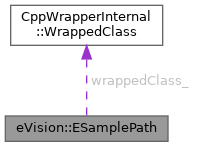
| CppWrapperInternal::WrappedClass | wrappedClass_ |
The class represents a sample path (ELine on which we sample the pixel values to find the strong edge-crossings).
The sample path can be directly specified as a ELine object though ESamplePath::GetSamplePath or through ESamplePath::SetCenter, ESamplePath::SetLength and ESamplePath::SetAngle.
The measurement of the sample path is done with ESamplePath::Measure. It will find ESamplePath::GetNumMeasuredPoints whose positions can be accessed with ESamplePath::GetMeasuredPoint or ESamplePath::GetMeasuredPoints. The characteristics of the edge-crossing can be accessed with ESamplePath::GetMeasuredPeak or ESamplePath::GetMeasuredPeaks.
The profile and derivatives of the sample path can be plotted with ESamplePath::Plot.
License(s): EasyGauge
| eVision::ESamplePath::ESamplePath | ( | const eVision::ELine & | line | ) |
Constructs a ESamplePath.
| line | Line segment representing the sample path |
| eVision::ESamplePath::ESamplePath | ( | const eVision::EPoint & | center, |
| float | pathLength, | ||
| float | pathAngle ) |
Constructs a ESamplePath.
| center | Center of the sample path |
| pathLength | Length of the sample path |
| pathAngle | Angle of the sample path |
| eVision::ESamplePath::ESamplePath | ( | const eVision::EPoint & | center, |
| float | pathLength ) |
Constructs a ESamplePath.
| center | Center of the sample path |
| pathLength | Length of the sample path |
| eVision::ESamplePath::ESamplePath | ( | const eVision::EPoint & | center | ) |
Constructs a ESamplePath.
| center | Center of the sample path |
| eVision::ESamplePath::ESamplePath | ( | ) |
Constructs a ESamplePath.
| eVision::ESamplePath::ESamplePath | ( | const eVision::ESamplePath & | other | ) |
Constructs a ESamplePath.
| other | Other ESamplePath object to copy from. |
|
virtual | ||||||||||||
| eVision::ESamplePath::ESamplePath | ( | CppWrapperInternal::InternalConstructor | ) |
| void eVision::ESamplePath::CopyParametersTo | ( | eVision::ESamplePath & | other | ) | const |
Copy the parameter to the other object.
| other | Object to copy the parameters to. |
| void eVision::ESamplePath::DrawPath | ( | eVision::EDrawAdapter * | drawAdapter, |
| const eVision::EFrame & | frame ) const |
Draws the sample path represented by the object.
| drawAdapter | Handle of the device context on which to draw. |
| frame | Frame of reference in which the gauge is located. |
| void eVision::ESamplePath::DrawPath | ( | eVision::EDrawAdapter * | drawAdapter, |
| const eVision::EFrame & | frame, | ||
| float | zoomX ) const |
Draws the sample path represented by the object.
| drawAdapter | Handle of the device context on which to draw. |
| frame | Frame of reference in which the gauge is located. |
| zoomX | Horizontal zoom factor. By default, true scale is used. |
| void eVision::ESamplePath::DrawPath | ( | eVision::EDrawAdapter * | drawAdapter, |
| const eVision::EFrame & | frame, | ||
| float | zoomX, | ||
| float | zoomY ) const |
Draws the sample path represented by the object.
| drawAdapter | Handle of the device context on which to draw. |
| frame | Frame of reference in which the gauge is located. |
| zoomX | Horizontal zoom factor. By default, true scale is used. |
| zoomY | Vertical zoom factor. By default, true scale is used. |
| void eVision::ESamplePath::DrawPath | ( | eVision::EDrawAdapter * | drawAdapter, |
| const eVision::EFrame & | frame, | ||
| float | zoomX, | ||
| float | zoomY, | ||
| float | panX ) const |
Draws the sample path represented by the object.
| drawAdapter | Handle of the device context on which to draw. |
| frame | Frame of reference in which the gauge is located. |
| zoomX | Horizontal zoom factor. By default, true scale is used. |
| zoomY | Vertical zoom factor. By default, true scale is used. |
| panX | Horizontal pan offset. By default, no pan is added. |
| void eVision::ESamplePath::DrawPath | ( | eVision::EDrawAdapter * | drawAdapter, |
| const eVision::EFrame & | frame, | ||
| float | zoomX, | ||
| float | zoomY, | ||
| float | panX, | ||
| float | panY ) const |
Draws the sample path represented by the object.
| drawAdapter | Handle of the device context on which to draw. |
| frame | Frame of reference in which the gauge is located. |
| zoomX | Horizontal zoom factor. By default, true scale is used. |
| zoomY | Vertical zoom factor. By default, true scale is used. |
| panX | Horizontal pan offset. By default, no pan is added. |
| panY | Vertical pan offset. By default, no pan is added. |
| void eVision::ESamplePath::DrawTransition | ( | eVision::EDrawAdapter * | graphicContext, |
| const eVision::EFrame & | frame ) const |
Draws the transition symbol between the points org and end if specified or between the origin and end of the ESamplePath::GetSamplePath.
| graphicContext | Handle of the device context on which to draw. |
| frame | Frame of reference in which the path is located. |
| void eVision::ESamplePath::DrawTransition | ( | eVision::EDrawAdapter * | graphicContext, |
| const eVision::EFrame & | frame, | ||
| float | zoomX ) const |
Draws the transition symbol between the points org and end if specified or between the origin and end of the ESamplePath::GetSamplePath.
| graphicContext | Handle of the device context on which to draw. |
| frame | Frame of reference in which the path is located. |
| zoomX | Horizontal zoom factor. By default, true scale is used. |
| void eVision::ESamplePath::DrawTransition | ( | eVision::EDrawAdapter * | graphicContext, |
| const eVision::EFrame & | frame, | ||
| float | zoomX, | ||
| float | zoomY ) const |
Draws the transition symbol between the points org and end if specified or between the origin and end of the ESamplePath::GetSamplePath.
| graphicContext | Handle of the device context on which to draw. |
| frame | Frame of reference in which the path is located. |
| zoomX | Horizontal zoom factor. By default, true scale is used. |
| zoomY | Vertical zoom factor. By default, true scale is used. |
| void eVision::ESamplePath::DrawTransition | ( | eVision::EDrawAdapter * | graphicContext, |
| const eVision::EFrame & | frame, | ||
| float | zoomX, | ||
| float | zoomY, | ||
| float | panX ) const |
Draws the transition symbol between the points org and end if specified or between the origin and end of the ESamplePath::GetSamplePath.
| graphicContext | Handle of the device context on which to draw. |
| frame | Frame of reference in which the path is located. |
| zoomX | Horizontal zoom factor. By default, true scale is used. |
| zoomY | Vertical zoom factor. By default, true scale is used. |
| panX | Horizontal pan offset. By default, no pan is added. |
| void eVision::ESamplePath::DrawTransition | ( | eVision::EDrawAdapter * | graphicContext, |
| const eVision::EFrame & | frame, | ||
| float | zoomX, | ||
| float | zoomY, | ||
| float | panX, | ||
| float | panY ) const |
Draws the transition symbol between the points org and end if specified or between the origin and end of the ESamplePath::GetSamplePath.
| graphicContext | Handle of the device context on which to draw. |
| frame | Frame of reference in which the path is located. |
| zoomX | Horizontal zoom factor. By default, true scale is used. |
| zoomY | Vertical zoom factor. By default, true scale is used. |
| panX | Horizontal pan offset. By default, no pan is added. |
| panY | Vertical pan offset. By default, no pan is added. |
| void eVision::ESamplePath::DrawTransition | ( | eVision::EDrawAdapter * | graphicContext, |
| eVision::EPoint | org, | ||
| eVision::EPoint | end, | ||
| const eVision::EFrame & | frame ) const |
Draws the transition symbol between the points org and end if specified or between the origin and end of the ESamplePath::GetSamplePath.
| graphicContext | Handle of the device context on which to draw. |
| org | Origin point used to specify the drawing position. |
| end | End point used to specify the drawing position. |
| frame | Frame of reference in which the path is located. |
| void eVision::ESamplePath::DrawTransition | ( | eVision::EDrawAdapter * | graphicContext, |
| eVision::EPoint | org, | ||
| eVision::EPoint | end, | ||
| const eVision::EFrame & | frame, | ||
| float | zoomX ) const |
Draws the transition symbol between the points org and end if specified or between the origin and end of the ESamplePath::GetSamplePath.
| graphicContext | Handle of the device context on which to draw. |
| org | Origin point used to specify the drawing position. |
| end | End point used to specify the drawing position. |
| frame | Frame of reference in which the path is located. |
| zoomX | Horizontal zoom factor. By default, true scale is used. |
| void eVision::ESamplePath::DrawTransition | ( | eVision::EDrawAdapter * | graphicContext, |
| eVision::EPoint | org, | ||
| eVision::EPoint | end, | ||
| const eVision::EFrame & | frame, | ||
| float | zoomX, | ||
| float | zoomY ) const |
Draws the transition symbol between the points org and end if specified or between the origin and end of the ESamplePath::GetSamplePath.
| graphicContext | Handle of the device context on which to draw. |
| org | Origin point used to specify the drawing position. |
| end | End point used to specify the drawing position. |
| frame | Frame of reference in which the path is located. |
| zoomX | Horizontal zoom factor. By default, true scale is used. |
| zoomY | Vertical zoom factor. By default, true scale is used. |
| void eVision::ESamplePath::DrawTransition | ( | eVision::EDrawAdapter * | graphicContext, |
| eVision::EPoint | org, | ||
| eVision::EPoint | end, | ||
| const eVision::EFrame & | frame, | ||
| float | zoomX, | ||
| float | zoomY, | ||
| float | panX ) const |
Draws the transition symbol between the points org and end if specified or between the origin and end of the ESamplePath::GetSamplePath.
| graphicContext | Handle of the device context on which to draw. |
| org | Origin point used to specify the drawing position. |
| end | End point used to specify the drawing position. |
| frame | Frame of reference in which the path is located. |
| zoomX | Horizontal zoom factor. By default, true scale is used. |
| zoomY | Vertical zoom factor. By default, true scale is used. |
| panX | Horizontal pan offset. By default, no pan is added. |
| void eVision::ESamplePath::DrawTransition | ( | eVision::EDrawAdapter * | graphicContext, |
| eVision::EPoint | org, | ||
| eVision::EPoint | end, | ||
| const eVision::EFrame & | frame, | ||
| float | zoomX, | ||
| float | zoomY, | ||
| float | panX, | ||
| float | panY ) const |
Draws the transition symbol between the points org and end if specified or between the origin and end of the ESamplePath::GetSamplePath.
| graphicContext | Handle of the device context on which to draw. |
| org | Origin point used to specify the drawing position. |
| end | End point used to specify the drawing position. |
| frame | Frame of reference in which the path is located. |
| zoomX | Horizontal zoom factor. By default, true scale is used. |
| zoomY | Vertical zoom factor. By default, true scale is used. |
| panX | Horizontal pan offset. By default, no pan is added. |
| panY | Vertical pan offset. By default, no pan is added. |
| float eVision::ESamplePath::GetAngle | ( | ) | const |
Angle of the path along which we measure.
| eVision::EPoint eVision::ESamplePath::GetCenter | ( | ) | const |
Center of the sample path.
| uint32_t eVision::ESamplePath::GetDefaultPointIndex | ( | ) | const |
The default edge-crossing point measured, chosen according to the transition choice parameter.
|
static |
Gets a standard drawing pen for the specified plot item.
| plotItem | Plot item for which to get a standard pen. |
| bool eVision::ESamplePath::GetHVConstraint | ( | ) | const |
Status of the restriction on the orientation of the sample path.
| float eVision::ESamplePath::GetLength | ( | ) | const |
Length of the path along which measure.
| eVision::EPeak eVision::ESamplePath::GetMeasuredPeak | ( | ) | const |
Returns information pertaining to the default derivative peak, along one of the sample paths of the gauge.
If index is left unchanged from its default value (i.e. ~0 = 0xFFFFFFFF), the default edge-crossing point is inspected. This default point is chosen according to the transition choice parameter that is managed by the ESamplePath::SetTransitionChoice property.
If you want to query more than 10 points, using ESamplePath::GetMeasuredPeaks should be faster.
| eVision::EPeak eVision::ESamplePath::GetMeasuredPeak | ( | uint32_t | index | ) | const |
Returns information pertaining to the default derivative peak, along one of the sample paths of the gauge.
| index | Index of the edge-crossing point along the probed line segment, between 0 and ESamplePath::GetNumMeasuredPoints (excluded). |
If index is left unchanged from its default value (i.e. ~0 = 0xFFFFFFFF), the default edge-crossing point is inspected. This default point is chosen according to the transition choice parameter that is managed by the ESamplePath::SetTransitionChoice property.
If you want to query more than 10 points, using ESamplePath::GetMeasuredPeaks should be faster.
| std::vector< eVision::EPeak > eVision::ESamplePath::GetMeasuredPeaks | ( | ) | const |
Returns information pertaining to the derivative peaks associated with all the edge-crossing point, such as their area, amplitude, start, length and center.
If you want to query less than 10 peaks, using ESamplePath::GetMeasuredPeak should be faster.
| eVision::EPoint eVision::ESamplePath::GetMeasuredPoint | ( | ) | const |
Coordinates of a sample point, measured along this sample path.
These coordinates pertain to the World space.
If index is left unchanged from its default value (i.e. ~0 = 0xFFFFFFFF), the default edge-crossing point is inspected. This default point is chosen according to the transition choice parameter that is managed by the ESamplePath::SetTransitionChoice property.
If you want to query more than 10 points, using ESamplePath::GetMeasuredPoints should be faster.
| eVision::EPoint eVision::ESamplePath::GetMeasuredPoint | ( | uint32_t | index | ) | const |
Coordinates of a sample point, measured along this sample path.
| index | Index of the edge-crossing point along the probed line segment, between 0 and ESamplePath::GetNumMeasuredPoints (excluded). |
These coordinates pertain to the World space.
If index is left unchanged from its default value (i.e. ~0 = 0xFFFFFFFF), the default edge-crossing point is inspected. This default point is chosen according to the transition choice parameter that is managed by the ESamplePath::SetTransitionChoice property.
If you want to query more than 10 points, using ESamplePath::GetMeasuredPoints should be faster.
| std::vector< eVision::EPoint > eVision::ESamplePath::GetMeasuredPoints | ( | ) | const |
Coordinates of all edge-crossing points, measured along the sample path of a gauge.
These coordinates pertain to the World space.
If you want to query less than 10 points, using ESamplePath::GetMeasuredPoint should be faster.
| uint32_t eVision::ESamplePath::GetMinAmplitude | ( | ) | const |
Offset added to the Threshold when a peak is to be detected.
| uint32_t eVision::ESamplePath::GetMinArea | ( | ) | const |
Minimum area value.
A transition is detected if its derivative peak reaches Threshold + MinAmplitude value, and then declared valid if the area between the peak curve and the horizontal at level Threshold reaches the MinArea value.
| uint32_t eVision::ESamplePath::GetNumMeasuredPoints | ( | ) | const |
Number of edge-crossing points along the sample path.
| eVision::ELine eVision::ESamplePath::GetSamplePath | ( | ) | const |
Line along which the edge-crossing points are measured.
| uint32_t eVision::ESamplePath::GetSmoothing | ( | ) | const |
Number of pixels used for the low-pass filtering operation.
To reduce the effect of noise, the profile data can be low-pass filtered along the point location gauge direction.
| uint32_t eVision::ESamplePath::GetThickness | ( | ) | const |
Number of parallel segments used to extract the data profile.
To reduce the effect of noise and/or strengthen a transition, several parallel profiles can be accumulated.
| uint32_t eVision::ESamplePath::GetThreshold | ( | ) | const |
Threshold level used to delimit significant peaks in the data profile.
| float eVision::ESamplePath::GetTolerance | ( | ) | const |
Tolerance (half-length of the path).
| float eVision::ESamplePath::GetToleranceAngle | ( | ) | const |
Alias for ESamplePath::SetAngle.
| eVision::ETransitionChoice eVision::ESamplePath::GetTransitionChoice | ( | ) | const |
Transition choice used to select the sample point corresponding to ESamplePath::SetTransitionIndex.
| uint32_t eVision::ESamplePath::GetTransitionIndex | ( | ) | const |
The sample point to select as default.
| bool eVision::ESamplePath::GetTransitionRectangularSamplingArea | ( | ) | const |
Flag indicating whether the sampling area remains a rectangle when rotated, instead of becoming a parallelogram.
| eVision::ETransitionType eVision::ESamplePath::GetTransitionType | ( | ) | const |
Transition type to measure.
| bool eVision::ESamplePath::GetValid | ( | ) | const |
Flag indicating if at least one valid transition has been found.
| bool eVision::ESamplePath::IsEqual | ( | const eVision::ESamplePath & | other | ) | const |
Compares this object with the other object.
Note that the class only compares its parameters and not the computations dependent variables.
| other | Other ESamplePath object. |
| void eVision::ESamplePath::Measure | ( | const eVision::EROIBW8 & | pSrc | ) |
Measure the peaks in the image, potentially applying normalization.
| pSrc | Image. |
| void eVision::ESamplePath::Measure | ( | const eVision::EROIBW8 & | pSrc, |
| const eVision::EFrame & | frame ) |
Measure the peaks in the image, potentially applying normalization.
| pSrc | Image. |
| frame | Frame of reference in which the path is located. |
| void eVision::ESamplePath::Measure | ( | const eVision::EROIBW8 & | pSrc, |
| const eVision::ERegion & | region ) |
Measure the peaks in the image, potentially applying normalization.
| pSrc | Image. |
| region | ERegion associated with the image. |
| void eVision::ESamplePath::Measure | ( | const eVision::EROIBW8 & | pSrc, |
| const eVision::ERegion & | region, | ||
| const eVision::EFrame & | frame ) |
Measure the peaks in the image, potentially applying normalization.
| pSrc | Image. |
| region | ERegion associated with the image. |
| frame | Frame of reference in which the path is located. |
| eVision::ESamplePath & eVision::ESamplePath::operator= | ( | const eVision::ESamplePath & | other | ) |
Copy assignment.
| other | Other ESamplePath to assign to this object |
| bool eVision::ESamplePath::operator== | ( | const eVision::ESamplePath & | other | ) | const |
Comparison operator.
Note that the class only compares its parameters and not the computations dependent variables.
| other | Other ESamplePath object. |
| void eVision::ESamplePath::Plot | ( | eVision::EDrawAdapter * | graphicContext, |
| eVision::EPlotItem | plotItems, | ||
| const eVision::EPlotDecorationOptions & | opts, | ||
| float | width, | ||
| float | height ) const |
Draws the profile of the sample paths of the gauge, as defined by EPlotItem.
| graphicContext | Handle of the device context on which to draw. |
| plotItems | Boolean combination of EPlotItem members, that indicates which items must be displayed. |
| opts | Options to control the drawing of the plot decorations (axes, ticks, etc.). |
| width | Width of the plot. |
| height | Height of the plot. |
The data will be plotted with the current pen of the EDrawAdapter. If there is no pen set, then the following color will be used:
| void eVision::ESamplePath::Plot | ( | eVision::EDrawAdapter * | graphicContext, |
| eVision::EPlotItem | plotItems, | ||
| const eVision::EPlotDecorationOptions & | opts, | ||
| float | width, | ||
| float | height, | ||
| float | originX ) const |
Draws the profile of the sample paths of the gauge, as defined by EPlotItem.
| graphicContext | Handle of the device context on which to draw. |
| plotItems | Boolean combination of EPlotItem members, that indicates which items must be displayed. |
| opts | Options to control the drawing of the plot decorations (axes, ticks, etc.). |
| width | Width of the plot. |
| height | Height of the plot. |
| originX | Origin point coordinates of the plot along the X axis. |
The data will be plotted with the current pen of the EDrawAdapter. If there is no pen set, then the following color will be used:
| void eVision::ESamplePath::Plot | ( | eVision::EDrawAdapter * | graphicContext, |
| eVision::EPlotItem | plotItems, | ||
| const eVision::EPlotDecorationOptions & | opts, | ||
| float | width, | ||
| float | height, | ||
| float | originX, | ||
| float | originY ) const |
Draws the profile of the sample paths of the gauge, as defined by EPlotItem.
| graphicContext | Handle of the device context on which to draw. |
| plotItems | Boolean combination of EPlotItem members, that indicates which items must be displayed. |
| opts | Options to control the drawing of the plot decorations (axes, ticks, etc.). |
| width | Width of the plot. |
| height | Height of the plot. |
| originX | Origin point coordinates of the plot along the X axis. |
| originY | Origin point coordinates of the plot along the Y axis. |
The data will be plotted with the current pen of the EDrawAdapter. If there is no pen set, then the following color will be used:
| void eVision::ESamplePath::SetAngle | ( | float | angle | ) |
Angle of the path along which we measure.
| angle | New sample path angle. |
| void eVision::ESamplePath::SetCenter | ( | eVision::EPoint | point | ) |
Center of the sample path.
| void eVision::ESamplePath::SetHVConstraint | ( | bool | bHVConstraint | ) |
Status of the restriction on the orientation of the sample path.
| void eVision::ESamplePath::SetLength | ( | float | length | ) |
Length of the path along which measure.
| length | New sample path length. |
| void eVision::ESamplePath::SetMinAmplitude | ( | uint32_t | un32MinAmplitude | ) |
Offset added to the Threshold when a peak is to be detected.
| void eVision::ESamplePath::SetMinArea | ( | uint32_t | un32MinArea | ) |
Minimum area value.
A transition is detected if its derivative peak reaches Threshold + MinAmplitude value, and then declared valid if the area between the peak curve and the horizontal at level Threshold reaches the MinArea value.
| void eVision::ESamplePath::SetSamplePath | ( | const eVision::ELine & | line | ) |
Line along which the edge-crossing points are measured.
| void eVision::ESamplePath::SetSmoothing | ( | uint32_t | un32Smoothing | ) |
Number of pixels used for the low-pass filtering operation.
To reduce the effect of noise, the profile data can be low-pass filtered along the point location gauge direction.
| void eVision::ESamplePath::SetThickness | ( | uint32_t | un32Thickness | ) |
Number of parallel segments used to extract the data profile.
To reduce the effect of noise and/or strengthen a transition, several parallel profiles can be accumulated.
| void eVision::ESamplePath::SetThreshold | ( | uint32_t | un32Threshold | ) |
Threshold level used to delimit significant peaks in the data profile.
| void eVision::ESamplePath::SetTolerance | ( | float | val | ) |
Tolerance (half-length of the path).
| void eVision::ESamplePath::SetToleranceAngle | ( | float | val | ) |
Alias for ESamplePath::SetAngle.
| void eVision::ESamplePath::SetTransitionChoice | ( | eVision::ETransitionChoice | eTransitionChoice | ) |
Transition choice used to select the sample point corresponding to ESamplePath::SetTransitionIndex.
| void eVision::ESamplePath::SetTransitionIndex | ( | uint32_t | un32TransitionIndex | ) |
The sample point to select as default.
| void eVision::ESamplePath::SetTransitionRectangularSamplingArea | ( | bool | bRectangularSamplingArea | ) |
Flag indicating whether the sampling area remains a rectangle when rotated, instead of becoming a parallelogram.
| void eVision::ESamplePath::SetTransitionType | ( | eVision::ETransitionType | eTransitionType | ) |
Transition type to measure.
| CppWrapperInternal::WrappedClass eVision::ESamplePath::wrappedClass_ |
 1.17.0