 |
eVision C++ API 26.10.0-beta.2.dev
|
|
eVision C++ API 26.10.0-beta.2.dev
|
ESpotDetector is dedicated to the detection of spots, particles and scratches on images. It is especially efficient at detecting faint contaminations on noisy surface images. It produces a list of ESpot objects. More...
#include <eVision/EasySpotDetector/ESpotDetector.h>
Public Member Functions | |
| ESpotDetector () | |
| Constructs an ESpotDetector with default configuration. | |
| ESpotDetector (const eVision::ESpotDetector &other) | |
| Copy constructor for ESpotDetector. | |
| virtual | ~ESpotDetector () throw () |
| eVision::ESpotDetector & | operator= (const eVision::ESpotDetector &other) |
| Assignment operator. | |
| bool | operator== (const eVision::ESpotDetector &other) const |
| Comparison operator. | |
| void | Load (const std::string &path) |
| Loads the ESpotDetector. The given ESerializer must have been created for reading. | |
| void | Load (eVision::ESerializer *serializer) |
| Loads the ESpotDetector. The given ESerializer must have been created for reading. | |
| void | Save (const std::string &path) |
| Saves the ESpotDetector. The given ESerializer must have been created for writing. | |
| void | Save (eVision::ESerializer *serializer) |
| Saves the ESpotDetector. The given ESerializer must have been created for writing. | |
| void | SetEnableAlignment (bool state) |
| Enables or disables the optional alignment process. The alignment area and the tolerance must be set as well, see ESpotDetector::SetAlignmentArea and ESpotDetector::SetAlignmentTolerance. | |
| bool | GetEnableAlignment () const |
| Enables or disables the optional alignment process. The alignment area and the tolerance must be set as well, see ESpotDetector::SetAlignmentArea and ESpotDetector::SetAlignmentTolerance. | |
| void | SetAlignmentArea (const eVision::ERectangle &rectangle) |
| Sets/Gets an initial estimate of the rectangle on which spots will be detected in the image. The alignment process is enabled with ESpotDetector::SetEnableAlignment. To perform the alignment, a tolerance must be set as well, see ESpotDetector::SetAlignmentTolerance. | |
| const eVision::ERectangle & | GetAlignmentArea () const |
| Sets/Gets an initial estimate of the rectangle on which spots will be detected in the image. The alignment process is enabled with ESpotDetector::SetEnableAlignment. To perform the alignment, a tolerance must be set as well, see ESpotDetector::SetAlignmentTolerance. | |
| void | SetAlignmentTolerance (uint32_t tolerance) |
| Sets/Gets the tolerance around the initial estimate of the alignment area, in pixels. The default is 100 pixels. See also ESpotDetector::SetAlignmentArea. | |
| uint32_t | GetAlignmentTolerance () const |
| Sets/Gets the tolerance around the initial estimate of the alignment area, in pixels. The default is 100 pixels. See also ESpotDetector::SetAlignmentArea. | |
| void | SetGuardBand (const eVision::EGuardBand &guardBand) |
| Sets/Gets the EGuardBand. | |
| eVision::EGuardBand | GetGuardBand () const |
| Sets/Gets the EGuardBand. | |
| void | SetEnableParticleDetection (bool state) |
| Sets/Gets the particle detection processing. | |
| bool | GetEnableParticleDetection () const |
| Sets/Gets the particle detection processing. | |
| void | SetEnableScratchDetection (bool state) |
| Sets/Gets the scratch detection processing. | |
| bool | GetEnableScratchDetection () const |
| Sets/Gets the scratch detection processing. | |
| void | SetParticleDetectionParameters (const eVision::EParticleDetectionParameters ¶meters) |
| Sets the particle detection parameters. | |
| void | GetParticleDetectionParameters (eVision::EParticleDetectionParameters ¶meters) const |
| Gets the particle detection parameters. | |
| void | SetScratchDetectionParameters (const eVision::EScratchDetectionParameters ¶meters) |
| Sets the scratch detection parameters. | |
| void | GetScratchDetectionParameters (eVision::EScratchDetectionParameters ¶meters) const |
| Gets the scratch detection parameters. | |
| uint32_t | Detect (const eVision::EROIBW8 &sourceImage) |
| Performs the spot detection in the given EROIBW8. It returns the number of spot detected. Use ESpotDetector::GetSpots the retrieve the list of detected spots. | |
| uint32_t | Detect (const eVision::EROIBW8 &sourceImage, const eVision::ERegion ®ion) |
| Performs the spot detection in the given EROIBW8. It returns the number of spot detected. Use ESpotDetector::GetSpots the retrieve the list of detected spots. | |
| uint32_t | Detect (const eVision::EROIBW8 &sourceImage, const eVision::EFrame &frame) |
| Performs the spot detection in the given EROIBW8. It returns the number of spot detected. Use ESpotDetector::GetSpots the retrieve the list of detected spots. | |
| uint32_t | Detect (const eVision::EROIBW8 &sourceImage, const eVision::ERegion ®ion, const eVision::EFrame &frame) |
| Performs the spot detection in the given EROIBW8. It returns the number of spot detected. Use ESpotDetector::GetSpots the retrieve the list of detected spots. | |
| std::vector< eVision::ESpot > | GetSpots () const |
| Gets the spots detected by a previous call to ESpotDetector::Detect. | |
| uint32_t | GetNumSpots () const |
| Gets the number of spots detected by a previous call to ESpotDetector::Detect. | |
| const eVision::EROIBW8 & | GetSourceROI () const |
| Gets the last used Region Of Interest, after optionnal alignment and guard band clipping. No image is attached to that EROIBW8. See also ESpotDetector::SetEnableAlignment and ESpotDetector::SetGuardBand. | |
| void | GenerateSegmentationMap (eVision::EImageBW8 &map) const |
| Returns the last computed segmentation map. | |
| void | Draw (eVision::EDrawAdapter *drawAdapter, const eVision::ERGBColor &color, float zoomX, float zoomY, float panX, float panY) const |
| Draw the ESpotDetector. | |
| void | Draw (eVision::EDrawAdapter *drawAdapter, const eVision::ERGBColor &color, float zoomX, float zoomY, float panX) const |
| Draw the ESpotDetector. | |
| void | Draw (eVision::EDrawAdapter *drawAdapter, const eVision::ERGBColor &color, float zoomX, float zoomY) const |
| Draw the ESpotDetector. | |
| void | Draw (eVision::EDrawAdapter *drawAdapter, const eVision::ERGBColor &color, float zoomX) const |
| Draw the ESpotDetector. | |
| void | Draw (eVision::EDrawAdapter *drawAdapter, const eVision::ERGBColor &color) const |
| Draw the ESpotDetector. | |
| void | Draw (eVision::EDrawAdapter *drawAdapter) const |
| Draw the ESpotDetector. | |
| void | Draw (HDC graphicContext, const eVision::ERGBColor &color, float zoomX, float zoomY, float panX, float panY) const |
| Draw the ESpotDetector. | |
| void | Draw (HDC graphicContext, const eVision::ERGBColor &color, float zoomX, float zoomY, float panX) const |
| Draw the ESpotDetector. | |
| void | Draw (HDC graphicContext, const eVision::ERGBColor &color, float zoomX, float zoomY) const |
| Draw the ESpotDetector. | |
| void | Draw (HDC graphicContext, const eVision::ERGBColor &color, float zoomX) const |
| Draw the ESpotDetector. | |
| void | Draw (HDC graphicContext, const eVision::ERGBColor &color) const |
| Draw the ESpotDetector. | |
| void | Draw (HDC graphicContext) const |
| Draw the ESpotDetector. | |
| uint32_t | AddDetectedSpotsToDLProject (const std::string &projectPath, uint32_t roiExtension, const std::string &imageName, uint32_t noDefectSamples, const std::string &noDefectLabel) |
| To be called after ESpotDetector::Detect to add the detected spots to a new or existing EDeepLearningProject. This method returns the number of spots added. | |
| uint32_t | AddDetectedSpotsToDLProject (const std::string &projectPath, uint32_t roiExtension, const std::string &imageName, uint32_t noDefectSamples) |
| To be called after ESpotDetector::Detect to add the detected spots to a new or existing EDeepLearningProject. This method returns the number of spots added. | |
| uint32_t | AddDetectedSpotsToDLProject (const std::string &projectPath, uint32_t roiExtension, const std::string &imageName) |
| To be called after ESpotDetector::Detect to add the detected spots to a new or existing EDeepLearningProject. This method returns the number of spots added. | |
| uint32_t | AddDetectedSpotsToDLProject (const std::string &projectPath, uint32_t roiExtension) |
| To be called after ESpotDetector::Detect to add the detected spots to a new or existing EDeepLearningProject. This method returns the number of spots added. | |
| uint32_t | AddDetectedSpotsToDLProject (const std::string &projectPath) |
| To be called after ESpotDetector::Detect to add the detected spots to a new or existing EDeepLearningProject. This method returns the number of spots added. | |
| void | SetDLClassifierPath (const std::string &classifierPath) |
| Opens a DL classifier and use it to classify all further detected spots. The resulting class is stored in ESpot. Use ESpotDetector::UnsetDLClassifier to remove the Deep Learning classification. Setting a Deep Learning Classifier triggers an initialization of the model. The initialization can take a few milliseconds to several minutes depending on the engine and device selected. | |
| std::string | GetDLClassifierPath () const |
| Opens a DL classifier and use it to classify all further detected spots. The resulting class is stored in ESpot. Use ESpotDetector::UnsetDLClassifier to remove the Deep Learning classification. Setting a Deep Learning Classifier triggers an initialization of the model. The initialization can take a few milliseconds to several minutes depending on the engine and device selected. | |
| void | UnsetDLClassifier () |
| Disable the usage of the Deep Learning classifier. | |
| bool | IsDLClassifierSet () const |
| Returns True if a classifier has been loaded. | |
| void | SetDLExecutionSettings (const eVision::EasyDeepLearning::EDeepLearningExecutionSettings &settings) |
| Controls the execution settings of the DL Classifier. Set the class EDeepLearningExecutionSettings to choose between engines, devices and other inference parameters. Changing the execution settings triggers an initialization of the deep learning model. The initialization can take a few milliseconds to several minutes depending on the engine and device selected. | |
| eVision::EasyDeepLearning::EDeepLearningExecutionSettings | GetDLExecutionSettings () const |
| Controls the execution settings of the DL Classifier. Set the class EDeepLearningExecutionSettings to choose between engines, devices and other inference parameters. Changing the execution settings triggers an initialization of the deep learning model. The initialization can take a few milliseconds to several minutes depending on the engine and device selected. | |
| ESpotDetector (CppWrapperInternal::InternalConstructor) | |
Public Attributes | |
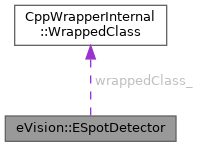
| CppWrapperInternal::WrappedClass | wrappedClass_ |
ESpotDetector is dedicated to the detection of spots, particles and scratches on images. It is especially efficient at detecting faint contaminations on noisy surface images. It produces a list of ESpot objects.
License(s): EasySpotDetector
| eVision::ESpotDetector::ESpotDetector | ( | ) |
Constructs an ESpotDetector with default configuration.
| eVision::ESpotDetector::ESpotDetector | ( | const eVision::ESpotDetector & | other | ) |
Copy constructor for ESpotDetector.
| other | The other ESpotDetector that we will copy into this one. |
|
virtual | ||||||||||||
| eVision::ESpotDetector::ESpotDetector | ( | CppWrapperInternal::InternalConstructor | ) |
| uint32_t eVision::ESpotDetector::AddDetectedSpotsToDLProject | ( | const std::string & | projectPath | ) |
To be called after ESpotDetector::Detect to add the detected spots to a new or existing EDeepLearningProject. This method returns the number of spots added.
The image used by ESpotDetector::Detect is copied to a subdirectory 'Images' of the project file and linked in the project. All detected spots are added to the project as ROI of the image, with the label depending on the spot type ('Particle' or 'Scratch'). Optional parameter roiExtension can be used to increase the ROI size by a pixel amount. It could help the deep learning inference to have a 'context' around the ROI. Automatic image names are generated unless the parameter imageName is set. All images must have a different name. The optional parameter noDefectSamples sets the number of extra ROIs added to the project representing areas without defect. The label of these defects are given by parameter noDefectLabel.
| projectPath | The path to the Deep Learning project (usually a file with edlproject extension). |
| uint32_t eVision::ESpotDetector::AddDetectedSpotsToDLProject | ( | const std::string & | projectPath, |
| uint32_t | roiExtension ) |
To be called after ESpotDetector::Detect to add the detected spots to a new or existing EDeepLearningProject. This method returns the number of spots added.
The image used by ESpotDetector::Detect is copied to a subdirectory 'Images' of the project file and linked in the project. All detected spots are added to the project as ROI of the image, with the label depending on the spot type ('Particle' or 'Scratch'). Optional parameter roiExtension can be used to increase the ROI size by a pixel amount. It could help the deep learning inference to have a 'context' around the ROI. Automatic image names are generated unless the parameter imageName is set. All images must have a different name. The optional parameter noDefectSamples sets the number of extra ROIs added to the project representing areas without defect. The label of these defects are given by parameter noDefectLabel.
| projectPath | The path to the Deep Learning project (usually a file with edlproject extension). |
| roiExtension | The ROI extension in pixels. Default value is 5. |
| uint32_t eVision::ESpotDetector::AddDetectedSpotsToDLProject | ( | const std::string & | projectPath, |
| uint32_t | roiExtension, | ||
| const std::string & | imageName ) |
To be called after ESpotDetector::Detect to add the detected spots to a new or existing EDeepLearningProject. This method returns the number of spots added.
The image used by ESpotDetector::Detect is copied to a subdirectory 'Images' of the project file and linked in the project. All detected spots are added to the project as ROI of the image, with the label depending on the spot type ('Particle' or 'Scratch'). Optional parameter roiExtension can be used to increase the ROI size by a pixel amount. It could help the deep learning inference to have a 'context' around the ROI. Automatic image names are generated unless the parameter imageName is set. All images must have a different name. The optional parameter noDefectSamples sets the number of extra ROIs added to the project representing areas without defect. The label of these defects are given by parameter noDefectLabel.
| projectPath | The path to the Deep Learning project (usually a file with edlproject extension). |
| roiExtension | The ROI extension in pixels. Default value is 5. |
| imageName | Override the default image name. |
| uint32_t eVision::ESpotDetector::AddDetectedSpotsToDLProject | ( | const std::string & | projectPath, |
| uint32_t | roiExtension, | ||
| const std::string & | imageName, | ||
| uint32_t | noDefectSamples ) |
To be called after ESpotDetector::Detect to add the detected spots to a new or existing EDeepLearningProject. This method returns the number of spots added.
The image used by ESpotDetector::Detect is copied to a subdirectory 'Images' of the project file and linked in the project. All detected spots are added to the project as ROI of the image, with the label depending on the spot type ('Particle' or 'Scratch'). Optional parameter roiExtension can be used to increase the ROI size by a pixel amount. It could help the deep learning inference to have a 'context' around the ROI. Automatic image names are generated unless the parameter imageName is set. All images must have a different name. The optional parameter noDefectSamples sets the number of extra ROIs added to the project representing areas without defect. The label of these defects are given by parameter noDefectLabel.
| projectPath | The path to the Deep Learning project (usually a file with edlproject extension). |
| roiExtension | The ROI extension in pixels. Default value is 5. |
| imageName | Override the default image name. |
| noDefectSamples | Number of extra ROI to be created to represent areas without defect. Default value is 0. |
| uint32_t eVision::ESpotDetector::AddDetectedSpotsToDLProject | ( | const std::string & | projectPath, |
| uint32_t | roiExtension, | ||
| const std::string & | imageName, | ||
| uint32_t | noDefectSamples, | ||
| const std::string & | noDefectLabel ) |
To be called after ESpotDetector::Detect to add the detected spots to a new or existing EDeepLearningProject. This method returns the number of spots added.
The image used by ESpotDetector::Detect is copied to a subdirectory 'Images' of the project file and linked in the project. All detected spots are added to the project as ROI of the image, with the label depending on the spot type ('Particle' or 'Scratch'). Optional parameter roiExtension can be used to increase the ROI size by a pixel amount. It could help the deep learning inference to have a 'context' around the ROI. Automatic image names are generated unless the parameter imageName is set. All images must have a different name. The optional parameter noDefectSamples sets the number of extra ROIs added to the project representing areas without defect. The label of these defects are given by parameter noDefectLabel.
| projectPath | The path to the Deep Learning project (usually a file with edlproject extension). |
| roiExtension | The ROI extension in pixels. Default value is 5. |
| imageName | Override the default image name. |
| noDefectSamples | Number of extra ROI to be created to represent areas without defect. Default value is 0. |
| noDefectLabel | The label for the extra ROI (if noDefectSamples>0). Default value is 'NotADefect'. |
| uint32_t eVision::ESpotDetector::Detect | ( | const eVision::EROIBW8 & | sourceImage | ) |
Performs the spot detection in the given EROIBW8. It returns the number of spot detected. Use ESpotDetector::GetSpots the retrieve the list of detected spots.
| sourceImage | The image in which the spots are detected. |
| uint32_t eVision::ESpotDetector::Detect | ( | const eVision::EROIBW8 & | sourceImage, |
| const eVision::EFrame & | frame ) |
Performs the spot detection in the given EROIBW8. It returns the number of spot detected. Use ESpotDetector::GetSpots the retrieve the list of detected spots.
| sourceImage | The image in which the spots are detected. |
| frame | Reference frame of the input region |
| uint32_t eVision::ESpotDetector::Detect | ( | const eVision::EROIBW8 & | sourceImage, |
| const eVision::ERegion & | region ) |
Performs the spot detection in the given EROIBW8. It returns the number of spot detected. Use ESpotDetector::GetSpots the retrieve the list of detected spots.
| sourceImage | The image in which the spots are detected. |
| region | The region on which the image is processed. |
| uint32_t eVision::ESpotDetector::Detect | ( | const eVision::EROIBW8 & | sourceImage, |
| const eVision::ERegion & | region, | ||
| const eVision::EFrame & | frame ) |
Performs the spot detection in the given EROIBW8. It returns the number of spot detected. Use ESpotDetector::GetSpots the retrieve the list of detected spots.
| sourceImage | The image in which the spots are detected. |
| region | The region on which the image is processed. |
| frame | Reference frame of the input region |
| void eVision::ESpotDetector::Draw | ( | eVision::EDrawAdapter * | drawAdapter | ) | const |
Draw the ESpotDetector.
| drawAdapter | EDrawAdapter that will be used to draw. |
| void eVision::ESpotDetector::Draw | ( | eVision::EDrawAdapter * | drawAdapter, |
| const eVision::ERGBColor & | color ) const |
Draw the ESpotDetector.
| drawAdapter | EDrawAdapter that will be used to draw. |
| color | Color of the drawn rectangle. |
| void eVision::ESpotDetector::Draw | ( | eVision::EDrawAdapter * | drawAdapter, |
| const eVision::ERGBColor & | color, | ||
| float | zoomX ) const |
Draw the ESpotDetector.
| drawAdapter | EDrawAdapter that will be used to draw. |
| color | Color of the drawn rectangle. |
| zoomX | Horizontal zooming factor. By default, true scale is used. |
| void eVision::ESpotDetector::Draw | ( | eVision::EDrawAdapter * | drawAdapter, |
| const eVision::ERGBColor & | color, | ||
| float | zoomX, | ||
| float | zoomY ) const |
Draw the ESpotDetector.
| drawAdapter | EDrawAdapter that will be used to draw. |
| color | Color of the drawn rectangle. |
| zoomX | Horizontal zooming factor. By default, true scale is used. |
| zoomY | Vertical zooming factor. If set to 0 (default), the horizontal zooming factor is used instead, so as to provide isotropic zooming. |
| void eVision::ESpotDetector::Draw | ( | eVision::EDrawAdapter * | drawAdapter, |
| const eVision::ERGBColor & | color, | ||
| float | zoomX, | ||
| float | zoomY, | ||
| float | panX ) const |
Draw the ESpotDetector.
| drawAdapter | EDrawAdapter that will be used to draw. |
| color | Color of the drawn rectangle. |
| zoomX | Horizontal zooming factor. By default, true scale is used. |
| zoomY | Vertical zooming factor. If set to 0 (default), the horizontal zooming factor is used instead, so as to provide isotropic zooming. |
| panX | Horizontal panning value expressed in pixels. By default, no panning occurs. |
| void eVision::ESpotDetector::Draw | ( | eVision::EDrawAdapter * | drawAdapter, |
| const eVision::ERGBColor & | color, | ||
| float | zoomX, | ||
| float | zoomY, | ||
| float | panX, | ||
| float | panY ) const |
Draw the ESpotDetector.
| drawAdapter | EDrawAdapter that will be used to draw. |
| color | Color of the drawn rectangle. |
| zoomX | Horizontal zooming factor. By default, true scale is used. |
| zoomY | Vertical zooming factor. If set to 0 (default), the horizontal zooming factor is used instead, so as to provide isotropic zooming. |
| panX | Horizontal panning value expressed in pixels. By default, no panning occurs. |
| panY | Vertical panning value expressed in pixels. By default, no panning occurs. |
| void eVision::ESpotDetector::Draw | ( | HDC | graphicContext | ) | const |
Draw the ESpotDetector.
| graphicContext | Handle of the graphics context on which to draw. |
Use the overload taking an EDrawAdapter by using an instance of EWindowsDrawAdapter.
Deprecated in version 23.12. Scheduled to be removed in version 27.6.
| void eVision::ESpotDetector::Draw | ( | HDC | graphicContext, |
| const eVision::ERGBColor & | color ) const |
Draw the ESpotDetector.
| graphicContext | Handle of the graphics context on which to draw. |
| color | Color of the drawn rectangle. |
Use the overload taking an EDrawAdapter by using an instance of EWindowsDrawAdapter.
Deprecated in version 23.12. Scheduled to be removed in version 27.6.
| void eVision::ESpotDetector::Draw | ( | HDC | graphicContext, |
| const eVision::ERGBColor & | color, | ||
| float | zoomX ) const |
Draw the ESpotDetector.
| graphicContext | Handle of the graphics context on which to draw. |
| color | Color of the drawn rectangle. |
| zoomX | Horizontal zooming factor. By default, true scale is used. |
Use the overload taking an EDrawAdapter by using an instance of EWindowsDrawAdapter.
Deprecated in version 23.12. Scheduled to be removed in version 27.6.
| void eVision::ESpotDetector::Draw | ( | HDC | graphicContext, |
| const eVision::ERGBColor & | color, | ||
| float | zoomX, | ||
| float | zoomY ) const |
Draw the ESpotDetector.
| graphicContext | Handle of the graphics context on which to draw. |
| color | Color of the drawn rectangle. |
| zoomX | Horizontal zooming factor. By default, true scale is used. |
| zoomY | Vertical zooming factor. If set to 0 (default), the horizontal zooming factor is used instead, so as to provide isotropic zooming. |
Use the overload taking an EDrawAdapter by using an instance of EWindowsDrawAdapter.
Deprecated in version 23.12. Scheduled to be removed in version 27.6.
| void eVision::ESpotDetector::Draw | ( | HDC | graphicContext, |
| const eVision::ERGBColor & | color, | ||
| float | zoomX, | ||
| float | zoomY, | ||
| float | panX ) const |
Draw the ESpotDetector.
| graphicContext | Handle of the graphics context on which to draw. |
| color | Color of the drawn rectangle. |
| zoomX | Horizontal zooming factor. By default, true scale is used. |
| zoomY | Vertical zooming factor. If set to 0 (default), the horizontal zooming factor is used instead, so as to provide isotropic zooming. |
| panX | Horizontal panning value expressed in pixels. By default, no panning occurs. |
Use the overload taking an EDrawAdapter by using an instance of EWindowsDrawAdapter.
Deprecated in version 23.12. Scheduled to be removed in version 27.6.
| void eVision::ESpotDetector::Draw | ( | HDC | graphicContext, |
| const eVision::ERGBColor & | color, | ||
| float | zoomX, | ||
| float | zoomY, | ||
| float | panX, | ||
| float | panY ) const |
Draw the ESpotDetector.
| graphicContext | Handle of the graphics context on which to draw. |
| color | Color of the drawn rectangle. |
| zoomX | Horizontal zooming factor. By default, true scale is used. |
| zoomY | Vertical zooming factor. If set to 0 (default), the horizontal zooming factor is used instead, so as to provide isotropic zooming. |
| panX | Horizontal panning value expressed in pixels. By default, no panning occurs. |
| panY | Vertical panning value expressed in pixels. By default, no panning occurs. |
Use the overload taking an EDrawAdapter by using an instance of EWindowsDrawAdapter.
Deprecated in version 23.12. Scheduled to be removed in version 27.6.
| void eVision::ESpotDetector::GenerateSegmentationMap | ( | eVision::EImageBW8 & | map | ) | const |
Returns the last computed segmentation map.
| map | The destination image for the segmentation map. |
| const eVision::ERectangle & eVision::ESpotDetector::GetAlignmentArea | ( | ) | const |
Sets/Gets an initial estimate of the rectangle on which spots will be detected in the image. The alignment process is enabled with ESpotDetector::SetEnableAlignment. To perform the alignment, a tolerance must be set as well, see ESpotDetector::SetAlignmentTolerance.
| uint32_t eVision::ESpotDetector::GetAlignmentTolerance | ( | ) | const |
Sets/Gets the tolerance around the initial estimate of the alignment area, in pixels. The default is 100 pixels. See also ESpotDetector::SetAlignmentArea.
| std::string eVision::ESpotDetector::GetDLClassifierPath | ( | ) | const |
Opens a DL classifier and use it to classify all further detected spots. The resulting class is stored in ESpot. Use ESpotDetector::UnsetDLClassifier to remove the Deep Learning classification. Setting a Deep Learning Classifier triggers an initialization of the model. The initialization can take a few milliseconds to several minutes depending on the engine and device selected.
| eVision::EasyDeepLearning::EDeepLearningExecutionSettings eVision::ESpotDetector::GetDLExecutionSettings | ( | ) | const |
Controls the execution settings of the DL Classifier. Set the class EDeepLearningExecutionSettings to choose between engines, devices and other inference parameters. Changing the execution settings triggers an initialization of the deep learning model. The initialization can take a few milliseconds to several minutes depending on the engine and device selected.
| bool eVision::ESpotDetector::GetEnableAlignment | ( | ) | const |
Enables or disables the optional alignment process. The alignment area and the tolerance must be set as well, see ESpotDetector::SetAlignmentArea and ESpotDetector::SetAlignmentTolerance.
| bool eVision::ESpotDetector::GetEnableParticleDetection | ( | ) | const |
Sets/Gets the particle detection processing.
| bool eVision::ESpotDetector::GetEnableScratchDetection | ( | ) | const |
Sets/Gets the scratch detection processing.
| eVision::EGuardBand eVision::ESpotDetector::GetGuardBand | ( | ) | const |
Sets/Gets the EGuardBand.
| uint32_t eVision::ESpotDetector::GetNumSpots | ( | ) | const |
Gets the number of spots detected by a previous call to ESpotDetector::Detect.
| void eVision::ESpotDetector::GetParticleDetectionParameters | ( | eVision::EParticleDetectionParameters & | parameters | ) | const |
Gets the particle detection parameters.
| parameters | From EParticleDetectionParameters. |
| void eVision::ESpotDetector::GetScratchDetectionParameters | ( | eVision::EScratchDetectionParameters & | parameters | ) | const |
Gets the scratch detection parameters.
| parameters | From EScratchDetectionParameters. |
| const eVision::EROIBW8 & eVision::ESpotDetector::GetSourceROI | ( | ) | const |
Gets the last used Region Of Interest, after optionnal alignment and guard band clipping. No image is attached to that EROIBW8. See also ESpotDetector::SetEnableAlignment and ESpotDetector::SetGuardBand.
| std::vector< eVision::ESpot > eVision::ESpotDetector::GetSpots | ( | ) | const |
Gets the spots detected by a previous call to ESpotDetector::Detect.
| bool eVision::ESpotDetector::IsDLClassifierSet | ( | ) | const |
Returns True if a classifier has been loaded.
See also ESpotDetector::SetDLClassifierPath and ESpotDetector::UnsetDLClassifier.
| void eVision::ESpotDetector::Load | ( | const std::string & | path | ) |
Loads the ESpotDetector. The given ESerializer must have been created for reading.
| path | The file path. |
| void eVision::ESpotDetector::Load | ( | eVision::ESerializer * | serializer | ) |
Loads the ESpotDetector. The given ESerializer must have been created for reading.
| serializer | The serializer. |
| eVision::ESpotDetector & eVision::ESpotDetector::operator= | ( | const eVision::ESpotDetector & | other | ) |
Assignment operator.
| other | The other ESpotDetector that we will copy into this one. |
| bool eVision::ESpotDetector::operator== | ( | const eVision::ESpotDetector & | other | ) | const |
Comparison operator.
| other | The other object. |
| void eVision::ESpotDetector::Save | ( | const std::string & | path | ) |
Saves the ESpotDetector. The given ESerializer must have been created for writing.
| path | The file path. |
| void eVision::ESpotDetector::Save | ( | eVision::ESerializer * | serializer | ) |
Saves the ESpotDetector. The given ESerializer must have been created for writing.
| serializer | The ESerializer object that is written to. |
| void eVision::ESpotDetector::SetAlignmentArea | ( | const eVision::ERectangle & | rectangle | ) |
Sets/Gets an initial estimate of the rectangle on which spots will be detected in the image. The alignment process is enabled with ESpotDetector::SetEnableAlignment. To perform the alignment, a tolerance must be set as well, see ESpotDetector::SetAlignmentTolerance.
| rectangle | The initial rectangle. |
| void eVision::ESpotDetector::SetAlignmentTolerance | ( | uint32_t | tolerance | ) |
Sets/Gets the tolerance around the initial estimate of the alignment area, in pixels. The default is 100 pixels. See also ESpotDetector::SetAlignmentArea.
| tolerance | The tolerance around the initial estimate in pixels. |
| void eVision::ESpotDetector::SetDLClassifierPath | ( | const std::string & | classifierPath | ) |
Opens a DL classifier and use it to classify all further detected spots. The resulting class is stored in ESpot. Use ESpotDetector::UnsetDLClassifier to remove the Deep Learning classification. Setting a Deep Learning Classifier triggers an initialization of the model. The initialization can take a few milliseconds to several minutes depending on the engine and device selected.
| classifierPath | The path to an EasyClassify tool. |
| void eVision::ESpotDetector::SetDLExecutionSettings | ( | const eVision::EasyDeepLearning::EDeepLearningExecutionSettings & | settings | ) |
Controls the execution settings of the DL Classifier. Set the class EDeepLearningExecutionSettings to choose between engines, devices and other inference parameters. Changing the execution settings triggers an initialization of the deep learning model. The initialization can take a few milliseconds to several minutes depending on the engine and device selected.
| settings | The Deep Learning execution settings to use for inference. |
| void eVision::ESpotDetector::SetEnableAlignment | ( | bool | state | ) |
Enables or disables the optional alignment process. The alignment area and the tolerance must be set as well, see ESpotDetector::SetAlignmentArea and ESpotDetector::SetAlignmentTolerance.
| state | The state of the alignment. |
| void eVision::ESpotDetector::SetEnableParticleDetection | ( | bool | state | ) |
Sets/Gets the particle detection processing.
| state | The state of the detection. |
| void eVision::ESpotDetector::SetEnableScratchDetection | ( | bool | state | ) |
Sets/Gets the scratch detection processing.
| state | The state of the detection. |
| void eVision::ESpotDetector::SetGuardBand | ( | const eVision::EGuardBand & | guardBand | ) |
Sets/Gets the EGuardBand.
| guardBand | The guard band. |
| void eVision::ESpotDetector::SetParticleDetectionParameters | ( | const eVision::EParticleDetectionParameters & | parameters | ) |
Sets the particle detection parameters.
| parameters | From EParticleDetectionParameters. |
| void eVision::ESpotDetector::SetScratchDetectionParameters | ( | const eVision::EScratchDetectionParameters & | parameters | ) |
Sets the scratch detection parameters.
| parameters | From EScratchDetectionParameters. |
| void eVision::ESpotDetector::UnsetDLClassifier | ( | ) |
Disable the usage of the Deep Learning classifier.
See also ESpotDetector::SetDLClassifierPath and ESpotDetector::IsDLClassifierSet.
| CppWrapperInternal::WrappedClass eVision::ESpotDetector::wrappedClass_ |
 1.17.0