 |
eVision C++ API 26.10.0-beta.2.dev
|
|
eVision C++ API 26.10.0-beta.2.dev
|
This class contains static properties and methods specific to the Easy library. More...
#include <eVision/Easy/Easy.h>
Static Public Member Functions | |
| static void | Initialize () |
| Initializes eVision. | |
| static void | Terminate () |
| Method not obligatory, but necessary for close dll cleanly. | |
| static void | EnsureInitialized () |
| Ensures eVision is initialized. | |
| static void | CheckLicenses () |
| Check if at least one license is available. Otherwise, an exception is thrown. | |
| static void | OverrideResourcesPath (const std::string &path) |
| Set a specific resources path. | |
| static std::string | GetSampleImagesRootPath () |
| Retrieves the sample images installation path. | |
| static std::string | GetDeepLearningAdditionalResourcesRootPath () |
| Retrieves the deep learning additional resources installation path. | |
| static std::string | GetSampleProgramsRootPath () |
| Retrieves the sample programs installation path. | |
| static std::string | GetResourcesRootPath () |
| Retrieves the resources installation path. | |
| static std::string | GetOnlineDocumentationUrl () |
| Gets the URL to the online eVision documentation. | |
| static void | SetOemKey (const std::vector< uint8_t > &key, eVision::EDongleType type, int32_t dongleIndex) |
| Writes an OEM key value on a dongle. | |
| static void | SetOemKey (const std::vector< uint8_t > &key, eVision::EDongleType type) |
| Writes an OEM key value on a dongle. | |
| static void | SetOemKey (uint32_t keyIndex, const std::vector< uint8_t > &key, eVision::EDongleType type, int32_t dongleIndex) |
| Writes an OEM key value on a dongle. | |
| static void | SetOemKey (uint32_t keyIndex, const std::vector< uint8_t > &key, eVision::EDongleType type) |
| Writes an OEM key value on a dongle. | |
| static bool | CheckOemKey (const std::vector< uint8_t > &key, eVision::EDongleType type, int32_t dongleIndex) |
| Checks if the OEM key, if any, matches a given argument. | |
| static bool | CheckOemKey (const std::vector< uint8_t > &key, eVision::EDongleType type) |
| Checks if the OEM key, if any, matches a given argument. | |
| static bool | CheckOemKey (uint32_t keyIndex, const std::vector< uint8_t > &key, eVision::EDongleType type, int32_t dongleIndex) |
| Checks if the OEM key, if any, matches a given argument. | |
| static bool | CheckOemKey (uint32_t keyIndex, const std::vector< uint8_t > &key, eVision::EDongleType type) |
| Checks if the OEM key, if any, matches a given argument. | |
| static bool | CheckLicense (eVision::LicenseFeatures::Features license) |
| Checks if a given license is available. | |
| static uint64_t | GetLicenseSources (eVision::LicenseFeatures::Features license) |
| Gets the sources of a single license. | |
| static void | SetAngleUnit (eVision::EAngleUnit unit) |
| Current angular unit. | |
| static eVision::EAngleUnit | GetAngleUnit () |
| Current angular unit. | |
| static void | SetHandleSize (int32_t size) |
| Sets the handle size. Handle size is used when drawing or when hit testing. | |
| static int32_t | GetHandleSize () |
| Gets the handle size. Handle size is used when drawing or when hit testing. | |
| static float | FromRadians (float angle) |
| Returns the angle, converted from radians to the current angle unit. | |
| static float | ToRadians (float angle) |
| Returns the angle, converted from current angle unit to radians. | |
| static float | ToDegrees (float angle) |
| Returns the angle, converted from current angle unit to degrees. | |
| static float | FromDegrees (float angle) |
| Returns the angle, converted from degrees to the current angle unit. | |
| static std::string | GetVersion () |
| Returns a string that contains the current version number of eVision. | |
| static void | SetMaxNumberOfProcessingThreads (int maxNumThreads) |
| Maximum number of threads used internally by the eVision tools (default value: 1). This number cannot be higher than the number of processor cores available to the system. See Easy::GetNumberOfAvailableProcessorCores. This value is thread local. It means that this value can be controlled independently for each thread you create. | |
| static int | GetMaxNumberOfProcessingThreads () |
| Maximum number of threads used internally by the eVision tools (default value: 1). This number cannot be higher than the number of processor cores available to the system. See Easy::GetNumberOfAvailableProcessorCores. This value is thread local. It means that this value can be controlled independently for each thread you create. | |
| static int | GetNumberOfAvailableProcessorCores () |
| Number of processor cores available to the system. This is the upper limit for the number of threads usable internally by the eVision tools. See Easy::SetMaxNumberOfProcessingThreads. | |
| static bool | IsGPUAvailable () |
| Indicates if a supported GPU is available for eVision computation. | |
| static int | GetNumGPUs () |
| Number of GPUs available to the system. | |
| static std::string | GetGPUName (int gpuId) |
| Name of the GPU. | |
| static std::string | GetGPUComputeCapability (int gpuId) |
| CUDA compute capability for the specified GPU. | |
| static HDC | OpenImageGraphicContext (eVision::EImageBW8 *pImage) |
| Allows to draw in a gray-level or a color image, using any of the Windows device context functions (the image contents is altered, allowing destructive overlays). | |
| static HDC | OpenImageGraphicContext (eVision::EImageC24 *pImage) |
| Allows to draw in a gray-level or a color image, using any of the Windows device context functions (the image contents is altered, allowing destructive overlays). | |
| static void | CloseImageGraphicContext (eVision::EImageBW8 *pImage, HDC hDC) |
| Releases the device context associated to an image. | |
| static void | CloseImageGraphicContext (eVision::EImageC24 *pImage, HDC hDC) |
| Releases the device context associated to an image. | |
| static void | Render3D (eVision::EROIBW8 *sourceImage, eVision::EROIBW8 *destinationImage, float phi, float psi, float xScale, float yScale, float zScale, int32_t dotSize) |
| Prepares a three-dimensional rendering of an image where the gray-level values are taken for altitudes. | |
| static void | Render3D (eVision::EROIBW8 *sourceImage, eVision::EROIBW8 *destinationImage, float phi, float psi, float xScale, float yScale, float zScale) |
| Prepares a three-dimensional rendering of an image where the gray-level values are taken for altitudes. | |
| static void | Render3D (eVision::EROIBW8 *sourceImage, eVision::EROIBW8 *destinationImage, float phi, float psi, float xScale, float yScale) |
| Prepares a three-dimensional rendering of an image where the gray-level values are taken for altitudes. | |
| static void | Render3D (eVision::EROIBW8 *sourceImage, eVision::EROIBW8 *destinationImage, float phi, float psi, float xScale) |
| Prepares a three-dimensional rendering of an image where the gray-level values are taken for altitudes. | |
| static void | Render3D (eVision::EROIBW8 *sourceImage, eVision::EROIBW8 *destinationImage, float phi, float psi) |
| Prepares a three-dimensional rendering of an image where the gray-level values are taken for altitudes. | |
| static void | Render3D (eVision::EROIC24 *sourceImage, eVision::EROIBW8 *zImage, eVision::EROIC24 *destinationImage, float phi, float psi, float xScale, float yScale, float zScale, int32_t dotSize) |
| Prepares a three-dimensional rendering of an image where the gray-level values are taken for altitudes. | |
| static void | Render3D (eVision::EROIC24 *sourceImage, eVision::EROIBW8 *zImage, eVision::EROIC24 *destinationImage, float phi, float psi, float xScale, float yScale, float zScale) |
| Prepares a three-dimensional rendering of an image where the gray-level values are taken for altitudes. | |
| static void | Render3D (eVision::EROIC24 *sourceImage, eVision::EROIBW8 *zImage, eVision::EROIC24 *destinationImage, float phi, float psi, float xScale, float yScale) |
| Prepares a three-dimensional rendering of an image where the gray-level values are taken for altitudes. | |
| static void | Render3D (eVision::EROIC24 *sourceImage, eVision::EROIBW8 *zImage, eVision::EROIC24 *destinationImage, float phi, float psi, float xScale) |
| Prepares a three-dimensional rendering of an image where the gray-level values are taken for altitudes. | |
| static void | Render3D (eVision::EROIC24 *sourceImage, eVision::EROIBW8 *zImage, eVision::EROIC24 *destinationImage, float phi, float psi) |
| Prepares a three-dimensional rendering of an image where the gray-level values are taken for altitudes. | |
| static void | RenderColorHistogram (eVision::EROIC24 *sourceImage, eVision::EROIC24 *destinationImage, float phi, float psi, float xScale, float yScale, float zScale) |
| Prepares a three-dimensional rendering of the histogram of a color image: the pixels are drawn in the RGB space rather than in the XY plane. | |
| static void | RenderColorHistogram (eVision::EROIC24 *sourceImage, eVision::EROIC24 *destinationImage, float phi, float psi, float xScale, float yScale) |
| Prepares a three-dimensional rendering of the histogram of a color image: the pixels are drawn in the RGB space rather than in the XY plane. | |
| static void | RenderColorHistogram (eVision::EROIC24 *sourceImage, eVision::EROIC24 *destinationImage, float phi, float psi, float xScale) |
| Prepares a three-dimensional rendering of the histogram of a color image: the pixels are drawn in the RGB space rather than in the XY plane. | |
| static void | RenderColorHistogram (eVision::EROIC24 *sourceImage, eVision::EROIC24 *destinationImage, float phi, float psi) |
| Prepares a three-dimensional rendering of the histogram of a color image: the pixels are drawn in the RGB space rather than in the XY plane. | |
| static void | RenderColorHistogram (eVision::EROIC24 *sourceImage, eVision::EROIC24 *sysImage, eVision::EROIC24 *destinationImage, float phi, float psi, float xScale, float yScale, float zScale) |
| Prepares a three-dimensional rendering of the histogram of a color image: the pixels are drawn in the RGB space rather than in the XY plane. | |
| static void | RenderColorHistogram (eVision::EROIC24 *sourceImage, eVision::EROIC24 *sysImage, eVision::EROIC24 *destinationImage, float phi, float psi, float xScale, float yScale) |
| Prepares a three-dimensional rendering of the histogram of a color image: the pixels are drawn in the RGB space rather than in the XY plane. | |
| static void | RenderColorHistogram (eVision::EROIC24 *sourceImage, eVision::EROIC24 *sysImage, eVision::EROIC24 *destinationImage, float phi, float psi, float xScale) |
| Prepares a three-dimensional rendering of the histogram of a color image: the pixels are drawn in the RGB space rather than in the XY plane. | |
| static void | RenderColorHistogram (eVision::EROIC24 *sourceImage, eVision::EROIC24 *sysImage, eVision::EROIC24 *destinationImage, float phi, float psi) |
| Prepares a three-dimensional rendering of the histogram of a color image: the pixels are drawn in the RGB space rather than in the XY plane. | |
| static eVision::EImageType | GetBestMatchingImageType (const std::string &path, bool constrainToBW8AndC24) |
| Returns the best matching image type for a given file on disk among EImageType::EImageType_BW8, EImageType::EImageType_BW16, EImageType::EImageType_BW32, EImageType::EImageType_BW32f, EImageType::EImageType_C24, EImageType::EImageType_C24A, EImageType::EImageType_C48. | |
| static eVision::EImageType | GetBestMatchingImageType (const std::string &path) |
| Returns the best matching image type for a given file on disk among EImageType::EImageType_BW8, EImageType::EImageType_BW16, EImageType::EImageType_BW32, EImageType::EImageType_BW32f, EImageType::EImageType_C24, EImageType::EImageType_C24A, EImageType::EImageType_C48. | |
| static int32_t | StopTiming (int32_t resolution) |
| Returns the time, in specified time units, elapsed since the last invocation of Easy::StartTiming. | |
| static int32_t | StopTiming () |
| Returns the time, in specified time units, elapsed since the last invocation of Easy::StartTiming. | |
| static void | StartTiming () |
| Starts timing, using the system clock or performance counter. | |
| static int32_t | TrueTimingResolution () |
| Returns the actual resolution of the timing clock, in ticks per seconds. | |
| static void | Resize (eVision::EROIBW8 *sourceImage, eVision::EROIBW8 *destinationImage) |
| Resizes an image without interpolation. | |
| static void | Resize (eVision::EROIBW16 *sourceImage, eVision::EROIBW16 *destinationImage) |
| Resizes an image without interpolation. | |
| static void | Resize (eVision::EROIC24 *sourceImage, eVision::EROIC24 *destinationImage) |
| Resizes an image without interpolation. | |
| static void | Resize (eVision::EROIC24A *sourceImage, eVision::EROIC24A *destinationImage) |
| Resizes an image without interpolation. | |
| static uint32_t | GetDongleCount (eVision::EDongleType type) |
| Get the number of available dongle on the system. | |
| static std::string | GetDongleInternalSerialNumber (eVision::EDongleType type, int index) |
| Get the serial number of the selected dongle. | |
| static void | SetEnableEnhancedImageDisplay (bool state) |
| The enhanced mode for displaying the images. | |
| static bool | GetEnableEnhancedImageDisplay () |
| The enhanced mode for displaying the images. | |
| static void | LogInMemento (const std::string &message, eVision::EVerbosity verbosity, uint8_t user) |
| Logs a message in eGrabber Memento. | |
| static void | LogInMemento (const std::string &message, eVision::EVerbosity verbosity) |
| Logs a message in eGrabber Memento. | |
| static void | LogInMemento (const std::string &message) |
| Logs a message in eGrabber Memento. | |
| static void | HealthCheck (bool checkDeepLearningDependencies) |
| Checks that eVision is correctly installed with a required dependencies and throws an exception if that's not the case. | |
| static void | HealthCheck () |
| Checks that eVision is correctly installed with a required dependencies and throws an exception if that's not the case. | |
Public Attributes | |
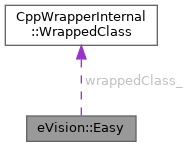
| CppWrapperInternal::WrappedClass | wrappedClass_ |
This class contains static properties and methods specific to the Easy library.
License(s): BasicTypes
|
static |
Checks if a given license is available.
| license | The license to check |
License(s): None
|
static |
Check if at least one license is available. Otherwise, an exception is thrown.
|
static |
Checks if the OEM key, if any, matches a given argument.
| key | The expected value of the OEM key |
| type | The EDongleType for which you want to check the OEM key. |
The length of the OEM key must be in [8, 64] characters.
|
static |
Checks if the OEM key, if any, matches a given argument.
| key | The expected value of the OEM key |
| type | The EDongleType for which you want to check the OEM key. |
| dongleIndex | The index of the dongle where the OEM key is expected. By default, the first dongle found is selected. |
The length of the OEM key must be in [8, 64] characters.
|
static |
Checks if the OEM key, if any, matches a given argument.
| keyIndex | The index of the key in the array of keys, must be in [0, 11]. This option is not compatible with EDongleType::EDongleType_Legacy |
| key | The expected value of the OEM key |
| type | The EDongleType for which you want to check the OEM key. |
The length of the OEM key must be in [8, 64] characters.
|
static |
Checks if the OEM key, if any, matches a given argument.
| keyIndex | The index of the key in the array of keys, must be in [0, 11]. This option is not compatible with EDongleType::EDongleType_Legacy |
| key | The expected value of the OEM key |
| type | The EDongleType for which you want to check the OEM key. |
| dongleIndex | The index of the dongle where the OEM key is expected. By default, the first dongle found is selected. |
The length of the OEM key must be in [8, 64] characters.
|
static |
Releases the device context associated to an image.
| pImage | Pointer to the target image (must be the same as that passed to Easy::OpenImageGraphicContext). |
| hDC | Handle to a device context that was produced by Easy::OpenImageGraphicContext. |
Use EWindowsDrawAdapter class by passing an image to its constructor instead.
Deprecated in version 23.12. Scheduled to be removed in version 27.6.
|
static |
Releases the device context associated to an image.
| pImage | Pointer to the target image (must be the same as that passed to Easy::OpenImageGraphicContext). |
| hDC | Handle to a device context that was produced by Easy::OpenImageGraphicContext. |
Use EWindowsDrawAdapter class by passing an image to its constructor instead.
Deprecated in version 23.12. Scheduled to be removed in version 27.6.
|
static |
Ensures eVision is initialized.
As of eVision 24.06, the initialization of eVision is fully automatic and implicit as the first call to any method of the library in all programming languages. This method performs no specific operation by itself, and it is never necessary to call it prior to using eVision. Its only use is to ensure that the eVision DLL is correctly loaded outside of code dedicated to computations in order to help isolate potential eVision installation problems.
Also see Easy::CheckLicenses that additionally check that licenses are correctly installed on the machine.
License(s): None
|
static |
Returns the angle, converted from degrees to the current angle unit.
| angle | Angle to be converted |
|
static |
Returns the angle, converted from radians to the current angle unit.
| angle | Angle to be converted |
|
static |
Current angular unit.
All angles are computed using some angular unit, as well on input as on output. The desired unit can be changed at any time. By default, all angles are given in degrees (0..360).
If you wish to use another Angle Unit than the default one (degrees), you must set the Angle Unit in each of your threads.
|
static |
Returns the best matching image type for a given file on disk among EImageType::EImageType_BW8, EImageType::EImageType_BW16, EImageType::EImageType_BW32, EImageType::EImageType_BW32f, EImageType::EImageType_C24, EImageType::EImageType_C24A, EImageType::EImageType_C48.
| path | The path to the file on disk. |
|
static |
Returns the best matching image type for a given file on disk among EImageType::EImageType_BW8, EImageType::EImageType_BW16, EImageType::EImageType_BW32, EImageType::EImageType_BW32f, EImageType::EImageType_C24, EImageType::EImageType_C24A, EImageType::EImageType_C48.
| path | The path to the file on disk. |
| constrainToBW8AndC24 | Constrain the image type to be either EImageType::EImageType_BW8 or EImageType::EImageType_C24. False by default. |
|
static |
Retrieves the deep learning additional resources installation path.
The deep learning additional resources are installed through their own installer, available on euresys website.
|
static |
Get the number of available dongle on the system.
| type | The EDongleType you want to enumerate. |
|
static |
Get the serial number of the selected dongle.
| type | The EDongleType. |
| index | The index of the dongle. |
|
static |
The enhanced mode for displaying the images.
When enabled, enhanced mode performs advanced interpolation for image display. By default, enhanced mode is disabled. Enhanced mode has a significant impact on drawing performances. Enhanced display mode is set for the current thread.
|
static |
CUDA compute capability for the specified GPU.
| gpuId | Index of the GPU between 0 and Easy::GetNumGPUs - 1. |
|
static |
Name of the GPU.
| gpuId | Index of the GPU between 0 and Easy::GetNumGPUs - 1. |
|
static |
Gets the handle size. Handle size is used when drawing or when hit testing.
|
static |
Gets the sources of a single license.
This will work for a single license only. If you try to pass a license mask, it will fail.
License(s): None
|
static |
Maximum number of threads used internally by the eVision tools (default value: 1). This number cannot be higher than the number of processor cores available to the system. See Easy::GetNumberOfAvailableProcessorCores. This value is thread local. It means that this value can be controlled independently for each thread you create.
|
static |
Number of processor cores available to the system. This is the upper limit for the number of threads usable internally by the eVision tools. See Easy::SetMaxNumberOfProcessingThreads.
|
static |
Number of GPUs available to the system.
|
static |
Gets the URL to the online eVision documentation.
|
static |
Retrieves the resources installation path.
|
static |
Retrieves the sample images installation path.
|
static |
Retrieves the sample programs installation path.
|
static |
|
static |
Checks that eVision is correctly installed with a required dependencies and throws an exception if that's not the case.
License(s): None
|
static |
Checks that eVision is correctly installed with a required dependencies and throws an exception if that's not the case.
| checkDeepLearningDependencies | If false, this function will only check the base installation and dependencies of eVision. |
It true, it will also check the proper installation and dependencies of the eVision Deep Learning Dependencies.
License(s): None
|
static |
Initializes eVision.
License(s): None
Library initialization is now performed automatically. This method doesn't perform any operation anymore. You can use Easy::EnsureInitialized instead to ensure eVision's DLL is properly loaded or Easy::CheckLicenses to also check that licenses are correctly installed.
Deprecated in version 24.6. Scheduled to be removed in version 27.6.
|
static |
Indicates if a supported GPU is available for eVision computation.
|
static |
Logs a message in eGrabber Memento.
| message | The message to log. |
The default verbosity level is EVerbosity_Info and the default user ID is 0. For more information about how Memento handles messages, please refer to the Memento documentation.
|
static |
Logs a message in eGrabber Memento.
| message | The message to log. |
| verbosity | The verbosity level of the message. |
The default verbosity level is EVerbosity_Info and the default user ID is 0. For more information about how Memento handles messages, please refer to the Memento documentation.
|
static |
Logs a message in eGrabber Memento.
| message | The message to log. |
| verbosity | The verbosity level of the message. |
| user | The user index, from 0 to 15 |
The default verbosity level is EVerbosity_Info and the default user ID is 0. For more information about how Memento handles messages, please refer to the Memento documentation.
|
static |
Allows to draw in a gray-level or a color image, using any of the Windows device context functions (the image contents is altered, allowing destructive overlays).
| pImage | Pointer to the target image. |
The function returns a handle to a device context associated to the image pixel data. When the device context is no more needed, call the Easy::CloseImageGraphicContext function with the same argument.
Use EWindowsDrawAdapter class by passing an image to its constructor instead.
Deprecated in version 23.12. Scheduled to be removed in version 27.6.
|
static |
Allows to draw in a gray-level or a color image, using any of the Windows device context functions (the image contents is altered, allowing destructive overlays).
| pImage | Pointer to the target image. |
The function returns a handle to a device context associated to the image pixel data. When the device context is no more needed, call the Easy::CloseImageGraphicContext function with the same argument.
Use EWindowsDrawAdapter class by passing an image to its constructor instead.
Deprecated in version 23.12. Scheduled to be removed in version 27.6.
|
static |
Set a specific resources path.
|
static |
Prepares a three-dimensional rendering of an image where the gray-level values are taken for altitudes.
| sourceImage | Pointer to the source image. |
| destinationImage | Pointer to the destination image. |
| phi | Rotation angle about the X-axis. |
| psi | Rotation angle about the Y-axis. |
The image is viewed by rotating it about the X-axis, then about the Y-axis. Magnification factors in the three directions (X = width, Y = height, and Z = depth) can be given.
The rendered image appears as independent dots. The dot size can be adjusted so that the surface appears more or less opaque.
The function does not display the rendered image by itself. Rather, it prepares a destination image to be displayed.
|
static |
Prepares a three-dimensional rendering of an image where the gray-level values are taken for altitudes.
| sourceImage | Pointer to the source image. |
| destinationImage | Pointer to the destination image. |
| phi | Rotation angle about the X-axis. |
| psi | Rotation angle about the Y-axis. |
| xScale | Magnification factor along X (should remain close to 1). |
The image is viewed by rotating it about the X-axis, then about the Y-axis. Magnification factors in the three directions (X = width, Y = height, and Z = depth) can be given.
The rendered image appears as independent dots. The dot size can be adjusted so that the surface appears more or less opaque.
The function does not display the rendered image by itself. Rather, it prepares a destination image to be displayed.
|
static |
Prepares a three-dimensional rendering of an image where the gray-level values are taken for altitudes.
| sourceImage | Pointer to the source image. |
| destinationImage | Pointer to the destination image. |
| phi | Rotation angle about the X-axis. |
| psi | Rotation angle about the Y-axis. |
| xScale | Magnification factor along X (should remain close to 1). |
| yScale | Magnification factor along Y (should remain close to 1). |
The image is viewed by rotating it about the X-axis, then about the Y-axis. Magnification factors in the three directions (X = width, Y = height, and Z = depth) can be given.
The rendered image appears as independent dots. The dot size can be adjusted so that the surface appears more or less opaque.
The function does not display the rendered image by itself. Rather, it prepares a destination image to be displayed.
|
static |
Prepares a three-dimensional rendering of an image where the gray-level values are taken for altitudes.
| sourceImage | Pointer to the source image. |
| destinationImage | Pointer to the destination image. |
| phi | Rotation angle about the X-axis. |
| psi | Rotation angle about the Y-axis. |
| xScale | Magnification factor along X (should remain close to 1). |
| yScale | Magnification factor along Y (should remain close to 1). |
| zScale | Magnification factor along Z (should remain close to 1). |
The image is viewed by rotating it about the X-axis, then about the Y-axis. Magnification factors in the three directions (X = width, Y = height, and Z = depth) can be given.
The rendered image appears as independent dots. The dot size can be adjusted so that the surface appears more or less opaque.
The function does not display the rendered image by itself. Rather, it prepares a destination image to be displayed.
|
static |
Prepares a three-dimensional rendering of an image where the gray-level values are taken for altitudes.
| sourceImage | Pointer to the source image. |
| destinationImage | Pointer to the destination image. |
| phi | Rotation angle about the X-axis. |
| psi | Rotation angle about the Y-axis. |
| xScale | Magnification factor along X (should remain close to 1). |
| yScale | Magnification factor along Y (should remain close to 1). |
| zScale | Magnification factor along Z (should remain close to 1). |
| dotSize | Size of the rendered dots; allowed values are 1, 4, 5 or 9. |
The image is viewed by rotating it about the X-axis, then about the Y-axis. Magnification factors in the three directions (X = width, Y = height, and Z = depth) can be given.
The rendered image appears as independent dots. The dot size can be adjusted so that the surface appears more or less opaque.
The function does not display the rendered image by itself. Rather, it prepares a destination image to be displayed.
|
static |
Prepares a three-dimensional rendering of an image where the gray-level values are taken for altitudes.
| sourceImage | Pointer to the source image. |
| zImage | Pointer to the altitude image. |
| destinationImage | Pointer to the destination image. |
| phi | Rotation angle about the X-axis. |
| psi | Rotation angle about the Y-axis. |
The image is viewed by rotating it about the X-axis, then about the Y-axis. Magnification factors in the three directions (X = width, Y = height, and Z = depth) can be given.
The rendered image appears as independent dots. The dot size can be adjusted so that the surface appears more or less opaque.
The function does not display the rendered image by itself. Rather, it prepares a destination image to be displayed.
|
static |
Prepares a three-dimensional rendering of an image where the gray-level values are taken for altitudes.
| sourceImage | Pointer to the source image. |
| zImage | Pointer to the altitude image. |
| destinationImage | Pointer to the destination image. |
| phi | Rotation angle about the X-axis. |
| psi | Rotation angle about the Y-axis. |
| xScale | Magnification factor along X (should remain close to 1). |
The image is viewed by rotating it about the X-axis, then about the Y-axis. Magnification factors in the three directions (X = width, Y = height, and Z = depth) can be given.
The rendered image appears as independent dots. The dot size can be adjusted so that the surface appears more or less opaque.
The function does not display the rendered image by itself. Rather, it prepares a destination image to be displayed.
|
static |
Prepares a three-dimensional rendering of an image where the gray-level values are taken for altitudes.
| sourceImage | Pointer to the source image. |
| zImage | Pointer to the altitude image. |
| destinationImage | Pointer to the destination image. |
| phi | Rotation angle about the X-axis. |
| psi | Rotation angle about the Y-axis. |
| xScale | Magnification factor along X (should remain close to 1). |
| yScale | Magnification factor along Y (should remain close to 1). |
The image is viewed by rotating it about the X-axis, then about the Y-axis. Magnification factors in the three directions (X = width, Y = height, and Z = depth) can be given.
The rendered image appears as independent dots. The dot size can be adjusted so that the surface appears more or less opaque.
The function does not display the rendered image by itself. Rather, it prepares a destination image to be displayed.
|
static |
Prepares a three-dimensional rendering of an image where the gray-level values are taken for altitudes.
| sourceImage | Pointer to the source image. |
| zImage | Pointer to the altitude image. |
| destinationImage | Pointer to the destination image. |
| phi | Rotation angle about the X-axis. |
| psi | Rotation angle about the Y-axis. |
| xScale | Magnification factor along X (should remain close to 1). |
| yScale | Magnification factor along Y (should remain close to 1). |
| zScale | Magnification factor along Z (should remain close to 1). |
The image is viewed by rotating it about the X-axis, then about the Y-axis. Magnification factors in the three directions (X = width, Y = height, and Z = depth) can be given.
The rendered image appears as independent dots. The dot size can be adjusted so that the surface appears more or less opaque.
The function does not display the rendered image by itself. Rather, it prepares a destination image to be displayed.
|
static |
Prepares a three-dimensional rendering of an image where the gray-level values are taken for altitudes.
| sourceImage | Pointer to the source image. |
| zImage | Pointer to the altitude image. |
| destinationImage | Pointer to the destination image. |
| phi | Rotation angle about the X-axis. |
| psi | Rotation angle about the Y-axis. |
| xScale | Magnification factor along X (should remain close to 1). |
| yScale | Magnification factor along Y (should remain close to 1). |
| zScale | Magnification factor along Z (should remain close to 1). |
| dotSize | Size of the rendered dots; allowed values are 1, 4, 5 or 9. |
The image is viewed by rotating it about the X-axis, then about the Y-axis. Magnification factors in the three directions (X = width, Y = height, and Z = depth) can be given.
The rendered image appears as independent dots. The dot size can be adjusted so that the surface appears more or less opaque.
The function does not display the rendered image by itself. Rather, it prepares a destination image to be displayed.
|
static |
Prepares a three-dimensional rendering of the histogram of a color image: the pixels are drawn in the RGB space rather than in the XY plane.
| sourceImage | Pointer to the raw source image. |
| destinationImage | Pointer to the destination image. |
| phi | Rotation angle about the X-axis. |
| psi | Rotation angle about the Y-axis. |
This allows to observe the clustering and dispersion of the RGB values. The image is viewed by rotating it about the X-axis, then about the Y-axis. Magnification factors in the three directions (X = Red, Y = Green, and Z = Blue) can be given.
In a more advanced version, prepares a three-dimensional rendering of the pixels in another system than RGB (EasyColor provides conversion means). However, the raw RGB image must still be provided to allow the display of the pixels in their usual colors. The rendered image appears as independent dots. The function does not display the rendered image by itself. Rather, it prepares a destination image to be displayed.
|
static |
Prepares a three-dimensional rendering of the histogram of a color image: the pixels are drawn in the RGB space rather than in the XY plane.
| sourceImage | Pointer to the raw source image. |
| destinationImage | Pointer to the destination image. |
| phi | Rotation angle about the X-axis. |
| psi | Rotation angle about the Y-axis. |
| xScale | Magnification factor along X (should remain close to 1). |
This allows to observe the clustering and dispersion of the RGB values. The image is viewed by rotating it about the X-axis, then about the Y-axis. Magnification factors in the three directions (X = Red, Y = Green, and Z = Blue) can be given.
In a more advanced version, prepares a three-dimensional rendering of the pixels in another system than RGB (EasyColor provides conversion means). However, the raw RGB image must still be provided to allow the display of the pixels in their usual colors. The rendered image appears as independent dots. The function does not display the rendered image by itself. Rather, it prepares a destination image to be displayed.
|
static |
Prepares a three-dimensional rendering of the histogram of a color image: the pixels are drawn in the RGB space rather than in the XY plane.
| sourceImage | Pointer to the raw source image. |
| destinationImage | Pointer to the destination image. |
| phi | Rotation angle about the X-axis. |
| psi | Rotation angle about the Y-axis. |
| xScale | Magnification factor along X (should remain close to 1). |
| yScale | Magnification factor along Y (should remain close to 1). |
This allows to observe the clustering and dispersion of the RGB values. The image is viewed by rotating it about the X-axis, then about the Y-axis. Magnification factors in the three directions (X = Red, Y = Green, and Z = Blue) can be given.
In a more advanced version, prepares a three-dimensional rendering of the pixels in another system than RGB (EasyColor provides conversion means). However, the raw RGB image must still be provided to allow the display of the pixels in their usual colors. The rendered image appears as independent dots. The function does not display the rendered image by itself. Rather, it prepares a destination image to be displayed.
|
static |
Prepares a three-dimensional rendering of the histogram of a color image: the pixels are drawn in the RGB space rather than in the XY plane.
| sourceImage | Pointer to the raw source image. |
| destinationImage | Pointer to the destination image. |
| phi | Rotation angle about the X-axis. |
| psi | Rotation angle about the Y-axis. |
| xScale | Magnification factor along X (should remain close to 1). |
| yScale | Magnification factor along Y (should remain close to 1). |
| zScale | Magnification factor along Z (should remain close to 1). |
This allows to observe the clustering and dispersion of the RGB values. The image is viewed by rotating it about the X-axis, then about the Y-axis. Magnification factors in the three directions (X = Red, Y = Green, and Z = Blue) can be given.
In a more advanced version, prepares a three-dimensional rendering of the pixels in another system than RGB (EasyColor provides conversion means). However, the raw RGB image must still be provided to allow the display of the pixels in their usual colors. The rendered image appears as independent dots. The function does not display the rendered image by itself. Rather, it prepares a destination image to be displayed.
|
static |
Prepares a three-dimensional rendering of the histogram of a color image: the pixels are drawn in the RGB space rather than in the XY plane.
| sourceImage | Pointer to the raw source image. |
| sysImage | Pointer to the source image transformed into another color system. |
| destinationImage | Pointer to the destination image. |
| phi | Rotation angle about the X-axis. |
| psi | Rotation angle about the Y-axis. |
This allows to observe the clustering and dispersion of the RGB values. The image is viewed by rotating it about the X-axis, then about the Y-axis. Magnification factors in the three directions (X = Red, Y = Green, and Z = Blue) can be given.
In a more advanced version, prepares a three-dimensional rendering of the pixels in another system than RGB (EasyColor provides conversion means). However, the raw RGB image must still be provided to allow the display of the pixels in their usual colors. The rendered image appears as independent dots. The function does not display the rendered image by itself. Rather, it prepares a destination image to be displayed.
|
static |
Prepares a three-dimensional rendering of the histogram of a color image: the pixels are drawn in the RGB space rather than in the XY plane.
| sourceImage | Pointer to the raw source image. |
| sysImage | Pointer to the source image transformed into another color system. |
| destinationImage | Pointer to the destination image. |
| phi | Rotation angle about the X-axis. |
| psi | Rotation angle about the Y-axis. |
| xScale | Magnification factor along X (should remain close to 1). |
This allows to observe the clustering and dispersion of the RGB values. The image is viewed by rotating it about the X-axis, then about the Y-axis. Magnification factors in the three directions (X = Red, Y = Green, and Z = Blue) can be given.
In a more advanced version, prepares a three-dimensional rendering of the pixels in another system than RGB (EasyColor provides conversion means). However, the raw RGB image must still be provided to allow the display of the pixels in their usual colors. The rendered image appears as independent dots. The function does not display the rendered image by itself. Rather, it prepares a destination image to be displayed.
|
static |
Prepares a three-dimensional rendering of the histogram of a color image: the pixels are drawn in the RGB space rather than in the XY plane.
| sourceImage | Pointer to the raw source image. |
| sysImage | Pointer to the source image transformed into another color system. |
| destinationImage | Pointer to the destination image. |
| phi | Rotation angle about the X-axis. |
| psi | Rotation angle about the Y-axis. |
| xScale | Magnification factor along X (should remain close to 1). |
| yScale | Magnification factor along Y (should remain close to 1). |
This allows to observe the clustering and dispersion of the RGB values. The image is viewed by rotating it about the X-axis, then about the Y-axis. Magnification factors in the three directions (X = Red, Y = Green, and Z = Blue) can be given.
In a more advanced version, prepares a three-dimensional rendering of the pixels in another system than RGB (EasyColor provides conversion means). However, the raw RGB image must still be provided to allow the display of the pixels in their usual colors. The rendered image appears as independent dots. The function does not display the rendered image by itself. Rather, it prepares a destination image to be displayed.
|
static |
Prepares a three-dimensional rendering of the histogram of a color image: the pixels are drawn in the RGB space rather than in the XY plane.
| sourceImage | Pointer to the raw source image. |
| sysImage | Pointer to the source image transformed into another color system. |
| destinationImage | Pointer to the destination image. |
| phi | Rotation angle about the X-axis. |
| psi | Rotation angle about the Y-axis. |
| xScale | Magnification factor along X (should remain close to 1). |
| yScale | Magnification factor along Y (should remain close to 1). |
| zScale | Magnification factor along Z (should remain close to 1). |
This allows to observe the clustering and dispersion of the RGB values. The image is viewed by rotating it about the X-axis, then about the Y-axis. Magnification factors in the three directions (X = Red, Y = Green, and Z = Blue) can be given.
In a more advanced version, prepares a three-dimensional rendering of the pixels in another system than RGB (EasyColor provides conversion means). However, the raw RGB image must still be provided to allow the display of the pixels in their usual colors. The rendered image appears as independent dots. The function does not display the rendered image by itself. Rather, it prepares a destination image to be displayed.
|
static |
Resizes an image without interpolation.
| sourceImage | Pointer to the source image/ROI. |
| destinationImage | Pointer to the destination image/ROI. |
|
static |
Resizes an image without interpolation.
| sourceImage | Pointer to the source image/ROI. |
| destinationImage | Pointer to the destination image/ROI. |
|
static |
Resizes an image without interpolation.
| sourceImage | Pointer to the source image/ROI. |
| destinationImage | Pointer to the destination image/ROI. |
|
static |
Resizes an image without interpolation.
| sourceImage | Pointer to the source image/ROI. |
| destinationImage | Pointer to the destination image/ROI. |
|
static |
Current angular unit.
All angles are computed using some angular unit, as well on input as on output. The desired unit can be changed at any time. By default, all angles are given in degrees (0..360).
If you wish to use another Angle Unit than the default one (degrees), you must set the Angle Unit in each of your threads.
|
static |
The enhanced mode for displaying the images.
| state | Set to true to enable enhanced display mode. |
When enabled, enhanced mode performs advanced interpolation for image display. By default, enhanced mode is disabled. Enhanced mode has a significant impact on drawing performances. Enhanced display mode is set for the current thread.
|
static |
Sets the handle size. Handle size is used when drawing or when hit testing.
|
static |
Maximum number of threads used internally by the eVision tools (default value: 1). This number cannot be higher than the number of processor cores available to the system. See Easy::GetNumberOfAvailableProcessorCores. This value is thread local. It means that this value can be controlled independently for each thread you create.
|
static |
Writes an OEM key value on a dongle.
| key | The OEM key value to write |
| type | The EDongleType for which you want to set the OEM key. |
The length of the OEM key must be in [8, 64] characters. This method raises an EError::EError_CannotWriteOEMKey error if the value cannot be set properly.
|
static |
Writes an OEM key value on a dongle.
| key | The OEM key value to write |
| type | The EDongleType for which you want to set the OEM key. |
| dongleIndex | The index of the dongle where the OEM key must be written. By default, the first dongle found is selected. |
The length of the OEM key must be in [8, 64] characters. This method raises an EError::EError_CannotWriteOEMKey error if the value cannot be set properly.
|
static |
Writes an OEM key value on a dongle.
| keyIndex | The index of the key in the array of keys, must be in [0, 11]. This option is not compatible with EDongleType::EDongleType_Legacy |
| key | The OEM key value to write |
| type | The EDongleType for which you want to set the OEM key. |
The length of the OEM key must be in [8, 64] characters. This method raises an EError::EError_CannotWriteOEMKey error if the value cannot be set properly.
|
static |
Writes an OEM key value on a dongle.
| keyIndex | The index of the key in the array of keys, must be in [0, 11]. This option is not compatible with EDongleType::EDongleType_Legacy |
| key | The OEM key value to write |
| type | The EDongleType for which you want to set the OEM key. |
| dongleIndex | The index of the dongle where the OEM key must be written. By default, the first dongle found is selected. |
The length of the OEM key must be in [8, 64] characters. This method raises an EError::EError_CannotWriteOEMKey error if the value cannot be set properly.
|
static |
Starts timing, using the system clock or performance counter.
|
static |
Returns the time, in specified time units, elapsed since the last invocation of Easy::StartTiming.
|
static |
Returns the time, in specified time units, elapsed since the last invocation of Easy::StartTiming.
| resolution | Temporal resolution, in ticks per second. |
|
static |
Method not obligatory, but necessary for close dll cleanly.
License(s): None
Library termination is now performed automatically. This method has no use anymore.
Deprecated in version 24.6. Scheduled to be removed in version 27.6.
|
static |
Returns the angle, converted from current angle unit to degrees.
| angle | Angle to be converted. |
|
static |
Returns the angle, converted from current angle unit to radians.
| angle | Angle to be converted. |
|
static |
Returns the actual resolution of the timing clock, in ticks per seconds.
Timing granularity is hardware-dependent, but is usually better than 1 microsecond. This function can be used to select an appropriate timing resolution when using Easy::StopTiming.
| CppWrapperInternal::WrappedClass eVision::Easy::wrappedClass_ |
 1.17.0