 |
eVision C++ API 26.10.0-beta.2.dev
|
|
eVision C++ API 26.10.0-beta.2.dev
|
Vector objects are used to store 1-dimensional data. More...
#include <eVision/Easy/EBW16Vector.h>
Public Member Functions | |
| EBW16Vector () | |
| Constructs a vector. | |
| EBW16Vector (uint32_t maxNumberOfElements) | |
| Constructs a vector. | |
| EBW16Vector (const eVision::EBW16Vector &other) | |
| Constructs a vector. | |
| virtual | ~EBW16Vector () throw () |
| eVision::EBW16 & | operator[] (uint32_t index) const |
| Gives access to the vector element at the given index. | |
| eVision::EBW16Vector & | operator= (const eVision::EBW16Vector &other) |
| Copies all the data from another EBW16Vector object into the current EBW16Vector object. | |
| void * | GetRawDataPtr () const |
| Pointer to the vector data. | |
| void | AddElement (eVision::EBW16 element) |
| Appends (adds at the tail) an element to the vector. | |
| eVision::EBW16 | GetElement (int32_t index) const |
| Returns the vector element at the given index. | |
| void | SetElement (int32_t index, eVision::EBW16 value) |
| Modifies the vector element at the given index by the given value. | |
| void | SetYRange (int32_t n32YMin, uint32_t un32YMax) |
| void | SetYRange (int32_t n32YMin) |
| void | SetYRange () |
| void | Draw (eVision::EDrawAdapter *graphicContext, float width, float height, float originX, float originY) const |
| Draws a plot of the vector element values. | |
| void | Draw (eVision::EDrawAdapter *graphicContext, float width, float height, float originX) const |
| Draws a plot of the vector element values. | |
| void | Draw (eVision::EDrawAdapter *graphicContext, float width, float height) const |
| Draws a plot of the vector element values. | |
| void | Draw (HDC graphicContext, float width, float height, float originX, float originY) const |
| Draws a plot of the vector element values. | |
| void | Draw (HDC graphicContext, float width, float height, float originX) const |
| Draws a plot of the vector element values. | |
| void | Draw (HDC graphicContext, float width, float height) const |
| Draws a plot of the vector element values. | |
| void | Draw (HDC graphicContext, const eVision::ERGBColor &color, float width, float height, float originX, float originY) const |
| Draws a plot of the vector element values. | |
| void | Draw (HDC graphicContext, const eVision::ERGBColor &color, float width, float height, float originX) const |
| Draws a plot of the vector element values. | |
| void | Draw (HDC graphicContext, const eVision::ERGBColor &color, float width, float height) const |
| Draws a plot of the vector element values. | |
| void | DrawWithCurrentPen (HDC graphicContext, float width, float height, float originX, float originY) const |
| Draws a plot of the vector element values. | |
| void | DrawWithCurrentPen (HDC graphicContext, float width, float height, float originX) const |
| Draws a plot of the vector element values. | |
| void | DrawWithCurrentPen (HDC graphicContext, float width, float height) const |
| Draws a plot of the vector element values. | |
| float | WeightedMoment (uint32_t from, uint32_t to) |
| Returns the first order geometric moment (weighted gravity center). | |
| float | WeightedMoment (uint32_t from) |
| Returns the first order geometric moment (weighted gravity center). | |
| float | WeightedMoment () |
| Returns the first order geometric moment (weighted gravity center). | |
| EBW16Vector (CppWrapperInternal::InternalConstructor) | |
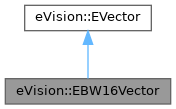
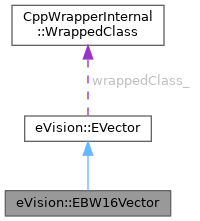
| Public Member Functions inherited from eVision::EVector | |
| virtual | ~EVector () throw () |
| uint32_t | GetNumElements () const |
| Number of elements in the vector. | |
| void | SetNumElements (uint32_t un32NumElements) |
| Number of elements in the vector. | |
| void | Empty () |
| Resets the number of elements to 0. | |
| virtual void | RemoveElement (uint32_t index) |
| Removes the element at the specified position. | |
| void | Save (const std::string &path) |
| Saves the EVector object with all its attributes. | |
| void | Save (eVision::ESerializer *serializer) |
| Saves the EVector object with all its attributes. | |
| void | Save (const std::string &path, uint32_t un32Version) |
| Saves the EVector object with all its attributes. | |
| void | Save (eVision::ESerializer *serializer, uint32_t un32Version) |
| Saves the EVector object with all its attributes. | |
| void | Load (const std::string &path) |
| Loads the EVector object with all its attributes. | |
| void | Load (eVision::ESerializer *serializer) |
| Loads the EVector object with all its attributes. | |
| void | Load (const std::string &path, uint32_t un32Version) |
| Loads the EVector object with all its attributes. | |
| void | Load (eVision::ESerializer *serializer, uint32_t un32Version) |
| Loads the EVector object with all its attributes. | |
| EVector (CppWrapperInternal::InternalConstructor) | |
Additional Inherited Members | |
| Public Attributes inherited from eVision::EVector | |
| CppWrapperInternal::WrappedClass | wrappedClass_ |
Vector objects are used to store 1-dimensional data.
Using vectors is very similar to using 1-dimensional arrays, except that the size can vary at runtime. Memory allocation is handled internally.
License(s): BasicTypes
| eVision::EBW16Vector::EBW16Vector | ( | ) |
Constructs a vector.
| eVision::EBW16Vector::EBW16Vector | ( | uint32_t | maxNumberOfElements | ) |
Constructs a vector.
| maxNumberOfElements | Optionally, memory can be pre-allocated to accommodate a given number of elements. |
| eVision::EBW16Vector::EBW16Vector | ( | const eVision::EBW16Vector & | other | ) |
Constructs a vector.
| other | EBW16Vector object to be copied |
|
virtual | ||||||||||||
| eVision::EBW16Vector::EBW16Vector | ( | CppWrapperInternal::InternalConstructor | ) |
| void eVision::EBW16Vector::AddElement | ( | eVision::EBW16 | element | ) |
Appends (adds at the tail) an element to the vector.
| element | The element to be added. |
| void eVision::EBW16Vector::Draw | ( | eVision::EDrawAdapter * | graphicContext, |
| float | width, | ||
| float | height ) const |
Draws a plot of the vector element values.
| graphicContext | Handle of the device context on which to draw. |
| width | Outermost horizontal size, in pixels. |
| height | Outermost vertical size, in pixels. |
A vector is able to draw itself in a window. The vector plots the element values as a function of the element indices. The drawing appears on a neutral background. Drawing is done in the device context associated to the desired window. To draw the curves, the current pen is used. To draw the annotations, a black pen is used instead.
| void eVision::EBW16Vector::Draw | ( | eVision::EDrawAdapter * | graphicContext, |
| float | width, | ||
| float | height, | ||
| float | originX ) const |
Draws a plot of the vector element values.
| graphicContext | Handle of the device context on which to draw. |
| width | Outermost horizontal size, in pixels. |
| height | Outermost vertical size, in pixels. |
| originX | Abscissa of the upper left corner of the plot's bounding rectangle, in pixels. By default, the upper left corner of the window is used. |
A vector is able to draw itself in a window. The vector plots the element values as a function of the element indices. The drawing appears on a neutral background. Drawing is done in the device context associated to the desired window. To draw the curves, the current pen is used. To draw the annotations, a black pen is used instead.
| void eVision::EBW16Vector::Draw | ( | eVision::EDrawAdapter * | graphicContext, |
| float | width, | ||
| float | height, | ||
| float | originX, | ||
| float | originY ) const |
Draws a plot of the vector element values.
| graphicContext | Handle of the device context on which to draw. |
| width | Outermost horizontal size, in pixels. |
| height | Outermost vertical size, in pixels. |
| originX | Abscissa of the upper left corner of the plot's bounding rectangle, in pixels. By default, the upper left corner of the window is used. |
| originY | Ordinate of the upper left corner of the plot's bounding rectangle, in pixels. By default, the upper left corner of the window is used. |
A vector is able to draw itself in a window. The vector plots the element values as a function of the element indices. The drawing appears on a neutral background. Drawing is done in the device context associated to the desired window. To draw the curves, the current pen is used. To draw the annotations, a black pen is used instead.
| void eVision::EBW16Vector::Draw | ( | HDC | graphicContext, |
| const eVision::ERGBColor & | color, | ||
| float | width, | ||
| float | height ) const |
Draws a plot of the vector element values.
| graphicContext | Handle of the device context on which to draw. |
| color | The color in which to draw the overlay. |
| width | Outermost horizontal size, in pixels. |
| height | Outermost vertical size, in pixels. |
A vector is able to draw itself in a window. The vector plots the element values as a function of the element indices. The drawing appears on a neutral background. Drawing is done in the device context associated to the desired window. To draw the curves, the current pen is used. To draw the annotations, a black pen is used instead.
| void eVision::EBW16Vector::Draw | ( | HDC | graphicContext, |
| const eVision::ERGBColor & | color, | ||
| float | width, | ||
| float | height, | ||
| float | originX ) const |
Draws a plot of the vector element values.
| graphicContext | Handle of the device context on which to draw. |
| color | The color in which to draw the overlay. |
| width | Outermost horizontal size, in pixels. |
| height | Outermost vertical size, in pixels. |
| originX | Abscissa of the upper left corner of the plot's bounding rectangle, in pixels. By default, the upper left corner of the window is used. |
A vector is able to draw itself in a window. The vector plots the element values as a function of the element indices. The drawing appears on a neutral background. Drawing is done in the device context associated to the desired window. To draw the curves, the current pen is used. To draw the annotations, a black pen is used instead.
| void eVision::EBW16Vector::Draw | ( | HDC | graphicContext, |
| const eVision::ERGBColor & | color, | ||
| float | width, | ||
| float | height, | ||
| float | originX, | ||
| float | originY ) const |
Draws a plot of the vector element values.
| graphicContext | Handle of the device context on which to draw. |
| color | The color in which to draw the overlay. |
| width | Outermost horizontal size, in pixels. |
| height | Outermost vertical size, in pixels. |
| originX | Abscissa of the upper left corner of the plot's bounding rectangle, in pixels. By default, the upper left corner of the window is used. |
| originY | Ordinate of the upper left corner of the plot's bounding rectangle, in pixels. By default, the upper left corner of the window is used. |
A vector is able to draw itself in a window. The vector plots the element values as a function of the element indices. The drawing appears on a neutral background. Drawing is done in the device context associated to the desired window. To draw the curves, the current pen is used. To draw the annotations, a black pen is used instead.
| void eVision::EBW16Vector::Draw | ( | HDC | graphicContext, |
| float | width, | ||
| float | height ) const |
Draws a plot of the vector element values.
| graphicContext | Handle of the device context on which to draw. |
| width | Outermost horizontal size, in pixels. |
| height | Outermost vertical size, in pixels. |
A vector is able to draw itself in a window. The vector plots the element values as a function of the element indices. The drawing appears on a neutral background. Drawing is done in the device context associated to the desired window. To draw the curves, the current pen is used. To draw the annotations, a black pen is used instead.
| void eVision::EBW16Vector::Draw | ( | HDC | graphicContext, |
| float | width, | ||
| float | height, | ||
| float | originX ) const |
Draws a plot of the vector element values.
| graphicContext | Handle of the device context on which to draw. |
| width | Outermost horizontal size, in pixels. |
| height | Outermost vertical size, in pixels. |
| originX | Abscissa of the upper left corner of the plot's bounding rectangle, in pixels. By default, the upper left corner of the window is used. |
A vector is able to draw itself in a window. The vector plots the element values as a function of the element indices. The drawing appears on a neutral background. Drawing is done in the device context associated to the desired window. To draw the curves, the current pen is used. To draw the annotations, a black pen is used instead.
| void eVision::EBW16Vector::Draw | ( | HDC | graphicContext, |
| float | width, | ||
| float | height, | ||
| float | originX, | ||
| float | originY ) const |
Draws a plot of the vector element values.
| graphicContext | Handle of the device context on which to draw. |
| width | Outermost horizontal size, in pixels. |
| height | Outermost vertical size, in pixels. |
| originX | Abscissa of the upper left corner of the plot's bounding rectangle, in pixels. By default, the upper left corner of the window is used. |
| originY | Ordinate of the upper left corner of the plot's bounding rectangle, in pixels. By default, the upper left corner of the window is used. |
A vector is able to draw itself in a window. The vector plots the element values as a function of the element indices. The drawing appears on a neutral background. Drawing is done in the device context associated to the desired window. To draw the curves, the current pen is used. To draw the annotations, a black pen is used instead.
| void eVision::EBW16Vector::DrawWithCurrentPen | ( | HDC | graphicContext, |
| float | width, | ||
| float | height ) const |
Draws a plot of the vector element values.
| graphicContext | Handle of the device context on which to draw. |
| width | Outermost horizontal size, in pixels. |
| height | Outermost vertical size, in pixels. |
A vector is able to draw itself in a window. The vector plots the element values as a function of the element indices. The drawing appears on a neutral background. Drawing is done in the device context associated to the desired window. To draw the curves, the current pen is used. To draw the annotations, a black pen is used instead.
| void eVision::EBW16Vector::DrawWithCurrentPen | ( | HDC | graphicContext, |
| float | width, | ||
| float | height, | ||
| float | originX ) const |
Draws a plot of the vector element values.
| graphicContext | Handle of the device context on which to draw. |
| width | Outermost horizontal size, in pixels. |
| height | Outermost vertical size, in pixels. |
| originX | Abscissa of the upper left corner of the plot's bounding rectangle, in pixels. By default, the upper left corner of the window is used. |
A vector is able to draw itself in a window. The vector plots the element values as a function of the element indices. The drawing appears on a neutral background. Drawing is done in the device context associated to the desired window. To draw the curves, the current pen is used. To draw the annotations, a black pen is used instead.
| void eVision::EBW16Vector::DrawWithCurrentPen | ( | HDC | graphicContext, |
| float | width, | ||
| float | height, | ||
| float | originX, | ||
| float | originY ) const |
Draws a plot of the vector element values.
| graphicContext | Handle of the device context on which to draw. |
| width | Outermost horizontal size, in pixels. |
| height | Outermost vertical size, in pixels. |
| originX | Abscissa of the upper left corner of the plot's bounding rectangle, in pixels. By default, the upper left corner of the window is used. |
| originY | Ordinate of the upper left corner of the plot's bounding rectangle, in pixels. By default, the upper left corner of the window is used. |
A vector is able to draw itself in a window. The vector plots the element values as a function of the element indices. The drawing appears on a neutral background. Drawing is done in the device context associated to the desired window. To draw the curves, the current pen is used. To draw the annotations, a black pen is used instead.
| eVision::EBW16 eVision::EBW16Vector::GetElement | ( | int32_t | index | ) | const |
Returns the vector element at the given index.
| index | Index, between 0 and EVector::GetNumElements (excluded) of the element to be accessed. |
If the given index is outside the bounds of the vector, the error code EError::EError_Parameter1OutOfRange is set.
| void * eVision::EBW16Vector::GetRawDataPtr | ( | ) | const |
Pointer to the vector data.
| eVision::EBW16Vector & eVision::EBW16Vector::operator= | ( | const eVision::EBW16Vector & | other | ) |
Copies all the data from another EBW16Vector object into the current EBW16Vector object.
| other | EBW16Vector object to be copied |
| eVision::EBW16 & eVision::EBW16Vector::operator[] | ( | uint32_t | index | ) | const |
Gives access to the vector element at the given index.
| index | Index, between 0 and EVector::GetNumElements (excluded) of the element to be accessed. |
| void eVision::EBW16Vector::SetElement | ( | int32_t | index, |
| eVision::EBW16 | value ) |
Modifies the vector element at the given index by the given value.
| index | Index, between 0 and EVector::GetNumElements (excluded), of the element to be modified. |
| value | The new value for the element. |
If the given index is outside the bounds of the vector, the error code EError::EError_Parameter1OutOfRange is set.
| void eVision::EBW16Vector::SetYRange | ( | ) |
| void eVision::EBW16Vector::SetYRange | ( | int32_t | n32YMin | ) |
| void eVision::EBW16Vector::SetYRange | ( | int32_t | n32YMin, |
| uint32_t | un32YMax ) |
| float eVision::EBW16Vector::WeightedMoment | ( | ) |
Returns the first order geometric moment (weighted gravity center).
| float eVision::EBW16Vector::WeightedMoment | ( | uint32_t | from | ) |
Returns the first order geometric moment (weighted gravity center).
| from | First element of the vector portion for which the weighted moment will be calculated. By default, this is the first element of the vector. |
| float eVision::EBW16Vector::WeightedMoment | ( | uint32_t | from, |
| uint32_t | to ) |
Returns the first order geometric moment (weighted gravity center).
| from | First element of the vector portion for which the weighted moment will be calculated. By default, this is the first element of the vector. |
| to | Last element of the vector portion for which the weighted moment will be calculated. By default, this is the last element of the vector. |
 1.17.0