 |
eVision Python API
|
|
eVision Python API
|
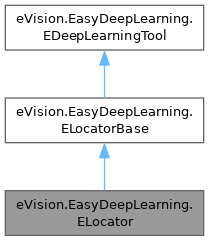
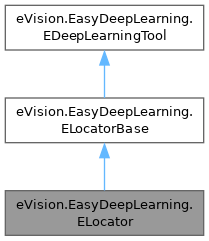
EasyLocate tool - axis aligned bounding box version. More...
Public Member Functions | |
| None | __init__ (self) |
| Constructs a eVision.EasyDeepLearning.ELocator object. | |
| None | __init__ (self, eVision.EasyDeepLearning.ELocator other) |
| Copy constructor of a eVision.EasyDeepLearning.ELocator object. | |
| None | SerializeSettings (self, eVision.ESerializer|None serializer) |
| Serializes the settings of the locator. | |
| list[eVision._eVision.ESize] | GenerateAnchors (self, eVision.EasyDeepLearning.EDataset dataset) |
| Generates anchors based on the objects in the dataset or a formal specification. | |
| list[eVision._eVision.ESize] | GenerateAnchors (self, float minDimension, float maxDimension, int numSubScales, list[float] aspectRatios) |
| Generates anchors based on the objects in the dataset or a formal specification. | |
| eVision.EasyDeepLearning.EDeepLearningToolType | ToolType (self) |
| Type of the deep learning tool. | |
| float | SameLabelMaxOverlap (self) |
| Maximum overlap (intersection over union) between two predicted objects with the same label. | |
| SameLabelMaxOverlap (self, float value) | |
| Maximum overlap (intersection over union) between two predicted objects with the same label. | |
| float | AbsoluteMaxOverlap (self) |
| Maximum overlap (intersection over union) between two predicted objects regardless of their label. | |
| AbsoluteMaxOverlap (self, float value) | |
| Maximum overlap (intersection over union) between two predicted objects regardless of their label. | |
| Public Member Functions inherited from eVision.EasyDeepLearning.ELocatorBase | |
| eVision.EasyDeepLearning.ELocatorMetrics | GetTrainingMetrics (self, int iteration) |
| Training metrics at the given iteration. | |
| eVision.EasyDeepLearning.ELocatorMetrics | GetValidationMetrics (self, int iteration) |
| Validation metrics at the given iteration. | |
| None | Train (self, eVision.EasyDeepLearning.EDataset dataset) |
| Trains the eVision.EasyDeepLearning.ELocatorBase with the given dataset for the specified number of iterations. | |
| None | Train (self, eVision.EasyDeepLearning.EDataset dataset, eVision.EasyDeepLearning.EDataAugmentation dataAugmentation) |
| Trains the eVision.EasyDeepLearning.ELocatorBase with the given dataset for the specified number of iterations. | |
| None | Train (self, eVision.EasyDeepLearning.EDataset trainingDataset, eVision.EasyDeepLearning.EDataset validationDataset) |
| Trains the eVision.EasyDeepLearning.ELocatorBase with the given dataset for the specified number of iterations. | |
| None | Train (self, eVision.EasyDeepLearning.EDataset trainingDataset, eVision.EasyDeepLearning.EDataset validationDataset, eVision.EasyDeepLearning.EDataAugmentation dataAugmentation) |
| Trains the eVision.EasyDeepLearning.ELocatorBase with the given dataset for the specified number of iterations. | |
| None | Train (self, eVision.EasyDeepLearning.EDataset dataset, int iterations) |
| Trains the eVision.EasyDeepLearning.ELocatorBase with the given dataset for the specified number of iterations. | |
| None | Train (self, eVision.EasyDeepLearning.EDataset dataset, eVision.EasyDeepLearning.EDataAugmentation dataAugmentation, int iterations) |
| Trains the eVision.EasyDeepLearning.ELocatorBase with the given dataset for the specified number of iterations. | |
| None | Train (self, eVision.EasyDeepLearning.EDataset trainingDataset, eVision.EasyDeepLearning.EDataset validationDataset, int iterations) |
| Trains the eVision.EasyDeepLearning.ELocatorBase with the given dataset for the specified number of iterations. | |
| None | Train (self, eVision.EasyDeepLearning.EDataset trainingDataset, eVision.EasyDeepLearning.EDataset validationDataset, eVision.EasyDeepLearning.EDataAugmentation dataAugmentation, int iterations) |
| Trains the eVision.EasyDeepLearning.ELocatorBase with the given dataset for the specified number of iterations. | |
| eVision.EasyDeepLearning.ELocatorResult | Apply (self, eVision.EBaseROI img) |
| Applies the tool on the given image and its mask region. | |
| eVision.EasyDeepLearning.ELocatorResult | Apply (self, eVision.EBaseROI img, eVision.ERegion mask) |
| Applies the tool on the given image and its mask region. | |
| eVision.EasyDeepLearning.ELocatorResult | Apply (self, eVision.EBaseROI img, eVision.EFrame frame) |
| Applies the tool on the given image and its mask region. | |
| eVision.EasyDeepLearning.ELocatorResult | Apply (self, eVision.EBaseROI img, eVision.EFrame frame, eVision.ERegion mask) |
| Applies the tool on the given image and its mask region. | |
| list[eVision._eVision.EasyDeepLearning.ELocatorResult] | Apply (self, list[eVision._eVision.EBaseROI|None] imgs) |
| Applies the tool on the given image and its mask region. | |
| list[eVision._eVision.EasyDeepLearning.ELocatorResult] | Apply (self, list[eVision._eVision.EBaseROI|None] imgs, list[eVision._eVision.ERegion] masks) |
| Applies the tool on the given image and its mask region. | |
| eVision.EasyDeepLearning.ELocatorMetrics | Evaluate (self, eVision.EasyDeepLearning.EDataset dataset) |
| Evaluates the dataset. | |
| bool | HasFeature (self, eVision.EasyDeepLearning.ELocatorFeature feature) |
| Whether the given feature is enabled. | |
| eVision.EasyDeepLearning.ELocatorCapacity | Capacity (self) |
| Capacity of the eVision.EasyDeepLearning.ELocatorBase. | |
| Capacity (self, eVision.EasyDeepLearning.ELocatorCapacity value) | |
| Capacity of the eVision.EasyDeepLearning.ELocatorBase. | |
| int | Width (self) |
| Width of input images. | |
| Width (self, int value) | |
| Width of input images. | |
| int | Height (self) |
| Height of input images. | |
| Height (self, int value) | |
| Height of input images. | |
| int | Channels (self) |
| Number of channels of input images. | |
| Channels (self, int value) | |
| Number of channels of input images. | |
| list[eVision._eVision.ESize] | PredictionAnchors (self) |
| Prediction anchors. | |
| PredictionAnchors (self, list[eVision._eVision.ESize] value) | |
| Prediction anchors. | |
| float | DetectionThreshold (self) |
| Detection threshold. | |
| DetectionThreshold (self, float value) | |
| Detection threshold. | |
| int | MaxNumberOfObjects (self) |
| Maximum number of objects in an image (default value: 100). | |
| MaxNumberOfObjects (self, int value) | |
| Maximum number of objects in an image (default value: 100). | |
| float | SameLabelMaxObjectProximity (self) |
| Maximum proximity between two predicted objects with the same label. | |
| SameLabelMaxObjectProximity (self, float value) | |
| Maximum proximity between two predicted objects with the same label. | |
| float | AbsoluteMaxObjectProximity (self) |
| Maximum proximity between two predicted objects regardless of their label. | |
| AbsoluteMaxObjectProximity (self, float value) | |
| Maximum proximity between two predicted objects regardless of their label. | |
| int | LocatorFeatures (self) |
| The features supported by the locator. | |
| Public Member Functions inherited from eVision.EasyDeepLearning.EDeepLearningTool | |
| None | Load (self, str filePath) |
| Loads a deep learning tool. | |
| None | Load (self, eVision.ESerializer|None serializer) |
| Loads a deep learning tool. | |
| eVision.EasyDeepLearning.EDeepLearningTool|None | Clone (self) |
| Clones this tool. | |
| None | Save (self, str filePath, bool includeTrainingModel) |
| Saves the settings, inference and training model of the deep learning tool. | |
| None | Save (self, str filePath) |
| Saves the settings, inference and training model of the deep learning tool. | |
| None | Save (self, eVision.ESerializer|None serializer, bool includeTrainingModel) |
| Saves the settings, inference and training model of the deep learning tool. | |
| None | Save (self, eVision.ESerializer|None serializer) |
| Saves the settings, inference and training model of the deep learning tool. | |
| None | SerializeInferenceModel (self, eVision.ESerializer|None serializer) |
| Serializes the inference model of the tool. | |
| None | SerializeTrainingModel (self, eVision.ESerializer|None serializer) |
| Serializes the training model of the tool. | |
| None | SaveSettings (self, str filePath) |
| Saves the settings of the tool to a file. | |
| None | SaveInferenceModel (self, str filePath) |
| Saves the tool's inference model to a file. | |
| None | SaveTrainingModel (self, str filePath) |
| Saves the tool's training model to a file. | |
| None | LoadSettings (self, str filePath) |
| Loads the settings of a tool. | |
| None | LoadInferenceModel (self, str filePath) |
| Loads the tool's inference model. | |
| None | LoadTrainingModel (self, str filePath) |
| Loads the tool's training model. | |
| None | UnloadInferenceModel (self) |
| Unloads the inference model. | |
| None | UnloadTrainingModel (self) |
| Unloads the training model. | |
| None | UnloadModels (self) |
| Unloads the inference and training model. | |
| bool | HasInferenceModel (self) |
| Whether the inference model is loaded or created when the tool is not yet trained. | |
| bool | HasTrainingModel (self) |
| Whether the training model is loaded or created when the tool is not yet trained. | |
| bool | IsTrained (self) |
| Tells whether the deep learning tool has been trained. | |
| str | GetAvailableDeviceName (self, int i) |
| Name of the i-th device of the current engine. | |
| eVision.EasyDeepLearning.EDeepLearningDevice | GetAvailableDevice (self, int i) |
| i-th eVision.EasyDeepLearning.EDeepLearningDevice of the current engine. | |
| None | SetActiveDevice (self, eVision.EasyDeepLearning.EDeepLearningDevice device) |
| Sets the device with which to run or train the model. | |
| eVision.EasyDeepLearning.EDeepLearningDevice | GetActiveDevice (self, int i) |
| Gets the active device. | |
| eVision.EasyDeepLearning.EDeepLearningDevice | GetActiveDevice (self) |
| Gets the active device. | |
| bool | HasEngineSetupData (self) |
| Whether the inference model has engine setup data. | |
| None | ClearEngineSetupData (self) |
| Clears the engine data saved in the inference model. | |
| bool | IsTraining (self) |
| Indicates whether the object is currently training. | |
| int | WaitForTrainingCompletion (self, int timeout) |
| Waits until the training is complete or the timeout is expired. | |
| int | WaitForTrainingCompletion (self) |
| Waits until the training is complete or the timeout is expired. | |
| int | WaitForIterationCompletion (self) |
| Waits until an iteration is complete. | |
| int | StopTraining (self, bool wait) |
| Stops training and returns the last completed iteration. | |
| None | SetLearningRate (self, eVision.EasyDeepLearning.EDeepLearningLearningRateType type, list[float] parameters) |
| Specifies how the value of the learning rate and how it evolves during training. | |
| None | InitializeInference (self, int width, int height, eVision.EImageType imageType, int numImages) |
| Initializes the neural network for inference (i.e. | |
| None | InitializeInference (self, eVision.EBaseROI img) |
| Initializes the neural network for inference (i.e. | |
| None | InitializeInference (self, list[eVision._eVision.EBaseROI|None] imgList) |
| Initializes the neural network for inference (i.e. | |
| str | GetLabel (self, int index) |
| Gets the label from its index. | |
| None | SetLabel (self, int index, str label) |
| Changes a label predicted by the tool. | |
| None | SetLabelWeight (self, int index, float weight) |
| Sets the label weight. | |
| float | GetLabelWeight (self, int index) |
| Gets the label weight. | |
| None | SetLabelColor (self, int index, eVision.ERGBColor c) |
| Changes a label color. | |
| eVision.ERGBColor | GetLabelColor (self, int index) |
| Label color. | |
| None | SetLabelOpacity (self, int index, int opacity) |
| Changes a label opacity (between 0 for fully transparent and 255 for opaque color). | |
| int | GetLabelOpacity (self, int index) |
| Gets the label opacity (between 0 for fully transparent and 255 for opaque color). | |
| int | GetOptimalNumImagesForBatchSize (self, eVision.EBaseROI sampleImage) |
| Optimal number of images to process together for inference given the batch size and eVision.EasyDeepLearning.EDeepLearningTool.GetNumPatchesForImage. | |
| int | GetOptimalNumImagesForBatchSize (self, int imageWidth, int imageHeight) |
| Optimal number of images to process together for inference given the batch size and eVision.EasyDeepLearning.EDeepLearningTool.GetNumPatchesForImage. | |
| int | GetNumPatchesForImage (self, eVision.EBaseROI sampleImage) |
| Number of patches that will be extracted from an input image to perform inference. | |
| int | GetNumPatchesForImage (self, int imageWidth, int imageHeight) |
| Number of patches that will be extracted from an input image to perform inference. | |
| None | Clean (self) |
| Reset the engine and clean CPU and GPU memory allocated for running the model. | |
| bool | EnableGPU (self) |
| Enable the use of a GPU for training and inference of the deep learning tool. | |
| EnableGPU (self, bool value) | |
| Enable the use of a GPU for training and inference of the deep learning tool. | |
| list[int] | GPUIndexes (self) |
| Indexes of the GPUs to use for computations. | |
| GPUIndexes (self, list[int] value) | |
| Indexes of the GPUs to use for computations. | |
| int | NumGPUs (self) |
| Number of detected NVIDIA GPU. | |
| str | Engine (self) |
| Sets the engine with which to execute or train the neural network. | |
| Engine (self, str value) | |
| Sets the engine with which to execute or train the neural network. | |
| eVision.EasyDeepLearning.EDeepLearningInferencePrecision | InferencePrecision (self) |
| Inference precision. | |
| InferencePrecision (self, eVision.EasyDeepLearning.EDeepLearningInferencePrecision value) | |
| Inference precision. | |
| int | NumAvailableDevices (self) |
| Available devices for the current eVision.EasyDeepLearning.EDeepLearningTool.Engine. | |
| list[eVision._eVision.EasyDeepLearning.EDeepLearningDevice] | AvailableDevices (self) |
| Get all available device for the current engine. | |
| int | NumActiveDevices (self) |
| Gets the number of devices with which to run or train the model. | |
| list[eVision._eVision.EasyDeepLearning.EDeepLearningDevice] | ActiveDevices (self) |
| Devices with which to run or train the model. | |
| ActiveDevices (self, list[eVision._eVision.EasyDeepLearning.EDeepLearningDevice] value) | |
| Devices with which to run or train the model. | |
| eVision.EasyDeepLearning.EDeepLearningExecutionSettings | ExecutionSettings (self) |
| Execution settings of the tool (engine, device(s), inference precision, batch size settings). | |
| ExecutionSettings (self, eVision.EasyDeepLearning.EDeepLearningExecutionSettings value) | |
| Execution settings of the tool (engine, device(s), inference precision, batch size settings). | |
| eVision.EasyDeepLearning.EDeepLearningDevice | EngineSetupDataDevice (self) |
| Device corresponding to the engine data contained in the tool. | |
| eVision.EasyDeepLearning.EDeepLearningInferencePrecision | EngineSetupDataInferencePrecision (self) |
| Inference precision corresponding to the engine data contained in the tool. | |
| int | EngineSetupDataBatchSize (self) |
| Batch size corresponding to the engine data contained in the tool. | |
| bool | OptimizeBatchSize (self) |
| Indicates whether to optimize the batch size (see eVision.EasyDeepLearning.EDeepLearningTool.BatchSize) to maximize the training and inference speed according to the engine, the device and the available memory. | |
| OptimizeBatchSize (self, bool value) | |
| Indicates whether to optimize the batch size (see eVision.EasyDeepLearning.EDeepLearningTool.BatchSize) to maximize the training and inference speed according to the engine, the device and the available memory. | |
| int | BatchSizeForMaximumInferenceSpeed (self) |
| Computes the batch size that will maximize the inference speed on NVIDIA GPU. | |
| int | BatchSize (self) |
| Batch size. | |
| BatchSize (self, int value) | |
| Batch size. | |
| float | CurrentTrainingProgression (self) |
| Current training progression as a percentage (between 0 and 1). | |
| int | CurrentTrainingFinishedIterations (self) |
| Number of iterations that are already finished in the current training. | |
| int | CurrentTrainingNumIterations (self) |
| Total number of training iterations that will be performed during the current training of the deep learning tool. | |
| int | NumTrainedIterations (self) |
| Number of iterations that were performed to train this deep learning tool. | |
| int | BestIteration (self) |
| Iteration at which the minimum validation error was reached. | |
| int | ImageCacheSize (self) |
| Size in byte of the image cache. | |
| ImageCacheSize (self, int value) | |
| Size in byte of the image cache. | |
| str | Path (self) |
| Path of the tool when loaded or saved using eVision.EasyDeepLearning.EDeepLearningTool.Save or eVision.EasyDeepLearning.EDeepLearningTool.Load. | |
| str | InferenceModelPath (self) |
| Path of the inference model when loaded or saved using eVision.EasyDeepLearning.EDeepLearningTool.SaveInferenceModel, eVision.EasyDeepLearning.EDeepLearningTool.LoadInferenceModel or eVision.EasyDeepLearning.EDeepLearningTool.SerializeInferenceModel. | |
| str | TrainingModelPath (self) |
| Path of the training model when loaded or saved using eVision.EasyDeepLearning.EDeepLearningTool.SaveTrainingModel, eVision.EasyDeepLearning.EDeepLearningTool.LoadTrainingModel or eVision.EasyDeepLearning.EDeepLearningTool.SerializeTrainingModel. | |
| str | SettingsPath (self) |
| Path of the settings when loaded or saved using eVision.EasyDeepLearning.EDeepLearningTool.SaveSettings, eVision.EasyDeepLearning.EDeepLearningTool.LoadSettings or eVision.EasyDeepLearning.EDeepLearningTool.SerializeSettings. | |
| int | AutoSavePeriod (self) |
| Auto-save period. | |
| AutoSavePeriod (self, int value) | |
| Auto-save period. | |
| eVision.EasyDeepLearning.EDeepLearningLearningRateType | LearningRateType (self) |
| Learning rate type. | |
| list[float] | LearningRateParameters (self) |
| Parameters of the learning rate. | |
| bool | EnableDeterministicTraining (self) |
| Whether to use deterministic training algorithm that allows to repeatable training results. | |
| EnableDeterministicTraining (self, bool value) | |
| Whether to use deterministic training algorithm that allows to repeatable training results. | |
| int | DeterministicTrainingRandomSeed (self) |
| Random seed to use when eVision.EasyDeepLearning.EDeepLearningTool.EnableDeterministicTraining is set to true. | |
| DeterministicTrainingRandomSeed (self, int value) | |
| Random seed to use when eVision.EasyDeepLearning.EDeepLearningTool.EnableDeterministicTraining is set to true. | |
| int | NumLabels (self) |
| Number of labels of this tool. | |
Additional Inherited Members | |
| Static Public Member Functions inherited from eVision.EasyDeepLearning.EDeepLearningTool | |
| eVision.EasyDeepLearning.EDeepLearningTool|None | Create (str path) |
| Factory method to open a deep learning tool. | |
| eVision.EasyDeepLearning.EDeepLearningTool|None | Create (eVision.ESerializer|None serializer) |
| Factory method to open a deep learning tool. | |
| eVision.EasyDeepLearning.EDeepLearningTool|None | Create (eVision.EasyDeepLearning.EDeepLearningToolType type) |
| Factory method to open a deep learning tool. | |
| int | GetNumAvailableEngines () |
| Number of available engines. | |
| str | GetAvailableEngineName (int id) |
| Gets the name of the engine given its id. | |
| list[str] | GetAvailableEngines () |
| Available engines. | |
| list[eVision._eVision.EasyDeepLearning.EDeepLearningDevice] | GetAvailableDevicesForEngine (str engine) |
| Available devices for the specified engine. | |
| Protected Member Functions inherited from eVision.EasyDeepLearning.EDeepLearningTool | |
| _ActiveDeviceByName__setter (self, str value) | |
| Sets the device with which to run the model using its name. | |
| _ActiveDeviceById__setter (self, int value) | |
| Sets the device with which to run the model using its index in the list returned by eVision.EasyDeepLearning.EDeepLearningTool.AvailableDevices. | |
| _ActiveDevicesById__setter (self, list[int] value) | |
| Sets the devices with which to run the model using their index in the list returned by eVision.EasyDeepLearning.EDeepLearningTool.AvailableDevices. | |
| Properties inherited from eVision.EasyDeepLearning.EDeepLearningTool | |
| ActiveDeviceByName | |
| ActiveDeviceById | |
| ActiveDevicesById | |
EasyLocate tool - axis aligned bounding box version.
The eVision.EasyDeepLearning.ELocator locates and classifies objects (or defects). With this class, an object is defined by the axis-aligned bounding box that surrounds it and a label (see eVision.EasyDeepLearning.ELocatorObject class). The tool must be trained using a dataset with annotated objects. The minimum size resolution supported by the tool is 128. The maximum size of the image supported is 500 000 pixels.
The tool has 5 main parameters:
Remarks:
License(s): EasyLocate or EasyLocateInference
| None eVision.EasyDeepLearning.ELocator.__init__ | ( | self | ) |
Constructs a eVision.EasyDeepLearning.ELocator object.
| None eVision.EasyDeepLearning.ELocator.__init__ | ( | self, | |
| eVision.EasyDeepLearning.ELocator | other ) |
Copy constructor of a eVision.EasyDeepLearning.ELocator object.
| other | Reference to the eVision.EasyDeepLearning.ELocator object that should be copied |
| float eVision.EasyDeepLearning.ELocator.AbsoluteMaxOverlap | ( | self | ) |
Maximum overlap (intersection over union) between two predicted objects regardless of their label.
The value of the parameter must be between 0 (no overlap allowed between two predicted objects with different labels) and 1 (full overlap allowed between two predicted objects with different labels).
Default value: 1.
Remarks:
This parameter can be changed before and after training.
| eVision.EasyDeepLearning.ELocator.AbsoluteMaxOverlap | ( | self, | |
| float | value ) |
Maximum overlap (intersection over union) between two predicted objects regardless of their label.
The value of the parameter must be between 0 (no overlap allowed between two predicted objects with different labels) and 1 (full overlap allowed between two predicted objects with different labels).
Default value: 1.
Remarks:
This parameter can be changed before and after training.
| list[eVision._eVision.ESize] eVision.EasyDeepLearning.ELocator.GenerateAnchors | ( | self, | |
| eVision.EasyDeepLearning.EDataset | dataset ) |
Generates anchors based on the objects in the dataset or a formal specification.
For the version that takes a dataset, the properties eVision.EasyDeepLearning.ELocatorBase.Width and eVision.EasyDeepLearning.ELocatorBase.Height must be set.
Remarks:
The dimension of an object corresponds to the square root of its area.
| dataset | Dataset |
| list[eVision._eVision.ESize] eVision.EasyDeepLearning.ELocator.GenerateAnchors | ( | self, | |
| float | minDimension, | ||
| float | maxDimension, | ||
| int | numSubScales, | ||
| list[float] | aspectRatios ) |
Generates anchors based on the objects in the dataset or a formal specification.
For the version that takes a dataset, the properties eVision.EasyDeepLearning.ELocatorBase.Width and eVision.EasyDeepLearning.ELocatorBase.Height must be set.
Remarks:
The dimension of an object corresponds to the square root of its area.
| minDimension | Minimum dimension of objects (minimum value: 16) |
| maxDimension | Maximum dimension of objects. |
| numSubScales | Number of sub-scales to produce for each scale covered by the given dimensions. |
| aspectRatios | Aspect ratios to generate at each scale. The aspect ratios are the ratios between the width and height of the anchor. Recommended value: {1.0f, 0.5f, 2.0f}. |
| float eVision.EasyDeepLearning.ELocator.SameLabelMaxOverlap | ( | self | ) |
Maximum overlap (intersection over union) between two predicted objects with the same label.
The value of the parameter must be between 0 (no overlap allowed between two predicted objects with the same label) and 1 (full overlap allowed between two predicted objects with the same label). A low value will reduce the amount of falsely detected objects but may increase the number of missed objects. A high value will increase the number of falsely detected objects and reduce the number of missed objects.
Default value: 0.5
Remarks:
This parameter is also used to compute the matching between ground truth and predicted objects during evaluation.
This parameter can be changed before and after training.
| eVision.EasyDeepLearning.ELocator.SameLabelMaxOverlap | ( | self, | |
| float | value ) |
Maximum overlap (intersection over union) between two predicted objects with the same label.
The value of the parameter must be between 0 (no overlap allowed between two predicted objects with the same label) and 1 (full overlap allowed between two predicted objects with the same label). A low value will reduce the amount of falsely detected objects but may increase the number of missed objects. A high value will increase the number of falsely detected objects and reduce the number of missed objects.
Default value: 0.5
Remarks:
This parameter is also used to compute the matching between ground truth and predicted objects during evaluation.
This parameter can be changed before and after training.
| None eVision.EasyDeepLearning.ELocator.SerializeSettings | ( | self, | |
| eVision.ESerializer | None | serializer ) |
Serializes the settings of the locator.
| serializer | Pointer to eVision.ESerializer |
Reimplemented from eVision.EasyDeepLearning.ELocatorBase.
| eVision.EasyDeepLearning.EDeepLearningToolType eVision.EasyDeepLearning.ELocator.ToolType | ( | self | ) |
Type of the deep learning tool.
Reimplemented from eVision.EasyDeepLearning.EDeepLearningTool.
 1.17.0