 |
eVision C++ API 26.10.0-beta.2.dev
|
|
eVision C++ API 26.10.0-beta.2.dev
|
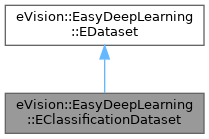
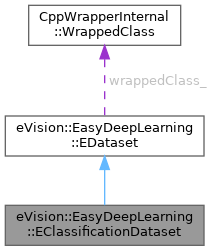
EClassificationDataset manages a dataset of images. More...
#include <eVision/EasyDeepLearning/EClassificationDataset.h>
Public Member Functions | |
| EClassificationDataset () | |
| Constructs a EClassificationDataset object. | |
| EClassificationDataset (const eVision::EasyDeepLearning::EClassificationDataset &other) | |
| Copy constructor of a EClassificationDataset object. | |
| EClassificationDataset (const eVision::EasyDeepLearning::EDataset &other) | |
| Copy constructor of a EClassificationDataset object from a EDataset object. | |
| virtual | ~EClassificationDataset () throw () |
| eVision::EasyDeepLearning::EClassificationDataset & | operator= (const eVision::EasyDeepLearning::EClassificationDataset &other) |
| Assignment operator. | |
| virtual void | Clear () |
| Clears the dataset. | |
| std::vector< eVision::EBaseROI * > | GetImages () const |
| Gets a copy of all images in the dataset. If data augmentation is enabled, the returned images will be augmented versions of the ones in the dataset. | |
| std::vector< eVision::EBaseROI * > | GetImages (const std::string &label) const |
| Gets all the images associated with the given label. | |
| std::unique_ptr< eVision::EBaseROI > | GetImageCopyWithDataAugmentation (int index, eVision::EasyDeepLearning::EDLDataAugmentationType generationType) const |
| Generates a new image from the i-th image of the dataset. For the variant where a pointer is returned, the user is responsible for clearing the memory of the returned pointer. | |
| std::unique_ptr< eVision::EBaseROI > | GetImageCopyWithDataAugmentation (int index) const |
| Generates a new image from the i-th image of the dataset. For the variant where a pointer is returned, the user is responsible for clearing the memory of the returned pointer. | |
| void | GetImageCopyWithDataAugmentation (int index, eVision::EBaseROI &img, eVision::EasyDeepLearning::EDLDataAugmentationType generationType) |
| Generates a new image from the i-th image of the dataset. For the variant where a pointer is returned, the user is responsible for clearing the memory of the returned pointer. | |
| void | GetImageCopyWithDataAugmentation (int index, eVision::EBaseROI &img) |
| Generates a new image from the i-th image of the dataset. For the variant where a pointer is returned, the user is responsible for clearing the memory of the returned pointer. | |
| void | SetEnableDataAugmentation (bool enable) |
| Enable data augmentation. | |
| bool | GetEnableDataAugmentation () const |
| Enable data augmentation. | |
| void | SetMaxHorizontalShift (int32_t maxShift) |
| Maximum horizontal shift for data augmentation. | |
| int32_t | GetMaxHorizontalShift () const |
| Maximum horizontal shift for data augmentation. | |
| void | SetMaxVerticalShift (int32_t maxShift) |
| Maximum vertical shift for data augmentation. | |
| int32_t | GetMaxVerticalShift () const |
| Maximum vertical shift for data augmentation. | |
| void | SetMaxRotationAngle (float maxAngle) |
| Maximum rotation angle for data augmentation. | |
| float | GetMaxRotationAngle () const |
| Maximum rotation angle for data augmentation. | |
| void | SetEnableVerticalFlip (bool enable) |
| Enable vertical flipping in data augmentation. | |
| bool | GetEnableVerticalFlip () const |
| Enable vertical flipping in data augmentation. | |
| void | SetEnableHorizontalFlip (bool enable) |
| Enable horizontal flipping in data augmentation. | |
| bool | GetEnableHorizontalFlip () const |
| Enable horizontal flipping in data augmentation. | |
| void | SetMinScale (float minScale) |
| Minimum scaling allowed for data augmentation. | |
| float | GetMinScale () const |
| Minimum scaling allowed for data augmentation. | |
| void | SetMaxScale (float maxScale) |
| Maximum scaling allowed for data augmentation. | |
| float | GetMaxScale () const |
| Maximum scaling allowed for data augmentation. | |
| void | SetMaxHorizontalShear (float hShear) |
| Maximum absolute horizontal shear. | |
| float | GetMaxHorizontalShear () const |
| Maximum absolute horizontal shear. | |
| void | SetMaxVerticalShear (float vShear) |
| Maximum absolute vertical shear. | |
| float | GetMaxVerticalShear () const |
| Maximum absolute vertical shear. | |
| void | SetMaxBrightnessOffset (float offset) |
| Maximum absolute brightness offset. Its value must be between 0 and 1. | |
| float | GetMaxBrightnessOffset () const |
| Maximum absolute brightness offset. Its value must be between 0 and 1. | |
| void | SetMaxContrastGain (float val) |
| Maximum contrast gain. Its value must be strictly positive and over EClassificationDataset::SetMinContrastGain. | |
| float | GetMaxContrastGain () const |
| Maximum contrast gain. Its value must be strictly positive and over EClassificationDataset::SetMinContrastGain. | |
| void | SetMinContrastGain (float val) |
| Minimum contrast gain. Its value must be strictly positive and below EClassificationDataset::SetMaxContrastGain. | |
| float | GetMinContrastGain () const |
| Minimum contrast gain. Its value must be strictly positive and below EClassificationDataset::SetMaxContrastGain. | |
| void | SetMinGamma (float gamma) |
| Minimum gamma for gamma correction. Its value must be strictly positive and below EClassificationDataset::SetMaxGamma. | |
| float | GetMinGamma () const |
| Minimum gamma for gamma correction. Its value must be strictly positive and below EClassificationDataset::SetMaxGamma. | |
| void | SetMaxGamma (float gamma) |
| Maximum gamma for gamma correction. Its value must be higher than EClassificationDataset::SetMinGamma. | |
| float | GetMaxGamma () const |
| Maximum gamma for gamma correction. Its value must be higher than EClassificationDataset::SetMinGamma. | |
| void | SetMaxHueOffset (float hueOffset) |
| Maximum absolute hue offset. Its value must be between 0 and 180 degrees. | |
| float | GetMaxHueOffset () const |
| Maximum absolute hue offset. Its value must be between 0 and 180 degrees. | |
| void | SetMinSaturationGain (float saturationGain) |
| Minimum saturation gain. Its value must be strictly positive. | |
| float | GetMinSaturationGain () const |
| Minimum saturation gain. Its value must be strictly positive. | |
| void | SetMaxSaturationGain (float saturationGain) |
| Maximum saturation gain. Its value must be over or equal to EClassificationDataset::SetMinSaturationGain. | |
| float | GetMaxSaturationGain () const |
| Maximum saturation gain. Its value must be over or equal to EClassificationDataset::SetMinSaturationGain. | |
| void | SetGaussianNoiseMaximumStandardDeviation (float gaussianMaximumDeviation) |
| The Gaussian noise maximum standard deviation. | |
| float | GetGaussianNoiseMaximumStandardDeviation () const |
| The Gaussian noise maximum standard deviation. | |
| void | SetGaussianNoiseMinimumStandardDeviation (float gaussianMinimumDeviation) |
| The Gaussian noise minimum standard deviation. | |
| float | GetGaussianNoiseMinimumStandardDeviation () const |
| The Gaussian noise minimum standard deviation. | |
| void | SetSpeckleNoiseMaximumStandardDeviation (float speckleMaximumDeviation) |
| The speckle noise maximum standard deviation. | |
| float | GetSpeckleNoiseMaximumStandardDeviation () const |
| The speckle noise maximum standard deviation. | |
| void | SetSpeckleNoiseMinimumStandardDeviation (float speckleMinimumDeviation) |
| The speckle noise minimum standard deviation. | |
| float | GetSpeckleNoiseMinimumStandardDeviation () const |
| The speckle noise minimum standard deviation. | |
| void | SetSaltAndPepperNoiseMaximumDensity (float saltAndPepperMaximumDensity) |
| The maximum density of the salt and pepper noise. | |
| float | GetSaltAndPepperNoiseMaximumDensity () const |
| The maximum density of the salt and pepper noise. | |
| void | SetSaltAndPepperNoiseMinimumDensity (float saltAndPepperMinimumDensity) |
| The minimum density of the salt and pepper noise. | |
| float | GetSaltAndPepperNoiseMinimumDensity () const |
| The minimum density of the salt and pepper noise. | |
| void | SplitDataset (eVision::EasyDeepLearning::EClassificationDataset &d1, eVision::EasyDeepLearning::EClassificationDataset &d2, float proportion, bool random) const |
| Splits the dataset in two parts to be used for training and validation respectively. | |
| void | SplitDataset (eVision::EasyDeepLearning::EClassificationDataset &d1, eVision::EasyDeepLearning::EClassificationDataset &d2, float proportion) const |
| Splits the dataset in two parts to be used for training and validation respectively. | |
| void | SplitDataset (eVision::EasyDeepLearning::EClassificationDataset &d1, eVision::EasyDeepLearning::EClassificationDataset &d2) const |
| Splits the dataset in two parts to be used for training and validation respectively. | |
| void | SplitDatasetForSegmentation (eVision::EasyDeepLearning::EClassificationDataset &d1, eVision::EasyDeepLearning::EClassificationDataset &d2, float proportion, bool random) const |
| Splits the dataset in two parts for a supervised segmenter. The two parts are to be used for training and validation respectively. | |
| void | SplitDatasetForSegmentation (eVision::EasyDeepLearning::EClassificationDataset &d1, eVision::EasyDeepLearning::EClassificationDataset &d2, float proportion) const |
| Splits the dataset in two parts for a supervised segmenter. The two parts are to be used for training and validation respectively. | |
| void | SplitDatasetForSegmentation (eVision::EasyDeepLearning::EClassificationDataset &d1, eVision::EasyDeepLearning::EClassificationDataset &d2) const |
| Splits the dataset in two parts for a supervised segmenter. The two parts are to be used for training and validation respectively. | |
| void | SplitDatasetForLocator (eVision::EasyDeepLearning::EClassificationDataset &d1, eVision::EasyDeepLearning::EClassificationDataset &d2, float proportion, bool random) const |
| Splits the dataset in two parts for training and validation of a ELocator tool. Images without object labeling are excluded from the split. | |
| void | SplitDatasetForLocator (eVision::EasyDeepLearning::EClassificationDataset &d1, eVision::EasyDeepLearning::EClassificationDataset &d2, float proportion) const |
| Splits the dataset in two parts for training and validation of a ELocator tool. Images without object labeling are excluded from the split. | |
| void | SplitDatasetForLocator (eVision::EasyDeepLearning::EClassificationDataset &d1, eVision::EasyDeepLearning::EClassificationDataset &d2) const |
| Splits the dataset in two parts for training and validation of a ELocator tool. Images without object labeling are excluded from the split. | |
| eVision::EasyDeepLearning::EClassificationDataset | ExtractSplit (const eVision::EasyDeepLearning::EDatasetSplit &split, eVision::EasyDeepLearning::EDatasetType type) const |
| Creates a new EClassificationDataset containing only the images of the given split type. | |
| EClassificationDataset (CppWrapperInternal::InternalConstructor) | |
| Public Member Functions inherited from eVision::EasyDeepLearning::EDataset | |
| EDataset () | |
| Constructs a EDataset object. | |
| EDataset (const eVision::EasyDeepLearning::EDataset &other) | |
| Copy constructor of a EDataset object. | |
| virtual | ~EDataset () throw () |
| eVision::EasyDeepLearning::EDataset & | operator= (const eVision::EasyDeepLearning::EDataset &other) |
| Assignment operator. | |
| void | Load (const std::string &path) |
| Loads a classification dataset from disk. | |
| void | Load (eVision::ESerializer *serializer) |
| Loads a classification dataset from disk. | |
| void | Save (const std::string &path) |
| Saves a classification dataset to disk, containing the file paths to the images in the dataset and their associated label. | |
| void | Save (eVision::ESerializer *serializer) |
| Saves a classification dataset to disk, containing the file paths to the images in the dataset and their associated label. | |
| void | SaveWithRelativePath (const std::string &path) |
| Saves the dataset with image paths relative to the directory in which the dataset file is saved. | |
| void | SetBasePath (const std::string &basePath) |
| Sets the base path for the images specified with a relative path. | |
| void | Export (const std::string &directory, eVision::EImageFileType fileType, int quality) const |
| Exports the dataset and its images to the given directory. | |
| void | Export (const std::string &directory, eVision::EImageFileType fileType) const |
| Exports the dataset and its images to the given directory. | |
| void | Export (const std::string &directory) const |
| Exports the dataset and its images to the given directory. | |
| void | Export (const std::string &directory, bool keepFilename, eVision::EImageFileType fileType, int quality) const |
| Exports the dataset and its images to the given directory. | |
| void | Export (const std::string &directory, bool keepFilename, eVision::EImageFileType fileType) const |
| Exports the dataset and its images to the given directory. | |
| void | Export (const std::string &directory, bool keepFilename) const |
| Exports the dataset and its images to the given directory. | |
| void | Export (const std::string &directory, int width, int height, int channels, eVision::EImageFileType fileType, int quality) const |
| Exports the dataset and its images to the given directory. | |
| void | Export (const std::string &directory, int width, int height, int channels, eVision::EImageFileType fileType) const |
| Exports the dataset and its images to the given directory. | |
| void | Export (const std::string &directory, int width, int height, int channels) const |
| Exports the dataset and its images to the given directory. | |
| void | Export (const std::string &directory, int width, int height, int channels, bool keepFilename, eVision::EImageFileType fileType, int quality) const |
| Exports the dataset and its images to the given directory. | |
| void | Export (const std::string &directory, int width, int height, int channels, bool keepFilename, eVision::EImageFileType fileType) const |
| Exports the dataset and its images to the given directory. | |
| void | Export (const std::string &directory, int width, int height, int channels, bool keepFilename) const |
| Exports the dataset and its images to the given directory. | |
| uint32_t | GetWidth () const |
| Width of the region of interest of the first image added to the dataset. | |
| uint32_t | GetHeight () const |
| Height of the region of interest of the first image added to the dataset. | |
| uint32_t | GetChannels () const |
| Number of channels of the first image added to the dataset. | |
| eVision::EasyDeepLearning::EImageAnnotationFormat | GetAvailableImageAnnotationFormat (const std::string &imageFile) const |
| Image annotation file formats that are available next to the image file. | |
| eVision::EasyDeepLearning::EImageAnnotationFormat | GetAvailableImageAnnotationFormat (int imgId) const |
| Image annotation file formats that are available next to the image file. | |
| void | ImportYOLOTXTAnnotations (int imgId, const std::string &labelFile) |
| Imports YOLO TXT annotations (for EasyLocate Bounding Box). | |
| void | ImportYOLOTXTAnnotations (const std::string &labelFile) |
| Imports YOLO TXT annotations (for EasyLocate Bounding Box). | |
| void | ImportPascalVOCXMLAnnotations (int imgId) |
| Imports Pascal VOC XML annotations (for EasyLocate Bounding Box). | |
| void | ImportPascalVOCXMLAnnotations () |
| Imports Pascal VOC XML annotations (for EasyLocate Bounding Box). | |
| int | AddImage (const std::string &imagePath) |
| Adds an image to the dataset. | |
| int | AddImage (const std::string &imagePath, const std::string &label) |
| Adds an image to the dataset. | |
| int | AddImage (const std::string &imagePath, int originX, int originY, int width, int height, const eVision::ERegion &mask) |
| Adds an image to the dataset. | |
| int | AddImage (const std::string &imagePath, int originX, int originY, int width, int height, const eVision::ERegion &mask, const std::string &label) |
| Adds an image to the dataset. | |
| int | AddImage (const eVision::EBaseROI &img) |
| Adds an image to the dataset. | |
| int | AddImage (const eVision::EBaseROI &img, const std::string &label) |
| Adds an image to the dataset. | |
| int | AddImage (const eVision::EBaseROI &img, int originX, int originY, int width, int height, const eVision::ERegion &mask) |
| Adds an image to the dataset. | |
| int | AddImage (const eVision::EBaseROI &img, int originX, int originY, int width, int height, const eVision::ERegion &mask, const std::string &label) |
| Adds an image to the dataset. | |
| int | AddImages (const std::string &filter) |
| Adds all the images present in the directory specified by the parameter path and whose filename matches the filter. | |
| int | AddImages (const std::string &filter, const std::string &label) |
| Adds all the images present in the directory specified by the parameter path and whose filename matches the filter. | |
| int | AddImages (const std::string &filter, int originX, int originY, int width, int height, const eVision::ERegion &mask) |
| Adds all the images present in the directory specified by the parameter path and whose filename matches the filter. | |
| int | AddImages (const std::string &filter, int originX, int originY, int width, int height, const eVision::ERegion &mask, const std::string &label) |
| Adds all the images present in the directory specified by the parameter path and whose filename matches the filter. | |
| int | AddImagesFromCSV (const std::string &csvFile, int imageColumn, int labelColumn, int skipLines, const std::string &separator) |
| Adds images using a CSV (Comma Separated Value) file where each row correspond to an image and the file path and label of each image is given in the columns imageColumn and labelColumn respectively. | |
| int | AddImagesFromCSV (const std::string &csvFile, int imageColumn, int labelColumn, int skipLines) |
| Adds images using a CSV (Comma Separated Value) file where each row correspond to an image and the file path and label of each image is given in the columns imageColumn and labelColumn respectively. | |
| int | AddImagesFromCSV (const std::string &csvFile, int imageColumn, int labelColumn) |
| Adds images using a CSV (Comma Separated Value) file where each row correspond to an image and the file path and label of each image is given in the columns imageColumn and labelColumn respectively. | |
| int | AddImagesFromCSV (const std::string &csvFile, int imageColumn) |
| Adds images using a CSV (Comma Separated Value) file where each row correspond to an image and the file path and label of each image is given in the columns imageColumn and labelColumn respectively. | |
| int | AddImagesFromCSV (const std::string &csvFile) |
| Adds images using a CSV (Comma Separated Value) file where each row correspond to an image and the file path and label of each image is given in the columns imageColumn and labelColumn respectively. | |
| void | RemoveImage (int imgId) |
| Removes the image at the given index. All annotations (label, segmentation, objects) will be lost. | |
| int | GetNumImages () const |
| Number of images in the dataset. | |
| int | GetNumImageFiles () const |
| Number of different image files contained in the dataset. | |
| int | GetNumImagesForFile (const std::string &filePath) const |
| Get the number of images in the dataset that are associated with the given image file. | |
| std::unique_ptr< eVision::EBaseROI > | GetImageCopy (int index) const |
| Gets a copy of the i-th image of the dataset. | |
| void | GetImageCopy (int index, eVision::EBaseROI &img) const |
| Gets a copy of the i-th image of the dataset. | |
| std::string | GetImagePath (int index) const |
| Gets the path of the i-th image of the dataset. If the image was not given using a path, the method will throw an exception. | |
| bool | IsImageFile (int index) const |
| Whether the image is stored as a file path towards an image. | |
| bool | IsEmbeddedImage (int index) const |
| Whether the image is embedded into the dataset and is not a reference towards an image file. | |
| std::string | GetImageLabel (int index) const |
| Gets the label of the i-th image of the dataset. An exception is thrown if the image has no classification label. | |
| void | SetImageLabel (int index, const std::string &label) |
| Sets the label of images in the dataset. | |
| void | SetImageLabel (const std::string &filter, const std::string &label) |
| Sets the label of images in the dataset. | |
| void | UnsetImageLabel (int index) |
| Unset the label of the given image of the dataset. After this operation, the given image will have no classification labels. | |
| bool | HasLabel (int index) const |
| Whether an image has a classification label. | |
| int | GetNumLabeledImages () const |
| Number of images that have a classification label. | |
| int | GetNumUnlabeledImages () const |
| Number of images that doesn't have any classification label. | |
| std::vector< uint32_t > | GetImagesIndexesWithLabel (const std::string &label) const |
| Gets a list of index corresponding to the images associated with the given label. | |
| std::vector< uint32_t > | GetImagesIndexesWithLabel (int labelIndex) const |
| Gets a list of index corresponding to the images associated with the given label. | |
| std::vector< int > | GetLabeledImagesIndexes () const |
| Gets a list of index corresponding to the images that have a classification label. | |
| std::vector< int > | GetTextLabeledImagesIndexes () const |
| Gets a list of index corresponding to the images that have a text only label. | |
| std::vector< int > | GetImagesIndexesWithNoLabel () const |
| Gets a list of index corresponding to the images with no classification labels. | |
| int | GetNumLabels () const |
| Number of labels in the dataset. | |
| void | AddLabel (const std::string &label) |
| Adds a label to the dataset. | |
| std::string | GetLabel (int i) const |
| Gets the i-th label of the dataset (starting from 0 to EDataset::GetNumLabels - 1). | |
| void | SetLabel (int index, const std::string &label) |
| Sets the i-th label of the dataset (starting from 0 to EDataset::GetNumLabels - 1). This operation does not add a new label to the dataset but simply renames an existing label. | |
| float | GetLabelWeight (int index) const |
| Gets the weight associated to the i-th label of the dataset (starting from 0 to EDataset::GetNumLabels - 1). | |
| void | SetLabelWeight (int index, const float &weight) |
| Sets the weight associated to the i-th label of the dataset (starting from 0 to EDataset::GetNumLabels - 1). This operation does not add a new label. | |
| void | SetLabelColor (int index, const eVision::ERGBColor &color) |
| Sets the label color for a classification label. | |
| eVision::ERGBColor | GetLabelColor (int index) const |
| Gets the label color for a classification label. | |
| void | SetLabelOpacity (int index, const uint8_t opacity) |
| Sets the label opacity for a classification label. | |
| uint8_t | GetLabelOpacity (int index) const |
| Gets the label opacity for a classification label. | |
| void | RemoveLabel (const std::string &label) |
| Removes a label from the dataset. | |
| void | RemoveLabel (int labelId) |
| Removes a label from the dataset. | |
| void | SetSegmentationMap (int imageIndex, const eVision::EROIBW16 &segmentationMap) |
| Sets the segmentation map of an image. The segmentation map is a 16-bit EROIBW16 image where the value of each pixel is equal to the corresponding segmentation label index (see EDataset::GetSegmentationLabel). | |
| eVision::EImageBW16 | GetSegmentationMap (int imageIndex) const |
| Gets the segmentation map of an image. The segmentation map is a 16-bit EROIBW16 image where the value of each pixel is equal to the corresponding segmentation label index (see EDataset::GetSegmentationLabel). | |
| void | UnsetSegmentation (int imageIndex) |
| Unsets the segmentation of an image. After this operation, the image will have no segmentation. | |
| void | ResetSegmentation (int imageIndex) |
| Resets the segmentation of an image by setting all pixels to background. | |
| void | AddRegionToSegment (int imageIndex, int segmentationLabelIndex, const eVision::ERegion ®ion) |
| Adds a region (see ERegion) to the given segment of an image. If, before this call, the image had no segmentation, the pixels not in the given region will be set to the background segmentation label. | |
| void | AddRegionToSegment (int imageIndex, const std::string &label, const eVision::ERegion ®ion) |
| Adds a region (see ERegion) to the given segment of an image. If, before this call, the image had no segmentation, the pixels not in the given region will be set to the background segmentation label. | |
| eVision::ERegion | GetRegionForSegment (int imageIndex, int segmentationLabelIndex) |
| Gets a region corresponding to the pixels of the given segment. | |
| eVision::ERegion | GetRegionForSegment (int imageIndex, const std::string &segmentationLabel) |
| Gets a region corresponding to the pixels of the given segment. | |
| int | GetNumSegmentationLabels () const |
| Number of segmentation labels. A dataset has always at least one segmentation label: "background". | |
| int | GetNumImagesForSegmentationLabel (int labelId) const |
| Number of images containing the given segmentation label. | |
| int | GetNumImagesForSegmentationLabel (const std::string &label) const |
| Number of images containing the given segmentation label. | |
| uint64_t | GetNumPixelsForSegmentationLabel (int labelId) const |
| Number of pixels assigned to the given segmentation label. | |
| uint64_t | GetNumPixelsForSegmentationLabel (const std::string &label) const |
| Number of pixels assigned to the given segmentation label. | |
| bool | HasSegmentation (int imageId) const |
| Whether the image has a segmentation. | |
| bool | HasForegroundSegments (int imageId) const |
| Whether the image segmentation contains segments that are not background. If the image has no segmentation, this method throws an exception. | |
| int | GetNumSegmentedBlobs (int imageId) const |
| Number of segmented blobs in the image for all non-background labels or for a specific label. | |
| int | GetNumSegmentedBlobs (int imageId, const std::string &label) const |
| Number of segmented blobs in the image for all non-background labels or for a specific label. | |
| int | GetNumSegmentedBlobs (int imageId, int labelId) const |
| Number of segmented blobs in the image for all non-background labels or for a specific label. | |
| std::string | GetSegmentationLabel (int index) const |
| Gets the segmentation label. | |
| void | SetSegmentationLabel (int index, const std::string &label) |
| Sets the segmentation labels. | |
| int | AddSegmentationLabel (const std::string &label, float labelWeight) |
| Adds a segmentation label. The index of the new segmentation labels is returned by the method. | |
| int | AddSegmentationLabel (const std::string &label) |
| Adds a segmentation label. The index of the new segmentation labels is returned by the method. | |
| void | RemoveSegmentationLabel (const std::string &label) |
| Remove a segmentation label. | |
| void | RemoveSegmentationLabel (int index) |
| Remove a segmentation label. | |
| float | GetSegmentationLabelWeight (int index) const |
| Gets the segmentation label weights. | |
| float | GetSegmentationLabelWeight (const std::string &label) const |
| Gets the segmentation label weights. | |
| void | SetSegmentationLabelWeight (int index, float weight) |
| Sets the segmentation label weight. | |
| void | SetSegmentationLabelWeight (const std::string &label, float weight) |
| Sets the segmentation label weight. | |
| void | SetSegmentationLabelColor (int index, const eVision::ERGBColor &color) |
| Sets the label color for a segmentation label. | |
| eVision::ERGBColor | GetSegmentationLabelColor (int index) const |
| Gets the label color for a segmentation label. | |
| void | SetSegmentationLabelOpacity (int index, const uint8_t opacity) |
| Sets the label opacity for a segmentation label. | |
| uint8_t | GetSegmentationLabelOpacity (int index) const |
| Gets the label opacity for a segmentation label. | |
| int | GetNumImagesWithSegmentation () const |
| Number of images that have a ground truth segmentation. | |
| int | GetNumImagesWithoutSegmentation () const |
| Number of images that doesn't have a ground truth segmentation. | |
| int | GetNumImagesWithoutForegroundSegments () const |
| Number of images that have a ground truth segmentation that has no foreground segments and is thus entirely composed of background pixels. | |
| int | GetNumImagesWithForegroundSegments () const |
| Number of images that have a ground truth segmentation that has foreground segments and is this not entirely composed of background pixels. | |
| void | ResetImageObjectLabeling (int imageIndex) |
| Resets the object labeling for the specified image. This sets the image as having been labeled for object detection with no object present in the image. | |
| void | UnsetImageObjectLabeling (int imageIndex) |
| Unsets the object labeling for the specified image. This sets the image as not having been labeled for object detection. This image won't be use for training with a ELocator tool. | |
| std::vector< eVision::EasyDeepLearning::ELocatorObject > | GetImageObjects (int imageIndex) const |
| Gets all the objects of the specified image. | |
| int | GetImageNumObjects (int imageIndex) const |
| Number of objects for the specified image. | |
| eVision::EasyDeepLearning::ELocatorObject | GetImageObject (int imageIndex, int objectIndex) const |
| Gets the specified object for the given image. | |
| void | SetImageObject (int imageIndex, int objectIndex, const eVision::EasyDeepLearning::ELocatorObject &obj) |
| Sets the specified object for the given image. | |
| void | SetImageObject (int imageIndex, int objectIndex, const std::string &label) |
| Sets the specified object for the given image. | |
| void | SetImageObject (int imageIndex, int objectIndex, const eVision::ERectangleRegion ®ion) |
| Sets the specified object for the given image. | |
| void | AddImageObject (int imageIndex, const eVision::EasyDeepLearning::ELocatorObject &obj) |
| Adds an object to the image. | |
| void | AddImageObject (int imageIndex, const std::string &label, const eVision::ERectangleRegion &box) |
| Adds an object to the image. | |
| void | RemoveImageObject (int imageIndex, int objectIndex) |
| Removes an object from an image. | |
| int | GetNumObjectLabels () const |
| Number of object labels. | |
| std::string | GetObjectLabel (int labelIndex) const |
| Object label. | |
| void | SetObjectLabel (int labelIndex, const std::string &newLabel) |
| Sets an object label. | |
| void | SetObjectLabel (const std::string &oldLabel, const std::string &newLabel) |
| Sets an object label. | |
| void | AddObjectLabel (const std::string &label, float weight) |
| Adds an object label. | |
| void | AddObjectLabel (const std::string &label) |
| Adds an object label. | |
| void | RemoveObjectLabel (int labelIndex) |
| Removes an object label. | |
| void | RemoveObjectLabel (const std::string &label) |
| Removes an object label. | |
| void | SetObjectLabelWeight (int labelIndex, float weight) |
| Sets the weight of an object label. | |
| void | SetObjectLabelWeight (const std::string &label, float weight) |
| Sets the weight of an object label. | |
| float | GetObjectLabelWeight (int labelIndex) const |
| Gets the weight of an object label. | |
| float | GetObjectLabelWeight (const std::string &label) const |
| Gets the weight of an object label. | |
| void | SetObjectLabelColor (int index, const eVision::ERGBColor &color) |
| Sets the label color for an object label. | |
| eVision::ERGBColor | GetObjectLabelColor (int index) const |
| Gets the label color for an object label. | |
| void | SetObjectLabelOpacity (int index, const uint8_t opacity) |
| Sets the label opacity for an object label. | |
| uint8_t | GetObjectLabelOpacity (int index) const |
| Gets the label opacity for an object label. | |
| bool | HasObjectLabeling (int imageIndex) const |
| Whether the image is labeled for object detection and use with ELocator. | |
| int | GetNumImagesWithObjectLabeling () const |
| Number of images in the dataset that are labeled for object detection. | |
| int | GetNumImagesWithoutObjectLabeling () const |
| Number of images in the dataset that are not labeled for object detection. | |
| int | GetNumImagesWithoutObjects () const |
| Number of images in the dataset that are labeled for object detection but have been associated with no object. | |
| int | GetNumImagesWithObjects () const |
| Number of images in the dataset that are labeled for object detection and have 1 or more objects. | |
| int | GetNumImagesWithObjectLabel (int labelIdx) const |
| Number of images that contain an object with the given label. | |
| int | GetNumImagesWithObjectLabel (const std::string &label) const |
| Number of images that contain an object with the given label. | |
| uint64_t | GetNumObjectsWithLabel (int labelIdx) const |
| Number of objects with the given label. | |
| uint64_t | GetNumObjectsWithLabel (const std::string &label) const |
| Number of objects with the given label. | |
| float | GetSameLabelMaxOverlap () const |
| Maximum overlap between objects with the same label in the dataset. | |
| float | GetAbsoluteMaxOverlap () const |
| Absolute maximum overlap between objects in the dataset. | |
| int | GetMaxNumObjectPerImage () const |
| Maximum number of objects for an image in the dataset. If no images has object labeling (see EDataset::HasObjectLabeling), the method returns -1. | |
| void | SetObjectSize (int objectSize) |
| Object size for EasyLocate Interest point. | |
| int | GetObjectSize () const |
| Object size for EasyLocate Interest point. | |
| bool | HasOCRAnnotations (int imgId) const |
| Whether the specified image has OCR annotations. | |
| void | UnsetOCRAnnotations (int imgId) |
| Unsets the OCR labeling for the specified image. | |
| std::vector< eVision::EasyDeepOCR::ETextLine > | GetOCRAnnotations (int imgId) const |
| Ground truth text lines for the specified image. | |
| void | SetOCRAnnotations (int imgId, const std::vector< eVision::EasyDeepOCR::ETextLine > &texts) |
| Sets the ground truth text lines for the specified image. | |
| int | GetNumImagesWithOCR () const |
| Number of images with OCR annotations. | |
| int | GetNumImagesWithoutOCR () const |
| Number of images without OCR annotations. | |
| int | GetNumTexts () const |
| Number of annotated texts in the dataset. | |
| eVision::EasyDeepLearning::EDataset | GetTextDataset () const |
| Transforms the current dataset to have only subwindow containing the actual text to read. | |
| eVision::EasyDeepLearning::EDataset | GetTextOrientationDataset () const |
| Transforms the current text dataset to duplicate it with half image flipped, adding corresponding ground truth. | |
| void | SplitDataset (eVision::EasyDeepLearning::EDataset &d1, eVision::EasyDeepLearning::EDataset &d2, float proportion, bool random) const |
| Splits the dataset in two parts to be used for training and validation respectively. | |
| void | SplitDataset (eVision::EasyDeepLearning::EDataset &d1, eVision::EasyDeepLearning::EDataset &d2, float proportion) const |
| Splits the dataset in two parts to be used for training and validation respectively. | |
| void | SplitDataset (eVision::EasyDeepLearning::EDataset &d1, eVision::EasyDeepLearning::EDataset &d2) const |
| Splits the dataset in two parts to be used for training and validation respectively. | |
| void | SplitDatasetForSegmentation (eVision::EasyDeepLearning::EDataset &d1, eVision::EasyDeepLearning::EDataset &d2, float proportion, bool random) const |
| Splits the dataset in two parts for a supervised segmenter. The two parts are to be used for training and validation respectively. | |
| void | SplitDatasetForSegmentation (eVision::EasyDeepLearning::EDataset &d1, eVision::EasyDeepLearning::EDataset &d2, float proportion) const |
| Splits the dataset in two parts for a supervised segmenter. The two parts are to be used for training and validation respectively. | |
| void | SplitDatasetForSegmentation (eVision::EasyDeepLearning::EDataset &d1, eVision::EasyDeepLearning::EDataset &d2) const |
| Splits the dataset in two parts for a supervised segmenter. The two parts are to be used for training and validation respectively. | |
| void | SplitDatasetForLocator (eVision::EasyDeepLearning::EDataset &d1, eVision::EasyDeepLearning::EDataset &d2, float proportion, bool random) const |
| Splits the dataset in two parts for training and validation of a ELocator tool. Images without object labeling are excluded from the split. | |
| void | SplitDatasetForLocator (eVision::EasyDeepLearning::EDataset &d1, eVision::EasyDeepLearning::EDataset &d2, float proportion) const |
| Splits the dataset in two parts for training and validation of a ELocator tool. Images without object labeling are excluded from the split. | |
| void | SplitDatasetForLocator (eVision::EasyDeepLearning::EDataset &d1, eVision::EasyDeepLearning::EDataset &d2) const |
| Splits the dataset in two parts for training and validation of a ELocator tool. Images without object labeling are excluded from the split. | |
| eVision::EasyDeepLearning::EDatasetSplit | GetSplit (float trainingProportion, float validationPropotion, eVision::EasyDeepLearning::EDeepLearningToolType toolType, const std::string &goodLabel) const |
| Generates a split. | |
| eVision::EasyDeepLearning::EDatasetSplit | GetSplit (float trainingProportion, float validationPropotion, eVision::EasyDeepLearning::EDeepLearningToolType toolType, const std::string &goodLabel, uint32_t seed) const |
| Generates a split. | |
| eVision::EasyDeepLearning::EDatasetSplit | GetSplit (int numTrainingImages, int numValidationImages, eVision::EasyDeepLearning::EDeepLearningToolType toolType, const std::string &goodLabel) const |
| Generates a split. | |
| eVision::EasyDeepLearning::EDatasetSplit | GetSplit (int numTrainingImages, int numValidationImages, eVision::EasyDeepLearning::EDeepLearningToolType toolType, const std::string &goodLabel, uint32_t seed) const |
| Generates a split. | |
| eVision::EasyDeepLearning::EDataset | ExtractSplit (const eVision::EasyDeepLearning::EDatasetSplit &split, eVision::EasyDeepLearning::EDatasetType type) const |
| Creates a new EDataset containing only the images of the given split type. | |
| void | SetRegionOfInterest (int imageIndex, int xOrg, int yOrg, int width, int height) |
| Sets the region of interest for the specified image. | |
| int | GetRegionOfInterestOriginX (int imageIndex) const |
| Region of interest origin abscissa for the specified image. | |
| int | GetRegionOfInterestOriginY (int imageIndex) const |
| Region of interest origin ordinate for the specified image. | |
| int | GetRegionOfInterestWidth (int imageIndex) const |
| Region of interest width for the specified image. | |
| int | GetRegionOfInterestHeight (int imageIndex) const |
| Region of interest height for the specified image. | |
| eVision::ERegion | GetMask (int imageIndex) const |
| Gets the mask region/don't care area for the given image. The mask is defined with respect to the region of interest of the image. | |
| void | SetMask (int imageIndex, const eVision::ERegion &mask) |
| Sets the mask region/don't care area for the given image. The mask is defined with respect to the region of interest of the image. | |
| EDataset (CppWrapperInternal::InternalConstructor) | |
Additional Inherited Members | |
| Public Attributes inherited from eVision::EasyDeepLearning::EDataset | |
| CppWrapperInternal::WrappedClass | wrappedClass_ |
EClassificationDataset manages a dataset of images.
A dataset is a collection of images with different types of labeling: labeling for the classification of images, labeling for the segmentation of pixels, and/or labeling for the detection of objects (classification and localization).
The dataset maintains 3 sets of labels for each type of labeling:
The classification and segmentation labels are entirely user defined. The set of segmentation labels will always contain at least the "Background" label representing pixels of the images that have no relevant information for your task (for example, in a defect segmentation application, the "Background" pixels would be the pixels without any defects).
For each type of labeling, an image can either be unlabeled or labeled. When an image in unlabeled for a given type of labeling, the image won't be used for training a deep learning tool that requires this type of labeling.
The image in the dataset can be stored as path to an image file or as an eVision image structure. Supported structures are 8-bits monochrome (EImageBW8), 16-bits monochrome (EImageBW16), and 24-bits color (EROIC24, EImageC24).
The dataset associates with each image a region of interest and a mask/don't care area. By default, the region of interest of an image is its full extent and its mask is empty.
A EClassificationDataset object is also responsible for providing tools to do data augmentation. Data augmentation is the process of generating new images on-the-fly by applying affine transformations to those already in the dataset. Data augmentation allows a deep neural network to be invariant to the applied transformation without having to capture and label real world images containing those transformations.
A dataset can contain images with different sizes (with and height of their region of interest). However, the dataset has a default resolution (see EDataset::GetWidth and EDataset::GetHeight) that is used by deep learning tools that require the same input image size such as the EClassifier. When the images have different sizes, the default resolution will be the resolution of the region of interest of the first image added to the dataset.
License(s): BasicTypes
| eVision::EasyDeepLearning::EClassificationDataset::EClassificationDataset | ( | ) |
Constructs a EClassificationDataset object.
| eVision::EasyDeepLearning::EClassificationDataset::EClassificationDataset | ( | const eVision::EasyDeepLearning::EClassificationDataset & | other | ) |
Copy constructor of a EClassificationDataset object.
| other | Reference to the EClassificationDataset object that should be copied |
| eVision::EasyDeepLearning::EClassificationDataset::EClassificationDataset | ( | const eVision::EasyDeepLearning::EDataset & | other | ) |
Copy constructor of a EClassificationDataset object from a EDataset object.
| other | Reference to the EDataset object that should be copied |
|
virtual | ||||||||||||
| eVision::EasyDeepLearning::EClassificationDataset::EClassificationDataset | ( | CppWrapperInternal::InternalConstructor | ) |
|
virtual |
Clears the dataset.
Reimplemented from eVision::EasyDeepLearning::EDataset.
| eVision::EasyDeepLearning::EClassificationDataset eVision::EasyDeepLearning::EClassificationDataset::ExtractSplit | ( | const eVision::EasyDeepLearning::EDatasetSplit & | split, |
| eVision::EasyDeepLearning::EDatasetType | type ) const |
Creates a new EClassificationDataset containing only the images of the given split type.
| split | Split |
| type | Type of the split to extract |
| bool eVision::EasyDeepLearning::EClassificationDataset::GetEnableDataAugmentation | ( | ) | const |
Enable data augmentation.
| bool eVision::EasyDeepLearning::EClassificationDataset::GetEnableHorizontalFlip | ( | ) | const |
Enable horizontal flipping in data augmentation.
| bool eVision::EasyDeepLearning::EClassificationDataset::GetEnableVerticalFlip | ( | ) | const |
Enable vertical flipping in data augmentation.
| float eVision::EasyDeepLearning::EClassificationDataset::GetGaussianNoiseMaximumStandardDeviation | ( | ) | const |
The Gaussian noise maximum standard deviation.
The Gaussian noise is an additive noise sampled from a Gaussian distribution of deviation between EClassificationDataset::SetGaussianNoiseMinimumStandardDeviation and EClassificationDataset::SetGaussianNoiseMaximumStandardDeviation (also called the normal distribution).
Its value must be superior or equal to EClassificationDataset::SetGaussianNoiseMinimumStandardDeviation.
This noise is computed before the salt and paper noise.
| float eVision::EasyDeepLearning::EClassificationDataset::GetGaussianNoiseMinimumStandardDeviation | ( | ) | const |
The Gaussian noise minimum standard deviation.
The Gaussian noise is an additive noise sampled from a Gaussian distribution of deviation between EClassificationDataset::SetGaussianNoiseMinimumStandardDeviation and EClassificationDataset::SetGaussianNoiseMaximumStandardDeviation (also called the normal distribution).
Its value must be between 0 and EClassificationDataset::SetGaussianNoiseMaximumStandardDeviation.
This noise is computed before the salt and paper noise.
| std::unique_ptr< eVision::EBaseROI > eVision::EasyDeepLearning::EClassificationDataset::GetImageCopyWithDataAugmentation | ( | int | index | ) | const |
Generates a new image from the i-th image of the dataset. For the variant where a pointer is returned, the user is responsible for clearing the memory of the returned pointer.
| index | The index of the image. |
If the data augmentation fails, the method will throw an exception.
| std::unique_ptr< eVision::EBaseROI > eVision::EasyDeepLearning::EClassificationDataset::GetImageCopyWithDataAugmentation | ( | int | index, |
| eVision::EasyDeepLearning::EDLDataAugmentationType | generationType ) const |
Generates a new image from the i-th image of the dataset. For the variant where a pointer is returned, the user is responsible for clearing the memory of the returned pointer.
| index | The index of the image. |
| generationType | The type of transformation to generate (default: random). |
If the data augmentation fails, the method will throw an exception.
| void eVision::EasyDeepLearning::EClassificationDataset::GetImageCopyWithDataAugmentation | ( | int | index, |
| eVision::EBaseROI & | img ) |
Generates a new image from the i-th image of the dataset. For the variant where a pointer is returned, the user is responsible for clearing the memory of the returned pointer.
| index | The index of the image. |
| img | Image object to copy the image into. |
If the data augmentation fails, the method will throw an exception.
| void eVision::EasyDeepLearning::EClassificationDataset::GetImageCopyWithDataAugmentation | ( | int | index, |
| eVision::EBaseROI & | img, | ||
| eVision::EasyDeepLearning::EDLDataAugmentationType | generationType ) |
Generates a new image from the i-th image of the dataset. For the variant where a pointer is returned, the user is responsible for clearing the memory of the returned pointer.
| index | The index of the image. |
| img | Image object to copy the image into. |
| generationType | The type of transformation to generate (default: random). |
If the data augmentation fails, the method will throw an exception.
| std::vector< eVision::EBaseROI * > eVision::EasyDeepLearning::EClassificationDataset::GetImages | ( | ) | const |
Gets a copy of all images in the dataset. If data augmentation is enabled, the returned images will be augmented versions of the ones in the dataset.
The caller is responsible for clearing the memory allocated for each image.
The method will load images from their given path when necessary.
| std::vector< eVision::EBaseROI * > eVision::EasyDeepLearning::EClassificationDataset::GetImages | ( | const std::string & | label | ) | const |
Gets all the images associated with the given label.
If the parameter is empty, all the images are returned. If data augmentation is enabled, the returned images will be augmented versions of the ones in the dataset.
The caller is responsible for clearing the memory allocated for each image.
| label | The label. |
The method will load images from their given path when necessary.
| float eVision::EasyDeepLearning::EClassificationDataset::GetMaxBrightnessOffset | ( | ) | const |
Maximum absolute brightness offset. Its value must be between 0 and 1.
Brightness transformation is performed by adding a value taken between -EClassificationDataset::SetMaxBrightnessOffset and +EClassificationDataset::SetMaxBrightnessOffset to each pixel of the normalized image.
| float eVision::EasyDeepLearning::EClassificationDataset::GetMaxContrastGain | ( | ) | const |
Maximum contrast gain. Its value must be strictly positive and over EClassificationDataset::SetMinContrastGain.
Contrast transformation is performed by multiplying each mean-centered pixel value by a gain value taken between EClassificationDataset::SetMinContrastGain and EClassificationDataset::SetMaxContrastGain. A contrast transformation does not change the overall brightness of an image.
| float eVision::EasyDeepLearning::EClassificationDataset::GetMaxGamma | ( | ) | const |
Maximum gamma for gamma correction. Its value must be higher than EClassificationDataset::SetMinGamma.
Gamma correction transformation is performed by raising each normalized pixel value to the power of gamma with gamma taken between EClassificationDataset::SetMinGamma and EClassificationDataset::SetMaxGamma.
| float eVision::EasyDeepLearning::EClassificationDataset::GetMaxHorizontalShear | ( | ) | const |
Maximum absolute horizontal shear.
It is represented as an angle from the vertical direction. Its value must be between 0 and 90 degrees.
| int32_t eVision::EasyDeepLearning::EClassificationDataset::GetMaxHorizontalShift | ( | ) | const |
Maximum horizontal shift for data augmentation.
The horizontal shift will be between -EClassificationDataset::SetMaxHorizontalShift and +EClassificationDataset::SetMaxHorizontalShift.
| float eVision::EasyDeepLearning::EClassificationDataset::GetMaxHueOffset | ( | ) | const |
Maximum absolute hue offset. Its value must be between 0 and 180 degrees.
The hue is represented as an angle between 0 and 360 degrees. The hue transformation is performed by rotating the hue of each pixel by a value between -EClassificationDataset::SetMaxHueOffset and +EClassificationDataset::SetMaxHueOffset. This transformation only works for color images.
| float eVision::EasyDeepLearning::EClassificationDataset::GetMaxRotationAngle | ( | ) | const |
Maximum rotation angle for data augmentation.
The rotation angle will be between -EClassificationDataset::SetMaxRotationAngle and +EClassificationDataset::SetMaxRotationAngle.
| float eVision::EasyDeepLearning::EClassificationDataset::GetMaxSaturationGain | ( | ) | const |
Maximum saturation gain. Its value must be over or equal to EClassificationDataset::SetMinSaturationGain.
The saturation transformation is performed by multiplying the saturation of each pixel by a value between EClassificationDataset::SetMinSaturationGain and EClassificationDataset::SetMaxSaturationGain.
| float eVision::EasyDeepLearning::EClassificationDataset::GetMaxScale | ( | ) | const |
Maximum scaling allowed for data augmentation.
| float eVision::EasyDeepLearning::EClassificationDataset::GetMaxVerticalShear | ( | ) | const |
Maximum absolute vertical shear.
It is represented as an angle from the horizontal direction. Its value must be between 0 and 90 degrees.
| int32_t eVision::EasyDeepLearning::EClassificationDataset::GetMaxVerticalShift | ( | ) | const |
Maximum vertical shift for data augmentation.
The vertical shift will be between -EClassificationDataset::SetMaxHorizontalShift and +EClassificationDataset::SetMaxHorizontalShift.
| float eVision::EasyDeepLearning::EClassificationDataset::GetMinContrastGain | ( | ) | const |
Minimum contrast gain. Its value must be strictly positive and below EClassificationDataset::SetMaxContrastGain.
Contrast transformation is performed by multiplying each mean-centered pixel value by a gain value taken between EClassificationDataset::SetMinContrastGain and EClassificationDataset::SetMaxContrastGain. A contrast transformation does not change the overall brightness of an image.
| float eVision::EasyDeepLearning::EClassificationDataset::GetMinGamma | ( | ) | const |
Minimum gamma for gamma correction. Its value must be strictly positive and below EClassificationDataset::SetMaxGamma.
Gamma correction transformation is performed by raising each normalized pixel value to the power of gamma with gamma taken between EClassificationDataset::SetMinGamma and
| float eVision::EasyDeepLearning::EClassificationDataset::GetMinSaturationGain | ( | ) | const |
Minimum saturation gain. Its value must be strictly positive.
The saturation transformation is performed by multiplying the saturation of each pixel by a value between EClassificationDataset::SetMinSaturationGain and EClassificationDataset::SetMaxSaturationGain.
| float eVision::EasyDeepLearning::EClassificationDataset::GetMinScale | ( | ) | const |
Minimum scaling allowed for data augmentation.
| float eVision::EasyDeepLearning::EClassificationDataset::GetSaltAndPepperNoiseMaximumDensity | ( | ) | const |
The maximum density of the salt and pepper noise.
The salt and pepper noise sets the value of a number of randomly selected (between EClassificationDataset::SetSaltAndPepperNoiseMinimumDensity and EClassificationDataset::SetSaltAndPepperNoiseMaximumDensity) pixels to its minimum or maximum value.
Its value must be between EClassificationDataset::SetSaltAndPepperNoiseMinimumDensity and 1.
This noise is computed after all the other noises.
| float eVision::EasyDeepLearning::EClassificationDataset::GetSaltAndPepperNoiseMinimumDensity | ( | ) | const |
The minimum density of the salt and pepper noise.
The salt and pepper noise sets the value of a number of randomly selected (between EClassificationDataset::SetSaltAndPepperNoiseMinimumDensity and EClassificationDataset::SetSaltAndPepperNoiseMaximumDensity) pixels to its minimum or maximum value.
Its value must be between 0 and EClassificationDataset::SetSaltAndPepperNoiseMaximumDensity.
This noise is computed after all the other noises.
| float eVision::EasyDeepLearning::EClassificationDataset::GetSpeckleNoiseMaximumStandardDeviation | ( | ) | const |
The speckle noise maximum standard deviation.
The speckle noise is a multiplicative noise sampled from a Gamma distribution with a mean of 1 and with its standard deviation between EClassificationDataset::SetSpeckleNoiseMinimumStandardDeviation and EClassificationDataset::SetSpeckleNoiseMaximumStandardDeviation.
Its value must be strictly higher than EClassificationDataset::SetSpeckleNoiseMinimumStandardDeviation.
This noise is computed before the salt and paper noise.
| float eVision::EasyDeepLearning::EClassificationDataset::GetSpeckleNoiseMinimumStandardDeviation | ( | ) | const |
The speckle noise minimum standard deviation.
The speckle noise is a multiplicative noise sampled from a Gamma distribution with a mean of 1 and with its standard deviation between EClassificationDataset::SetSpeckleNoiseMinimumStandardDeviation and EClassificationDataset::SetSpeckleNoiseMaximumStandardDeviation.
Its value must be strictly positive and lower than EClassificationDataset::SetSpeckleNoiseMaximumStandardDeviation.
This noise is computed before the salt and paper noise.
| eVision::EasyDeepLearning::EClassificationDataset & eVision::EasyDeepLearning::EClassificationDataset::operator= | ( | const eVision::EasyDeepLearning::EClassificationDataset & | other | ) |
Assignment operator.
| other | Reference to the EClassificationDataset object used for the assignment |
| void eVision::EasyDeepLearning::EClassificationDataset::SetEnableDataAugmentation | ( | bool | enable | ) |
Enable data augmentation.
| void eVision::EasyDeepLearning::EClassificationDataset::SetEnableHorizontalFlip | ( | bool | enable | ) |
Enable horizontal flipping in data augmentation.
| void eVision::EasyDeepLearning::EClassificationDataset::SetEnableVerticalFlip | ( | bool | enable | ) |
Enable vertical flipping in data augmentation.
| void eVision::EasyDeepLearning::EClassificationDataset::SetGaussianNoiseMaximumStandardDeviation | ( | float | gaussianMaximumDeviation | ) |
The Gaussian noise maximum standard deviation.
The Gaussian noise is an additive noise sampled from a Gaussian distribution of deviation between EClassificationDataset::SetGaussianNoiseMinimumStandardDeviation and EClassificationDataset::SetGaussianNoiseMaximumStandardDeviation (also called the normal distribution).
Its value must be superior or equal to EClassificationDataset::SetGaussianNoiseMinimumStandardDeviation.
| gaussianMaximumDeviation | The maximum standard deviation of the gaussian distribution expressed in percentage of the image type max intensity |
This noise is computed before the salt and paper noise.
| void eVision::EasyDeepLearning::EClassificationDataset::SetGaussianNoiseMinimumStandardDeviation | ( | float | gaussianMinimumDeviation | ) |
The Gaussian noise minimum standard deviation.
The Gaussian noise is an additive noise sampled from a Gaussian distribution of deviation between EClassificationDataset::SetGaussianNoiseMinimumStandardDeviation and EClassificationDataset::SetGaussianNoiseMaximumStandardDeviation (also called the normal distribution).
Its value must be between 0 and EClassificationDataset::SetGaussianNoiseMaximumStandardDeviation.
| gaussianMinimumDeviation | The minimum standard deviation of the gaussian distribution expressed in percentage of the image type max intensity |
This noise is computed before the salt and paper noise.
| void eVision::EasyDeepLearning::EClassificationDataset::SetMaxBrightnessOffset | ( | float | offset | ) |
Maximum absolute brightness offset. Its value must be between 0 and 1.
Brightness transformation is performed by adding a value taken between -EClassificationDataset::SetMaxBrightnessOffset and +EClassificationDataset::SetMaxBrightnessOffset to each pixel of the normalized image.
| void eVision::EasyDeepLearning::EClassificationDataset::SetMaxContrastGain | ( | float | val | ) |
Maximum contrast gain. Its value must be strictly positive and over EClassificationDataset::SetMinContrastGain.
Contrast transformation is performed by multiplying each mean-centered pixel value by a gain value taken between EClassificationDataset::SetMinContrastGain and EClassificationDataset::SetMaxContrastGain. A contrast transformation does not change the overall brightness of an image.
| void eVision::EasyDeepLearning::EClassificationDataset::SetMaxGamma | ( | float | gamma | ) |
Maximum gamma for gamma correction. Its value must be higher than EClassificationDataset::SetMinGamma.
Gamma correction transformation is performed by raising each normalized pixel value to the power of gamma with gamma taken between EClassificationDataset::SetMinGamma and EClassificationDataset::SetMaxGamma.
| void eVision::EasyDeepLearning::EClassificationDataset::SetMaxHorizontalShear | ( | float | hShear | ) |
Maximum absolute horizontal shear.
It is represented as an angle from the vertical direction. Its value must be between 0 and 90 degrees.
| void eVision::EasyDeepLearning::EClassificationDataset::SetMaxHorizontalShift | ( | int32_t | maxShift | ) |
Maximum horizontal shift for data augmentation.
The horizontal shift will be between -EClassificationDataset::SetMaxHorizontalShift and +EClassificationDataset::SetMaxHorizontalShift.
| void eVision::EasyDeepLearning::EClassificationDataset::SetMaxHueOffset | ( | float | hueOffset | ) |
Maximum absolute hue offset. Its value must be between 0 and 180 degrees.
The hue is represented as an angle between 0 and 360 degrees. The hue transformation is performed by rotating the hue of each pixel by a value between -EClassificationDataset::SetMaxHueOffset and +EClassificationDataset::SetMaxHueOffset. This transformation only works for color images.
| void eVision::EasyDeepLearning::EClassificationDataset::SetMaxRotationAngle | ( | float | maxAngle | ) |
Maximum rotation angle for data augmentation.
The rotation angle will be between -EClassificationDataset::SetMaxRotationAngle and +EClassificationDataset::SetMaxRotationAngle.
| void eVision::EasyDeepLearning::EClassificationDataset::SetMaxSaturationGain | ( | float | saturationGain | ) |
Maximum saturation gain. Its value must be over or equal to EClassificationDataset::SetMinSaturationGain.
The saturation transformation is performed by multiplying the saturation of each pixel by a value between EClassificationDataset::SetMinSaturationGain and EClassificationDataset::SetMaxSaturationGain.
| void eVision::EasyDeepLearning::EClassificationDataset::SetMaxScale | ( | float | maxScale | ) |
Maximum scaling allowed for data augmentation.
| void eVision::EasyDeepLearning::EClassificationDataset::SetMaxVerticalShear | ( | float | vShear | ) |
Maximum absolute vertical shear.
It is represented as an angle from the horizontal direction. Its value must be between 0 and 90 degrees.
| void eVision::EasyDeepLearning::EClassificationDataset::SetMaxVerticalShift | ( | int32_t | maxShift | ) |
Maximum vertical shift for data augmentation.
The vertical shift will be between -EClassificationDataset::SetMaxHorizontalShift and +EClassificationDataset::SetMaxHorizontalShift.
| void eVision::EasyDeepLearning::EClassificationDataset::SetMinContrastGain | ( | float | val | ) |
Minimum contrast gain. Its value must be strictly positive and below EClassificationDataset::SetMaxContrastGain.
Contrast transformation is performed by multiplying each mean-centered pixel value by a gain value taken between EClassificationDataset::SetMinContrastGain and EClassificationDataset::SetMaxContrastGain. A contrast transformation does not change the overall brightness of an image.
| void eVision::EasyDeepLearning::EClassificationDataset::SetMinGamma | ( | float | gamma | ) |
Minimum gamma for gamma correction. Its value must be strictly positive and below EClassificationDataset::SetMaxGamma.
Gamma correction transformation is performed by raising each normalized pixel value to the power of gamma with gamma taken between EClassificationDataset::SetMinGamma and
| void eVision::EasyDeepLearning::EClassificationDataset::SetMinSaturationGain | ( | float | saturationGain | ) |
Minimum saturation gain. Its value must be strictly positive.
The saturation transformation is performed by multiplying the saturation of each pixel by a value between EClassificationDataset::SetMinSaturationGain and EClassificationDataset::SetMaxSaturationGain.
| void eVision::EasyDeepLearning::EClassificationDataset::SetMinScale | ( | float | minScale | ) |
Minimum scaling allowed for data augmentation.
| void eVision::EasyDeepLearning::EClassificationDataset::SetSaltAndPepperNoiseMaximumDensity | ( | float | saltAndPepperMaximumDensity | ) |
The maximum density of the salt and pepper noise.
The salt and pepper noise sets the value of a number of randomly selected (between EClassificationDataset::SetSaltAndPepperNoiseMinimumDensity and EClassificationDataset::SetSaltAndPepperNoiseMaximumDensity) pixels to its minimum or maximum value.
Its value must be between EClassificationDataset::SetSaltAndPepperNoiseMinimumDensity and 1.
| saltAndPepperMaximumDensity | The maximum density of the salt and pepper noise expressed in percentage of the total number of pixels of the image |
This noise is computed after all the other noises.
| void eVision::EasyDeepLearning::EClassificationDataset::SetSaltAndPepperNoiseMinimumDensity | ( | float | saltAndPepperMinimumDensity | ) |
The minimum density of the salt and pepper noise.
The salt and pepper noise sets the value of a number of randomly selected (between EClassificationDataset::SetSaltAndPepperNoiseMinimumDensity and EClassificationDataset::SetSaltAndPepperNoiseMaximumDensity) pixels to its minimum or maximum value.
Its value must be between 0 and EClassificationDataset::SetSaltAndPepperNoiseMaximumDensity.
| saltAndPepperMinimumDensity | The minimum density of the salt and pepper noise expressed in percentage of the total number of pixels of the image |
This noise is computed after all the other noises.
| void eVision::EasyDeepLearning::EClassificationDataset::SetSpeckleNoiseMaximumStandardDeviation | ( | float | speckleMaximumDeviation | ) |
The speckle noise maximum standard deviation.
The speckle noise is a multiplicative noise sampled from a Gamma distribution with a mean of 1 and with its standard deviation between EClassificationDataset::SetSpeckleNoiseMinimumStandardDeviation and EClassificationDataset::SetSpeckleNoiseMaximumStandardDeviation.
Its value must be strictly higher than EClassificationDataset::SetSpeckleNoiseMinimumStandardDeviation.
| speckleMaximumDeviation | The standard maximum deviation of the gamma distribution |
This noise is computed before the salt and paper noise.
| void eVision::EasyDeepLearning::EClassificationDataset::SetSpeckleNoiseMinimumStandardDeviation | ( | float | speckleMinimumDeviation | ) |
The speckle noise minimum standard deviation.
The speckle noise is a multiplicative noise sampled from a Gamma distribution with a mean of 1 and with its standard deviation between EClassificationDataset::SetSpeckleNoiseMinimumStandardDeviation and EClassificationDataset::SetSpeckleNoiseMaximumStandardDeviation.
Its value must be strictly positive and lower than EClassificationDataset::SetSpeckleNoiseMaximumStandardDeviation.
| speckleMinimumDeviation | The standard minimum deviation of the gamma distribution |
This noise is computed before the salt and paper noise.
| void eVision::EasyDeepLearning::EClassificationDataset::SplitDataset | ( | eVision::EasyDeepLearning::EClassificationDataset & | d1, |
| eVision::EasyDeepLearning::EClassificationDataset & | d2 ) const |
Splits the dataset in two parts to be used for training and validation respectively.
| d1 | First part of the dataset |
| d2 | Second part of the dataset |
| void eVision::EasyDeepLearning::EClassificationDataset::SplitDataset | ( | eVision::EasyDeepLearning::EClassificationDataset & | d1, |
| eVision::EasyDeepLearning::EClassificationDataset & | d2, | ||
| float | proportion ) const |
Splits the dataset in two parts to be used for training and validation respectively.
| d1 | First part of the dataset |
| d2 | Second part of the dataset |
| proportion | Proportion of image of each class to put into the first part. The remaining images are put in d2 |
| void eVision::EasyDeepLearning::EClassificationDataset::SplitDataset | ( | eVision::EasyDeepLearning::EClassificationDataset & | d1, |
| eVision::EasyDeepLearning::EClassificationDataset & | d2, | ||
| float | proportion, | ||
| bool | random ) const |
Splits the dataset in two parts to be used for training and validation respectively.
| d1 | First part of the dataset |
| d2 | Second part of the dataset |
| proportion | Proportion of image of each class to put into the first part. The remaining images are put in d2 |
| random | Randomly sample the images. |
| void eVision::EasyDeepLearning::EClassificationDataset::SplitDatasetForLocator | ( | eVision::EasyDeepLearning::EClassificationDataset & | d1, |
| eVision::EasyDeepLearning::EClassificationDataset & | d2 ) const |
Splits the dataset in two parts for training and validation of a ELocator tool. Images without object labeling are excluded from the split.
| d1 | First part of the dataset |
| d2 | Second part of the dataset |
The method ensures that all the object labels are represented in d1. Thus, even when the parameter random is set to false, the images in d1 and d2 can be ordered differently than they were in the original dataset.
| void eVision::EasyDeepLearning::EClassificationDataset::SplitDatasetForLocator | ( | eVision::EasyDeepLearning::EClassificationDataset & | d1, |
| eVision::EasyDeepLearning::EClassificationDataset & | d2, | ||
| float | proportion ) const |
Splits the dataset in two parts for training and validation of a ELocator tool. Images without object labeling are excluded from the split.
| d1 | First part of the dataset |
| d2 | Second part of the dataset |
| proportion | Proportion of image of each class to put into the first part. The remaining images are put in d2 |
The method ensures that all the object labels are represented in d1. Thus, even when the parameter random is set to false, the images in d1 and d2 can be ordered differently than they were in the original dataset.
| void eVision::EasyDeepLearning::EClassificationDataset::SplitDatasetForLocator | ( | eVision::EasyDeepLearning::EClassificationDataset & | d1, |
| eVision::EasyDeepLearning::EClassificationDataset & | d2, | ||
| float | proportion, | ||
| bool | random ) const |
Splits the dataset in two parts for training and validation of a ELocator tool. Images without object labeling are excluded from the split.
| d1 | First part of the dataset |
| d2 | Second part of the dataset |
| proportion | Proportion of image of each class to put into the first part. The remaining images are put in d2 |
| random | Randomly sample the images. |
The method ensures that all the object labels are represented in d1. Thus, even when the parameter random is set to false, the images in d1 and d2 can be ordered differently than they were in the original dataset.
| void eVision::EasyDeepLearning::EClassificationDataset::SplitDatasetForSegmentation | ( | eVision::EasyDeepLearning::EClassificationDataset & | d1, |
| eVision::EasyDeepLearning::EClassificationDataset & | d2 ) const |
Splits the dataset in two parts for a supervised segmenter. The two parts are to be used for training and validation respectively.
| d1 | First part of the dataset |
| d2 | Second part of the dataset |
The method ensures that all the segmentation labels are represented in d1. Thus, even when the parameter random is set to false, the images in d1 and d2 can be ordered differently than they were in the original dataset.
| void eVision::EasyDeepLearning::EClassificationDataset::SplitDatasetForSegmentation | ( | eVision::EasyDeepLearning::EClassificationDataset & | d1, |
| eVision::EasyDeepLearning::EClassificationDataset & | d2, | ||
| float | proportion ) const |
Splits the dataset in two parts for a supervised segmenter. The two parts are to be used for training and validation respectively.
| d1 | First part of the dataset |
| d2 | Second part of the dataset |
| proportion | Proportion of image of each class to put into the first part. The remaining images are put in d2 |
The method ensures that all the segmentation labels are represented in d1. Thus, even when the parameter random is set to false, the images in d1 and d2 can be ordered differently than they were in the original dataset.
| void eVision::EasyDeepLearning::EClassificationDataset::SplitDatasetForSegmentation | ( | eVision::EasyDeepLearning::EClassificationDataset & | d1, |
| eVision::EasyDeepLearning::EClassificationDataset & | d2, | ||
| float | proportion, | ||
| bool | random ) const |
Splits the dataset in two parts for a supervised segmenter. The two parts are to be used for training and validation respectively.
| d1 | First part of the dataset |
| d2 | Second part of the dataset |
| proportion | Proportion of image of each class to put into the first part. The remaining images are put in d2 |
| random | Randomly sample the images. |
The method ensures that all the segmentation labels are represented in d1. Thus, even when the parameter random is set to false, the images in d1 and d2 can be ordered differently than they were in the original dataset.
 1.17.0