 |
eVision C++ API 26.10.0-beta.2.dev
|
|
eVision C++ API 26.10.0-beta.2.dev
|
Manages a wedge shape. More...
#include <eVision/EasyGauge/Legacy/EWedgeShape.h>
Public Member Functions | |
| virtual | ~EWedgeShape () throw () |
| eVision::Legacy::EWedgeShape & | operator= (const eVision::Legacy::EWedgeShape &other) |
| Copies all the data from another EWedgeShape object into the current EWedgeShape object. | |
| eVision::EPoint | GetCenter () const |
| Center point of the shape. | |
| void | SetCenter (const eVision::EPoint ¢er) |
| Center point of the shape. | |
| void | SetCenterXY (float centerX, float centerY) |
| Sets the center coordinates of a EWedgeShape object. | |
| float | GetCenterX () const |
| Abscissa of the origin point of the shape. | |
| float | GetCenterY () const |
| Ordinate of the origin point of the shape. | |
| float | GetAngle () const |
| Orientation of the shape. | |
| void | SetAngle (float f32Angle) |
| Orientation of the shape. | |
| float | GetScale () const |
| Horizontal sensor resolution, in pixels per unit. | |
| void | SetScale (float f32Scale) |
| Horizontal sensor resolution, in pixels per unit. | |
| void | CopyTo (eVision::Legacy::EWedgeShape &dest, bool bRecursive) const |
| Copies all the data of the current EWedgeShape object into another EWedgeShape object and returns it. | |
| void | CopyTo (eVision::Legacy::EWedgeShape &dest) const |
| Copies all the data of the current EWedgeShape object into another EWedgeShape object and returns it. | |
| eVision::Legacy::EWedgeShape * | CopyTo (eVision::Legacy::EWedgeShape *dest, bool bRecursive) const |
| Copies all the data of the current EWedgeShape object into another EWedgeShape object and returns it. | |
| virtual eVision::EShapeType | GetType () const |
| Shape type. | |
| void | SetFromCenterAndOrigin (const eVision::EPoint ¢er, const eVision::EPoint &origin, float breadth, bool direct) |
| Sets the geometric parameters (nominal position and diameter, breadth, angular position and amplitude) of an EWedgeShape object. | |
| void | SetFromCenterAndOrigin (const eVision::EPoint ¢er, const eVision::EPoint &origin, float breadth) |
| Sets the geometric parameters (nominal position and diameter, breadth, angular position and amplitude) of an EWedgeShape object. | |
| void | SetFromCenterAndOrigin (const eVision::EPoint ¢er, const eVision::EPoint &origin) |
| Sets the geometric parameters (nominal position and diameter, breadth, angular position and amplitude) of an EWedgeShape object. | |
| virtual void | SetFromTwoPoints (const eVision::EPoint ¢er, const eVision::EPoint &origin, float breadth, bool direct) |
| Sets the geometric parameters (nominal position and diameter, breadth, angular position and amplitude) of an EWedgeShape object. | |
| virtual void | SetFromTwoPoints (const eVision::EPoint ¢er, const eVision::EPoint &origin, float breadth) |
| Sets the geometric parameters (nominal position and diameter, breadth, angular position and amplitude) of an EWedgeShape object. | |
| virtual void | SetFromTwoPoints (const eVision::EPoint ¢er, const eVision::EPoint &origin) |
| Sets the geometric parameters (nominal position and diameter, breadth, angular position and amplitude) of an EWedgeShape object. | |
| virtual void | SetFromOriginMiddleEnd (const eVision::EPoint &origin, const eVision::EPoint &middle, const eVision::EPoint &end, float breadth, bool fullCircle) |
| Sets the geometric parameters (nominal position and diameter, breadth, angular position and amplitude) of an EWedgeShape object. | |
| virtual void | SetFromOriginMiddleEnd (const eVision::EPoint &origin, const eVision::EPoint &middle, const eVision::EPoint &end, float breadth) |
| Sets the geometric parameters (nominal position and diameter, breadth, angular position and amplitude) of an EWedgeShape object. | |
| virtual void | SetFromOriginMiddleEnd (const eVision::EPoint &origin, const eVision::EPoint &middle, const eVision::EPoint &end) |
| Sets the geometric parameters (nominal position and diameter, breadth, angular position and amplitude) of an EWedgeShape object. | |
| virtual void | SetWedge (const eVision::Legacy::EWedge &wedge) |
| Sets the nominal position, length and rotation angle of the wedge according to a known EWedge object. | |
| void | SetAmplitude (float amplitude) |
| Angular amplitude of the EWedgeShape. | |
| float | GetAmplitude () const |
| Angular amplitude of the EWedgeShape. | |
| virtual void | SetRadii (float outerRadius, float breadth) |
| Sets the nominal radius and breadth of the EWedgeShape. | |
| virtual void | SetRadii (float outerRadius) |
| Sets the nominal radius and breadth of the EWedgeShape. | |
| virtual void | SetDiameters (float diameter, float breadth) |
| Sets the nominal inner/outer diameter and breadth of the EWedgeShape. | |
| virtual void | SetDiameters (float diameter) |
| Sets the nominal inner/outer diameter and breadth of the EWedgeShape. | |
| float | GetInnerDiameter () const |
| Inner diameter of the EWedgeShape. | |
| float | GetOuterDiameter () const |
| Outer diameter of the EWedgeShape. | |
| float | GetInnerRadius () const |
| Inner radius of the EWedgeShape. | |
| float | GetOuterRadius () const |
| Outer radius of the EWedgeShape. | |
| float | GetBreadth () const |
| Breadth of the EWedgeShape. | |
| float | GetInnerArcLength () const |
| Inner circle arc length of the EWedgeShape. | |
| float | GetOuterArcLength () const |
| Outer circle arc length of the EWedgeShape. | |
| float | GetOrgAngle () const |
| Angular position from where the EWedgeShape extents. | |
| float | GetApexAngle () const |
| Angular position at the apex of the EWedgeShape. | |
| float | GetEndAngle () const |
| Ending angular position of the EWedgeShape. | |
| eVision::EPoint | GetInnerOrg () const |
| Inner origin point coordinates of the EWedgeShape. | |
| eVision::EPoint | GetInnerApex () const |
| Inner apex point coordinates of the EWedgeShape. | |
| eVision::EPoint | GetInnerEnd () const |
| Inner end point coordinates of the EWedgeShape. | |
| eVision::EPoint | GetOuterOrg () const |
| Outer origin point coordinates of the EWedgeShape. | |
| eVision::EPoint | GetOuterApex () const |
| Outer apex point coordinates of the EWedgeShape. | |
| eVision::EPoint | GetOuterEnd () const |
| Outer end point coordinates of the EWedgeShape. | |
| eVision::EPoint | GetInnerPoint (float fraction) const |
| Returns the coordinates of a particular point specified by its location along the inner circle arc. | |
| eVision::EPoint | GetOuterPoint (float fraction) const |
| Returns the coordinates of a particular point specified by its location along the outter circle arc. | |
| eVision::EPoint | GetPoint (float breadthFraction, float angleFraction) const |
| Returns the coordinates of a particular point specified by its location along the wedge perimeter. | |
| bool | GetFullBreadth () const |
| Flag indicating if the EWedgeShape has a full breadth (breadth = radius). | |
| bool | GetFullCircle () const |
| Flag indicating if the EWedgeShape is a full circle (amplitude = 2 PI). | |
| bool | GetDirect () |
| Flag indicating whether positive angles correspond to a clockwise or an anticlockwise rotation. | |
| void | SetDirect (bool direct) |
| void | GetMidEdges (eVision::EPoint &a, eVision::EPoint &AA, eVision::EPoint &r, eVision::EPoint &RR) |
| Retrieves the center coordinates of each edge of the wedge fitting gauge. | |
| void | GetCorners (eVision::EPoint &ar, eVision::EPoint &AAr, eVision::EPoint &aRR, eVision::EPoint &AARR) |
| Retrieves the coordinates of each corner of the EWedgeShape. | |
| void | GetEdges (eVision::Legacy::ELine &a, eVision::Legacy::ELine &AA, eVision::Legacy::ECircle &r, eVision::Legacy::ECircle &RR) |
| Retrieves each edge of the EWedgeShape. | |
| virtual void | Draw (eVision::EDrawAdapter *graphicContext, eVision::EDrawingMode drawingMode, bool daughters) |
| Draws a graphical representation of a shape, as defined by EDrawingMode. | |
| virtual void | Draw (eVision::EDrawAdapter *graphicContext, eVision::EDrawingMode drawingMode) |
| Draws a graphical representation of a shape, as defined by EDrawingMode. | |
| virtual void | Draw (eVision::EDrawAdapter *graphicContext) |
| Draws a graphical representation of a shape, as defined by EDrawingMode. | |
| virtual void | Draw (HDC graphicContext, eVision::EDrawingMode drawingMode, bool daughters) |
| Draws a graphical representation of a shape, as defined by EDrawingMode. | |
| virtual void | Draw (HDC graphicContext, eVision::EDrawingMode drawingMode) |
| Draws a graphical representation of a shape, as defined by EDrawingMode. | |
| virtual void | Draw (HDC graphicContext) |
| Draws a graphical representation of a shape, as defined by EDrawingMode. | |
| virtual void | Draw (HDC graphicContext, const eVision::ERGBColor &color, eVision::EDrawingMode drawingMode, bool daughters) |
| Draws a graphical representation of a shape, as defined by EDrawingMode. | |
| virtual void | Draw (HDC graphicContext, const eVision::ERGBColor &color, eVision::EDrawingMode drawingMode) |
| Draws a graphical representation of a shape, as defined by EDrawingMode. | |
| virtual void | Draw (HDC graphicContext, const eVision::ERGBColor &color) |
| Draws a graphical representation of a shape, as defined by EDrawingMode. | |
| virtual void | DrawWithCurrentPen (HDC graphicContext, eVision::EDrawingMode drawingMode, bool daughters) |
| Draws a graphical representation of a shape, as defined by EDrawingMode. | |
| virtual void | DrawWithCurrentPen (HDC graphicContext, eVision::EDrawingMode drawingMode) |
| Draws a graphical representation of a shape, as defined by EDrawingMode. | |
| virtual void | DrawWithCurrentPen (HDC graphicContext) |
| Draws a graphical representation of a shape, as defined by EDrawingMode. | |
| virtual void | Closest () |
| Find the daughter shape that is the closest to this shape. To retrieve the closest shape, use EShape::GetClosestShape. | |
| virtual bool | HitTest (bool bDaughters) |
| Checks if there is a handle under the cursor. | |
| virtual bool | HitTest () |
| Checks if there is a handle under the cursor. | |
| virtual void | Drag (int32_t n32CursorX, int32_t n32CursorY) |
| Moves a handle to a new position and updates the position parameters of the shape. | |
| EWedgeShape (CppWrapperInternal::InternalConstructor) | |
| Public Member Functions inherited from eVision::Legacy::EShape | |
| virtual | ~EShape () throw () |
| std::string | GetName () const |
| Name of the EShape object. | |
| void | SetName (const std::string &name) |
| Name of the EShape object. | |
| eVision::Legacy::EShape * | GetShapeNamed (const std::string &name) |
| Returns a pointer to a daughter gauge or shape specified by its name. | |
| bool | GetVisible () const |
| Flag indicating whether the shape is visible or not. | |
| void | SetVisible (bool visible) |
| Flag indicating whether the shape is visible or not. | |
| void | SetVisibleRecursive (bool visible) |
| Sets the flag indicating whether the shape and its daughter shapes are visible or not. | |
| bool | GetSelected () const |
| Flag indicating whether the shape is selected or not. | |
| void | SetSelected (bool selected) |
| Flag indicating whether the shape is selected or not. | |
| void | SetSelectedRecursive (bool selected) |
| Sets the flag indicating whether the shape and all its daughters are selected or not. | |
| bool | GetSelectable () const |
| Flag indicating whether the shape can be selected or not. | |
| void | SetSelectable (bool selectable) |
| Flag indicating whether the shape can be selected or not. | |
| void | SetSelectableRecursive (bool selectable) |
| Sets the flag indicating whether the shape and all its daughters can be selected or not. | |
| bool | GetDragable () const |
| Flag indicating whether the shape can be dragged or not. | |
| void | SetDragable (bool dragable) |
| Flag indicating whether the shape can be dragged or not. | |
| void | SetDragableRecursive (bool dragable) |
| Sets the flag indicating whether the shape and all its daughters can be dragged or not. | |
| bool | GetResizable () const |
| Flag indicating whether the shape can be resized or not. | |
| void | SetResizable (bool resizable) |
| Flag indicating whether the shape can be resized or not. | |
| void | SetResizableRecursive (bool resizable) |
| Sets the flag indicating whether the shape and all its daughters can be resized or not. | |
| bool | GetRotatable () const |
| Flag indicating whether the shape can be rotated or not. | |
| void | SetRotatable (bool rotatable) |
| Flag indicating whether the shape can be rotated or not. | |
| void | SetRotatableRecursive (bool rotatable) |
| Sets the flag indicating whether the shape and all its daughters can be rotated or not. | |
| bool | GetLabeled () const |
| Flag indicating whether the shape label should be displayed or not. | |
| void | SetLabeled (bool labeled) |
| Flag indicating whether the shape label should be displayed or not. | |
| void | SetLabeledRecursive (bool labeled) |
| Sets the flag indicating whether the shape label should be displayed or not. The flag is set in this shape and all its daughters. | |
| virtual bool | GetActive () const |
| Flag indicating whether the shape is active or not. | |
| virtual void | SetActive (bool active) |
| Flag indicating whether the shape is active or not. | |
| virtual void | SetActiveRecursive (bool active) |
| Sets the flag indicating whether the shape and all its daughters are active or not. | |
| bool | GetActualShape () const |
| Flag indicating whether an inquiry returns a result pertaining to the nominal gauge (false, default) or the fitted model (true). | |
| void | SetActualShape (bool actualShape) |
| Flag indicating whether an inquiry returns a result pertaining to the nominal gauge (false, default) or the fitted model (true). | |
| void | SetActualShapeRecursive (bool actualShape) |
| Sets the flag indicating whether an inquiry returns a result pertaining to the nominal gauge (false, default) or the fitted model (true). The flag is set in this shape and all its daughters. | |
| bool | GetFound () const |
| Flag indicating whether a measured shape has been found. | |
| bool | GetAutoArrange () const |
| void | SetAutoArrange (bool bAutoArrange, bool bDaughters) |
| void | SetAutoArrange (bool bAutoArrange) |
| virtual void | SetFound (bool bFound, bool bDaughters) |
| virtual void | SetFound (bool bFound) |
| bool | GetInspected () const |
| void | SetInspected (bool bFound, bool bDaughters) |
| void | SetInspected (bool bFound) |
| bool | GetPassed () const |
| void | SetPassed (bool bFound, bool bDaughters) |
| void | SetPassed (bool bFound) |
| bool | GetQuickDraw () const |
| void | SetQuickDraw (bool bFound, bool bDaughters) |
| void | SetQuickDraw (bool bFound) |
| bool | GetOptionalDraw () const |
| void | SetOptionalDraw (bool bFound, bool bDaughters) |
| void | SetOptionalDraw (bool bFound) |
| bool | GetUserFlag () const |
| void | SetUserFlag (bool bUserFlag, bool bDaughters) |
| void | SetUserFlag (bool bUserFlag) |
| bool | GetAllocated () const |
| Gets the allocated flag. | |
| void | EnableBehaviorFilter (eVision::EShapeBehavior behavior, bool value) |
| Modifies the so-called behavior filter that is a conjunction of conditions specifying when a shape or a gauge should be displayed or taken into consideration when monitoring the mouse interactions. | |
| void | EnableBehaviorFilter (eVision::EShapeBehavior behavior) |
| Modifies the so-called behavior filter that is a conjunction of conditions specifying when a shape or a gauge should be displayed or taken into consideration when monitoring the mouse interactions. | |
| void | DisableBehaviorFilter (eVision::EShapeBehavior behavior) |
| Disables (i.e. removes) a condition from the list of conditions in the behavior filter. | |
| void | Attach (eVision::Legacy::EShape *mother) |
| Attaches the gauge to a mother gauge or shape. | |
| void | Detach () |
| Detaches the gauge from its mother gauge or shape. | |
| void | DetachDaughters () |
| Detaches the daughter gauges or shapes. | |
| uint32_t | GetNumDaughters () const |
| Number of daughters attached to the shape. | |
| eVision::Legacy::EShape * | GetMother () const |
| Pointer to the mother shape. | |
| virtual eVision::Legacy::EShape * | GetDaughter (uint32_t index) const |
| Returns a pointer to the specified daughter gauge or shape. | |
| eVision::Legacy::EWorldShape * | GetWorldShape () const |
| World ancestor. | |
| bool | IsWorld () const |
| void | InvalidateWorld () |
| Invalidates the world shape for this shape and all its ancestors. | |
| eVision::EPoint | LocalToSensor (const eVision::EPoint &LPoint) |
| Transforms a point from local coordinates to sensor coordinates. | |
| eVision::EPoint | SensorToLocal (const eVision::EPoint &SPoint) |
| Transforms a point from sensor coordinates to local coordinates. | |
| virtual float | GetZoomX () const |
| Current horizontal zooming factor for drawing operations. | |
| virtual float | GetZoomY () const |
| Current vertical zooming factor for drawing operations. | |
| virtual float | GetPanX () const |
| Current horizontal panning value for drawing operations, expressed in pixels. By default, no panning occurs. | |
| virtual float | GetPanY () const |
| Current vertical panning value for drawing operations, expressed in pixels. By default, no panning occurs. | |
| virtual void | SetZoom (float zoomX, float zoomY) |
| Sets the horizontal and vertical zooming factors for drawing operations. | |
| virtual void | SetZoom (float zoomX) |
| Sets the horizontal and vertical zooming factors for drawing operations. | |
| virtual void | SetZoom () |
| Sets the horizontal and vertical zooming factors for drawing operations. | |
| virtual void | SetPan (float panX, float panY) |
| Sets the horizontal and vertical panning values for drawing operations, expressed in pixels. | |
| virtual void | SetPan (float panX) |
| Sets the horizontal and vertical panning values for drawing operations, expressed in pixels. | |
| virtual void | SetPan () |
| Sets the horizontal and vertical panning values for drawing operations, expressed in pixels. | |
| eVision::EDragHandle | GetHitHandle () const |
| Handle currently under the cursor. | |
| eVision::Legacy::EShape * | GetHitShape () const |
| Pointer to the shape currently under the cursor. | |
| void | SetDraggingMode (eVision::EDraggingMode eDraggingMode, bool bDaughters) |
| Sets the dragging mode which defines how the shape could be dragged. | |
| void | SetDraggingMode (eVision::EDraggingMode eDraggingMode) |
| Sets the dragging mode which defines how the shape could be dragged. | |
| eVision::EDraggingMode | GetDraggingMode () const |
| Gets the dragging mode which defines how the shape could be dragged. | |
| void | SetCursor (int32_t x, int32_t y) |
| Sets the cursor current coordinates. | |
| eVision::Legacy::EShape * | GetClosestShape () const |
| Closest shape among the daughters. | |
| virtual void | Process (eVision::EROIBW8 *pSrc, bool bDaughters) |
| virtual void | Process (eVision::EROIBW8 *pSrc) |
| virtual void | Process (eVision::EROIBW8 *pSrc, const eVision::ERegion ®ion, bool bDaughters) |
| virtual void | Process (eVision::EROIBW8 *pSrc, const eVision::ERegion ®ion) |
| void | Save (const std::string &path, bool daughters) |
| Loads a Shape.The given ESerializer must have been created for writing. | |
| void | Save (const std::string &path) |
| Loads a Shape.The given ESerializer must have been created for writing. | |
| void | Save (eVision::ESerializer *serializer, bool daughters) |
| Loads a Shape.The given ESerializer must have been created for writing. | |
| void | Save (eVision::ESerializer *serializer) |
| Loads a Shape.The given ESerializer must have been created for writing. | |
| void | Load (const std::string &path, bool daughters) |
| Loads a Shape.The given ESerializer must have been created for reading. | |
| void | Load (const std::string &path) |
| Loads a Shape.The given ESerializer must have been created for reading. | |
| void | Load (eVision::ESerializer *serializer, bool daughters) |
| Loads a Shape.The given ESerializer must have been created for reading. | |
| void | Load (eVision::ESerializer *serializer) |
| Loads a Shape.The given ESerializer must have been created for reading. | |
| bool | HasProperty (const std::string &aProperty) const |
| Returns whether a EShape has a property named aProperty. | |
| std::string | GetProperty (const std::string &aProperty) const |
| Gets the value of property aProperty. Throws an exception if no such property exists. | |
| void | SetProperty (const std::string &aProperty, const std::string &aValue) |
| Sets the value of property aProperty to aValue for this EShape. | |
| void | SetPropertyRecursive (const std::string &aProperty, const std::string &aValue) |
| Sets the value of property aProperty to aValue for this EShape and all of its daughters. | |
| void | RemoveProperty (const std::string &aProperty) |
| Removes the property name aProperty from the EShape. | |
| bool | HasValidPolarityProperty () const |
| Returns whether the EShape has a valid polarity property. | |
| virtual void | EnableTypeFilter (uint32_t un32Types) |
| Enables the filter of the specified shape type. | |
| virtual void | DisableTypeFilter () |
| Enables all shape types. | |
| EShape (CppWrapperInternal::InternalConstructor) | |
Additional Inherited Members | |
| Public Attributes inherited from eVision::Legacy::EShape | |
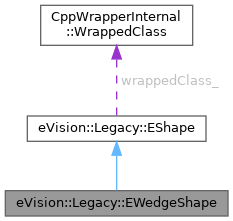
| CppWrapperInternal::WrappedClass | wrappedClass_ |
Manages a wedge shape.
License(s): BasicTypes
|
virtual | ||||||||||||
| eVision::Legacy::EWedgeShape::EWedgeShape | ( | CppWrapperInternal::InternalConstructor | ) |
|
virtual |
Find the daughter shape that is the closest to this shape. To retrieve the closest shape, use EShape::GetClosestShape.
Implements eVision::Legacy::EShape.
| void eVision::Legacy::EWedgeShape::CopyTo | ( | eVision::Legacy::EWedgeShape & | dest | ) | const |
Copies all the data of the current EWedgeShape object into another EWedgeShape object and returns it.
| dest | Pointer to the EWedgeShape object in which the current EWedgeShape object data have to be copied. |
In the overload taking a pointer, in case of a NULL pointer, a new EWedgeShape object will be created and returned.
| void eVision::Legacy::EWedgeShape::CopyTo | ( | eVision::Legacy::EWedgeShape & | dest, |
| bool | bRecursive ) const |
Copies all the data of the current EWedgeShape object into another EWedgeShape object and returns it.
| dest | Pointer to the EWedgeShape object in which the current EWedgeShape object data have to be copied. |
| bRecursive | true if the children shapes have to be copied as well, false otherwise. |
In the overload taking a pointer, in case of a NULL pointer, a new EWedgeShape object will be created and returned.
| eVision::Legacy::EWedgeShape * eVision::Legacy::EWedgeShape::CopyTo | ( | eVision::Legacy::EWedgeShape * | dest, |
| bool | bRecursive ) const |
Copies all the data of the current EWedgeShape object into another EWedgeShape object and returns it.
| dest | Pointer to the EWedgeShape object in which the current EWedgeShape object data have to be copied. |
| bRecursive | true if the children shapes have to be copied as well, false otherwise. |
In the overload taking a pointer, in case of a NULL pointer, a new EWedgeShape object will be created and returned.
Use the overload taking a reference.
Deprecated in version 23.12. Scheduled to be removed in version 27.6.
|
virtual |
Moves a handle to a new position and updates the position parameters of the shape.
| n32CursorX | Current cursor coordinates. |
| n32CursorY | Current cursor coordinates. |
Implements eVision::Legacy::EShape.
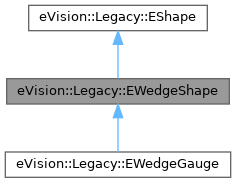
Reimplemented in eVision::Legacy::EWedgeGauge.
|
virtual |
Draws a graphical representation of a shape, as defined by EDrawingMode.
| graphicContext | Handle of the device context on which to draw. |
Implements eVision::Legacy::EShape.
Reimplemented in eVision::Legacy::EWedgeGauge.
|
virtual |
Draws a graphical representation of a shape, as defined by EDrawingMode.
| graphicContext | Handle of the device context on which to draw. |
| drawingMode | Indicates how the point location or model fitting gauge must be displayed, as defined by EDrawingMode. |
Implements eVision::Legacy::EShape.
Reimplemented in eVision::Legacy::EWedgeGauge.
|
virtual |
Draws a graphical representation of a shape, as defined by EDrawingMode.
| graphicContext | Handle of the device context on which to draw. |
| drawingMode | Indicates how the point location or model fitting gauge must be displayed, as defined by EDrawingMode. |
| daughters | true if the daughters gauges are to be displayed also. |
Implements eVision::Legacy::EShape.
Reimplemented in eVision::Legacy::EWedgeGauge.
|
virtual |
Draws a graphical representation of a shape, as defined by EDrawingMode.
| graphicContext | Handle of the device context on which to draw. |
Implements eVision::Legacy::EShape.
Reimplemented in eVision::Legacy::EWedgeGauge.
|
virtual |
Draws a graphical representation of a shape, as defined by EDrawingMode.
| graphicContext | Handle of the device context on which to draw. |
| color | The color to draw with. |
Implements eVision::Legacy::EShape.
Reimplemented in eVision::Legacy::EWedgeGauge.
|
virtual |
Draws a graphical representation of a shape, as defined by EDrawingMode.
| graphicContext | Handle of the device context on which to draw. |
| color | The color to draw with. |
| drawingMode | Indicates how the point location or model fitting gauge must be displayed, as defined by EDrawingMode. |
Implements eVision::Legacy::EShape.
Reimplemented in eVision::Legacy::EWedgeGauge.
|
virtual |
Draws a graphical representation of a shape, as defined by EDrawingMode.
| graphicContext | Handle of the device context on which to draw. |
| color | The color to draw with. |
| drawingMode | Indicates how the point location or model fitting gauge must be displayed, as defined by EDrawingMode. |
| daughters | true if the daughters gauges are to be displayed also. |
Implements eVision::Legacy::EShape.
Reimplemented in eVision::Legacy::EWedgeGauge.
|
virtual |
Draws a graphical representation of a shape, as defined by EDrawingMode.
| graphicContext | Handle of the device context on which to draw. |
| drawingMode | Indicates how the point location or model fitting gauge must be displayed, as defined by EDrawingMode. |
Implements eVision::Legacy::EShape.
Reimplemented in eVision::Legacy::EWedgeGauge.
|
virtual |
Draws a graphical representation of a shape, as defined by EDrawingMode.
| graphicContext | Handle of the device context on which to draw. |
| drawingMode | Indicates how the point location or model fitting gauge must be displayed, as defined by EDrawingMode. |
| daughters | true if the daughters gauges are to be displayed also. |
Implements eVision::Legacy::EShape.
Reimplemented in eVision::Legacy::EWedgeGauge.
|
virtual |
Draws a graphical representation of a shape, as defined by EDrawingMode.
| graphicContext | Handle of the device context on which to draw. |
Implements eVision::Legacy::EShape.
Reimplemented in eVision::Legacy::EWedgeGauge.
|
virtual |
Draws a graphical representation of a shape, as defined by EDrawingMode.
| graphicContext | Handle of the device context on which to draw. |
| drawingMode | Indicates how the point location or model fitting gauge must be displayed, as defined by EDrawingMode. |
Implements eVision::Legacy::EShape.
Reimplemented in eVision::Legacy::EWedgeGauge.
|
virtual |
Draws a graphical representation of a shape, as defined by EDrawingMode.
| graphicContext | Handle of the device context on which to draw. |
| drawingMode | Indicates how the point location or model fitting gauge must be displayed, as defined by EDrawingMode. |
| daughters | true if the daughters gauges are to be displayed also. |
Implements eVision::Legacy::EShape.
Reimplemented in eVision::Legacy::EWedgeGauge.
| float eVision::Legacy::EWedgeShape::GetAmplitude | ( | ) | const |
Angular amplitude of the EWedgeShape.
A EWedgeShape is fully defined knowing its nominal position (its center coordinates), its nominal radius (diameter), its breadth, the angular position from where it extents, its angular amplitude, and its outline tolerance.
The sign of the rotation angle depends whether the field of view is calibrated or not.
| float eVision::Legacy::EWedgeShape::GetAngle | ( | ) | const |
Orientation of the shape.
| float eVision::Legacy::EWedgeShape::GetApexAngle | ( | ) | const |
Angular position at the apex of the EWedgeShape.
A EWedgeShape is fully defined knowing its nominal position (its center coordinates), its nominal radius (diameter), its breadth, the angular position from where it extents, its angular amplitude, and its outline tolerance.
The sign of the rotation angle depends whether the field of view is calibrated or not.
| float eVision::Legacy::EWedgeShape::GetBreadth | ( | ) | const |
Breadth of the EWedgeShape.
A EWedgeShape is fully defined knowing its nominal position (its center coordinates), its nominal radius (diameter), its breadth, the angular position from where it extents, its angular amplitude, and its outline tolerance.
| eVision::EPoint eVision::Legacy::EWedgeShape::GetCenter | ( | ) | const |
Center point of the shape.
| float eVision::Legacy::EWedgeShape::GetCenterX | ( | ) | const |
Abscissa of the origin point of the shape.
| float eVision::Legacy::EWedgeShape::GetCenterY | ( | ) | const |
Ordinate of the origin point of the shape.
| void eVision::Legacy::EWedgeShape::GetCorners | ( | eVision::EPoint & | ar, |
| eVision::EPoint & | AAr, | ||
| eVision::EPoint & | aRR, | ||
| eVision::EPoint & | AARR ) |
Retrieves the coordinates of each corner of the EWedgeShape.
| ar | Coordinates of the inner org corner of the EWedgeShape. |
| AAr | Coordinates of the inner end corner of the EWedgeShape. |
| aRR | Coordinates of the outer org corner of the EWedgeShape. |
| AARR | Coordinates of the outer end corner of the EWedgeShape. |
| bool eVision::Legacy::EWedgeShape::GetDirect | ( | ) |
Flag indicating whether positive angles correspond to a clockwise or an anticlockwise rotation.
true (default) means that angles increase anticlockwisely in a direct coordinate system, and clockwisely in an inverse coordinate system.
| void eVision::Legacy::EWedgeShape::GetEdges | ( | eVision::Legacy::ELine & | a, |
| eVision::Legacy::ELine & | AA, | ||
| eVision::Legacy::ECircle & | r, | ||
| eVision::Legacy::ECircle & | RR ) |
Retrieves each edge of the EWedgeShape.
| a | Org edge of the EWedgeShape. |
| AA | End edge of the EWedgeShape. |
| r | Inner edge of the EWedgeShape. |
| RR | Outer edge of the EWedgeShape. |
| float eVision::Legacy::EWedgeShape::GetEndAngle | ( | ) | const |
Ending angular position of the EWedgeShape.
A EWedgeShape is fully defined knowing its nominal position (its center coordinates), its nominal radius (diameter), its breadth, the angular position from where it extents, its angular amplitude, and its outline tolerance.
The sign of the rotation angle depends whether the field of view is calibrated or not.
| bool eVision::Legacy::EWedgeShape::GetFullBreadth | ( | ) | const |
Flag indicating if the EWedgeShape has a full breadth (breadth = radius).
| bool eVision::Legacy::EWedgeShape::GetFullCircle | ( | ) | const |
Flag indicating if the EWedgeShape is a full circle (amplitude = 2 PI).
| eVision::EPoint eVision::Legacy::EWedgeShape::GetInnerApex | ( | ) | const |
Inner apex point coordinates of the EWedgeShape.
| float eVision::Legacy::EWedgeShape::GetInnerArcLength | ( | ) | const |
Inner circle arc length of the EWedgeShape.
| float eVision::Legacy::EWedgeShape::GetInnerDiameter | ( | ) | const |
Inner diameter of the EWedgeShape.
| eVision::EPoint eVision::Legacy::EWedgeShape::GetInnerEnd | ( | ) | const |
Inner end point coordinates of the EWedgeShape.
| eVision::EPoint eVision::Legacy::EWedgeShape::GetInnerOrg | ( | ) | const |
Inner origin point coordinates of the EWedgeShape.
| eVision::EPoint eVision::Legacy::EWedgeShape::GetInnerPoint | ( | float | fraction | ) | const |
Returns the coordinates of a particular point specified by its location along the inner circle arc.
| fraction | Point location expressed as a fraction of the circle arc (range [-1, +1]). |
| float eVision::Legacy::EWedgeShape::GetInnerRadius | ( | ) | const |
Inner radius of the EWedgeShape.
| void eVision::Legacy::EWedgeShape::GetMidEdges | ( | eVision::EPoint & | a, |
| eVision::EPoint & | AA, | ||
| eVision::EPoint & | r, | ||
| eVision::EPoint & | RR ) |
Retrieves the center coordinates of each edge of the wedge fitting gauge.
| a | Center coordinates of the org edge of the EWedgeShape. |
| AA | Center coordinates of the end edge of the EWedgeShape. |
| r | Center coordinates of the inner edge of the EWedgeShape. |
| RR | Center coordinates of the outer edge of the EWedgeShape. |
| float eVision::Legacy::EWedgeShape::GetOrgAngle | ( | ) | const |
Angular position from where the EWedgeShape extents.
A EWedgeShape is fully defined knowing its nominal position (its center coordinates), its nominal radius (diameter), its breadth, the angular position from where it extents, its angular amplitude, and its outline tolerance.
The sign of the rotation angle depends whether the field of view is calibrated or not.
| eVision::EPoint eVision::Legacy::EWedgeShape::GetOuterApex | ( | ) | const |
Outer apex point coordinates of the EWedgeShape.
A EWedgeShape is fully defined knowing its nominal position (its center coordinates), its nominal radius (diameter), its breadth, the angular position from where it extents, its angular amplitude, and its outline tolerance.
| float eVision::Legacy::EWedgeShape::GetOuterArcLength | ( | ) | const |
Outer circle arc length of the EWedgeShape.
A EWedgeShape is fully defined knowing its nominal position (its center coordinates), its nominal radius (diameter), its breadth, the angular position from where it extents, its angular amplitude, and its outline tolerance.
| float eVision::Legacy::EWedgeShape::GetOuterDiameter | ( | ) | const |
Outer diameter of the EWedgeShape.
A EWedgeShape is fully defined knowing its nominal position (its center coordinates), its nominal radius (diameter), its breadth, the angular position from where it extents, its angular amplitude, and its outline tolerance.
| eVision::EPoint eVision::Legacy::EWedgeShape::GetOuterEnd | ( | ) | const |
Outer end point coordinates of the EWedgeShape.
A EWedgeShape is fully defined knowing its nominal position (its center coordinates), its nominal radius (diameter), its breadth, the angular position from where it extents, its angular amplitude, and its outline tolerance.
| eVision::EPoint eVision::Legacy::EWedgeShape::GetOuterOrg | ( | ) | const |
Outer origin point coordinates of the EWedgeShape.
A EWedgeShape is fully defined knowing its nominal position (its center coordinates), its nominal outer radius (diameter), its breadth (must be negative), the angular position from where it extents, its angular amplitude, and its outline tolerance.
| eVision::EPoint eVision::Legacy::EWedgeShape::GetOuterPoint | ( | float | fraction | ) | const |
Returns the coordinates of a particular point specified by its location along the outter circle arc.
| fraction | Point location expressed as a fraction of the circle arc (range [-1, +1]). |
| float eVision::Legacy::EWedgeShape::GetOuterRadius | ( | ) | const |
Outer radius of the EWedgeShape.
A EWedgeShape is fully defined knowing its nominal position (its center coordinates), its nominal radius (diameter), its breadth, the angular position from where it extents, its angular amplitude, and its outline tolerance.
| eVision::EPoint eVision::Legacy::EWedgeShape::GetPoint | ( | float | breadthFraction, |
| float | angleFraction ) const |
Returns the coordinates of a particular point specified by its location along the wedge perimeter.
| breadthFraction | Point location expressed as a fraction of the wedge breadth (range -1, +1). |
| angleFraction | Point location expressed as a fraction of the wedge amplitude (range -1, +1). |
| float eVision::Legacy::EWedgeShape::GetScale | ( | ) | const |
Horizontal sensor resolution, in pixels per unit.
|
virtual |
|
virtual |
Checks if there is a handle under the cursor.
Implements eVision::Legacy::EShape.
Reimplemented in eVision::Legacy::EWedgeGauge.
|
virtual |
Checks if there is a handle under the cursor.
| bDaughters | Indicates if the check must be done in the whole hierarchy or just this object. |
Implements eVision::Legacy::EShape.
Reimplemented in eVision::Legacy::EWedgeGauge.
| eVision::Legacy::EWedgeShape & eVision::Legacy::EWedgeShape::operator= | ( | const eVision::Legacy::EWedgeShape & | other | ) |
Copies all the data from another EWedgeShape object into the current EWedgeShape object.
| other | EWedgeShape object to be copied |
| void eVision::Legacy::EWedgeShape::SetAmplitude | ( | float | amplitude | ) |
Angular amplitude of the EWedgeShape.
A EWedgeShape is fully defined knowing its nominal position (its center coordinates), its nominal radius (diameter), its breadth, the angular position from where it extents, its angular amplitude, and its outline tolerance.
The sign of the rotation angle depends whether the field of view is calibrated or not.
| void eVision::Legacy::EWedgeShape::SetAngle | ( | float | f32Angle | ) |
Orientation of the shape.
| void eVision::Legacy::EWedgeShape::SetCenter | ( | const eVision::EPoint & | center | ) |
Center point of the shape.
| void eVision::Legacy::EWedgeShape::SetCenterXY | ( | float | centerX, |
| float | centerY ) |
Sets the center coordinates of a EWedgeShape object.
| centerX | Center coordinates of the EWedgeShape object. |
| centerY | Center coordinates of the EWedgeShape object. |
|
virtual |
Sets the nominal inner/outer diameter and breadth of the EWedgeShape.
| diameter | Outer diameter of the EWedgeShape. The default value is 100. |
A EWedgeShape is fully defined knowing its nominal position (given by the coordinates of its center), its nominal outer radius (diameter), its breadth, the angular position from where it extents, its angular amplitude and its outline tolerance.
By default, the EWedgeShape diameter value is 100, which means 100 pixels when the field of view is not calibrated and 100 "units" in case of a calibrated field of view.
|
virtual |
Sets the nominal inner/outer diameter and breadth of the EWedgeShape.
| diameter | Outer diameter of the EWedgeShape. The default value is 100. |
| breadth | Breadth of the EWedgeShape. It must be negative or zero. Its default value is -50. |
A EWedgeShape is fully defined knowing its nominal position (given by the coordinates of its center), its nominal outer radius (diameter), its breadth, the angular position from where it extents, its angular amplitude and its outline tolerance.
By default, the EWedgeShape diameter value is 100, which means 100 pixels when the field of view is not calibrated and 100 "units" in case of a calibrated field of view.
Reimplemented in eVision::Legacy::EWedgeGauge.
| void eVision::Legacy::EWedgeShape::SetDirect | ( | bool | direct | ) |
| void eVision::Legacy::EWedgeShape::SetFromCenterAndOrigin | ( | const eVision::EPoint & | center, |
| const eVision::EPoint & | origin ) |
Sets the geometric parameters (nominal position and diameter, breadth, angular position and amplitude) of an EWedgeShape object.
| center | Center coordinates of the wedge at its nominal position. The default value is (0,0). |
| origin | Origin point coordinates of the wedge. |
In a direct coordinate system, the abscissa extends rightwards and the ordinate extends upwards. The coordinate system is said to be inverse if the abscissa extends rightwards and the ordinate extends downwards.
| void eVision::Legacy::EWedgeShape::SetFromCenterAndOrigin | ( | const eVision::EPoint & | center, |
| const eVision::EPoint & | origin, | ||
| float | breadth ) |
Sets the geometric parameters (nominal position and diameter, breadth, angular position and amplitude) of an EWedgeShape object.
| center | Center coordinates of the wedge at its nominal position. The default value is (0,0). |
| origin | Origin point coordinates of the wedge. |
| breadth | Nominal breadth of the wedge. It must be negative or zero. The default value is -50. |
In a direct coordinate system, the abscissa extends rightwards and the ordinate extends upwards. The coordinate system is said to be inverse if the abscissa extends rightwards and the ordinate extends downwards.
| void eVision::Legacy::EWedgeShape::SetFromCenterAndOrigin | ( | const eVision::EPoint & | center, |
| const eVision::EPoint & | origin, | ||
| float | breadth, | ||
| bool | direct ) |
Sets the geometric parameters (nominal position and diameter, breadth, angular position and amplitude) of an EWedgeShape object.
| center | Center coordinates of the wedge at its nominal position. The default value is (0,0). |
| origin | Origin point coordinates of the wedge. |
| breadth | Nominal breadth of the wedge. It must be negative or zero. The default value is -50. |
| direct | true (default) means that angles increase anticlockwise in a direct coordinate system and clockwise in an inverse coordinate system. |
In a direct coordinate system, the abscissa extends rightwards and the ordinate extends upwards. The coordinate system is said to be inverse if the abscissa extends rightwards and the ordinate extends downwards.
|
virtual |
Sets the geometric parameters (nominal position and diameter, breadth, angular position and amplitude) of an EWedgeShape object.
| origin | Origin point coordinates of the wedge. |
| middle | Middle point coordinates of the wedge. |
| end | End point coordinates of the wedge. |
In a direct coordinate system, the abscissa extends rightwards and the ordinate extends upwards. The coordinate system is said to be inverse if the abscissa extends rightwards and the ordinate extends downwards.
Reimplemented in eVision::Legacy::EWedgeGauge.
|
virtual |
Sets the geometric parameters (nominal position and diameter, breadth, angular position and amplitude) of an EWedgeShape object.
| origin | Origin point coordinates of the wedge. |
| middle | Middle point coordinates of the wedge. |
| end | End point coordinates of the wedge. |
| breadth | Nominal breadth of the wedge. It must be negative or zero. The default value is -50. |
In a direct coordinate system, the abscissa extends rightwards and the ordinate extends upwards. The coordinate system is said to be inverse if the abscissa extends rightwards and the ordinate extends downwards.
Reimplemented in eVision::Legacy::EWedgeGauge.
|
virtual |
Sets the geometric parameters (nominal position and diameter, breadth, angular position and amplitude) of an EWedgeShape object.
| origin | Origin point coordinates of the wedge. |
| middle | Middle point coordinates of the wedge. |
| end | End point coordinates of the wedge. |
| breadth | Nominal breadth of the wedge. It must be negative or zero. The default value is -50. |
| fullCircle | true (default) in case of a full turn wedge. If fullCircle is false, origin and end give the wedge's amplitude. |
In a direct coordinate system, the abscissa extends rightwards and the ordinate extends upwards. The coordinate system is said to be inverse if the abscissa extends rightwards and the ordinate extends downwards.
Reimplemented in eVision::Legacy::EWedgeGauge.
|
virtual |
Sets the geometric parameters (nominal position and diameter, breadth, angular position and amplitude) of an EWedgeShape object.
| center | Center coordinates of the wedge at its nominal position. The default value is (0,0). |
| origin | Origin point coordinates of the wedge. |
In a direct coordinate system, the abscissa extends rightwards and the ordinate extends upwards. The coordinate system is said to be inverse if the abscissa extends rightwards and the ordinate extends downwards.
Use EWedgeShape::SetFromCenterAndOrigin instead.
Deprecated in version 23.12. Scheduled to be removed in version 27.6.
Reimplemented in eVision::Legacy::EWedgeGauge.
|
virtual |
Sets the geometric parameters (nominal position and diameter, breadth, angular position and amplitude) of an EWedgeShape object.
| center | Center coordinates of the wedge at its nominal position. The default value is (0,0). |
| origin | Origin point coordinates of the wedge. |
| breadth | Nominal breadth of the wedge. It must be negative or zero. The default value is -50. |
In a direct coordinate system, the abscissa extends rightwards and the ordinate extends upwards. The coordinate system is said to be inverse if the abscissa extends rightwards and the ordinate extends downwards.
Use EWedgeShape::SetFromCenterAndOrigin instead.
Deprecated in version 23.12. Scheduled to be removed in version 27.6.
Reimplemented in eVision::Legacy::EWedgeGauge.
|
virtual |
Sets the geometric parameters (nominal position and diameter, breadth, angular position and amplitude) of an EWedgeShape object.
| center | Center coordinates of the wedge at its nominal position. The default value is (0,0). |
| origin | Origin point coordinates of the wedge. |
| breadth | Nominal breadth of the wedge. It must be negative or zero. The default value is -50. |
| direct | true (default) means that angles increase anticlockwise in a direct coordinate system and clockwise in an inverse coordinate system. |
In a direct coordinate system, the abscissa extends rightwards and the ordinate extends upwards. The coordinate system is said to be inverse if the abscissa extends rightwards and the ordinate extends downwards.
Use EWedgeShape::SetFromCenterAndOrigin instead.
Deprecated in version 23.12. Scheduled to be removed in version 27.6.
Reimplemented in eVision::Legacy::EWedgeGauge.
|
virtual |
Sets the nominal radius and breadth of the EWedgeShape.
| outerRadius | Outer radius of the EWedgeShape. The default value is 50. |
A EWedgeShape is fully defined knowing its nominal position (given by the coordinates of its center), its nominal radius (diameter), its breadth, the angular position from where it extents, its angular amplitude and its outline tolerance.
By default, the EWedgeShape radius value is 50, which means 50 pixels when the field of view is not calibrated and 50 "units" in case of a calibrated field of view.
|
virtual |
Sets the nominal radius and breadth of the EWedgeShape.
| outerRadius | Outer radius of the EWedgeShape. The default value is 50. |
| breadth | Breadth of the EWedgeShape, which must be negative or zero. Its default value is -50. |
A EWedgeShape is fully defined knowing its nominal position (given by the coordinates of its center), its nominal radius (diameter), its breadth, the angular position from where it extents, its angular amplitude and its outline tolerance.
By default, the EWedgeShape radius value is 50, which means 50 pixels when the field of view is not calibrated and 50 "units" in case of a calibrated field of view.
Reimplemented in eVision::Legacy::EWedgeGauge.
| void eVision::Legacy::EWedgeShape::SetScale | ( | float | f32Scale | ) |
Horizontal sensor resolution, in pixels per unit.
|
virtual |
Sets the nominal position, length and rotation angle of the wedge according to a known EWedge object.
Reimplemented in eVision::Legacy::EWedgeGauge.
 1.17.0