Principles of EasyGauge
Finding Transition Points
All gauges are based on finding the position of all the transition points, called sample points, along a line segment probe, called the sample path, that cross one or several object edges and selecting the most relevant ones.
To do that, EasyGauge extracts the pixel values along the sample path (the red curve) then uses the peak analysis to determine the transition location. All the pixel values in the peak area are used to compute the transition location.
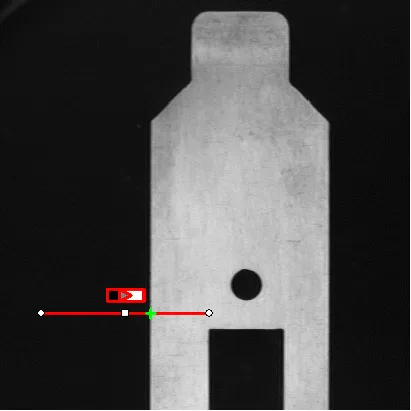
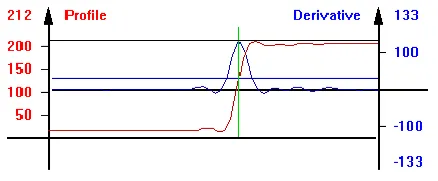
On the left, a measured point on a sample path. On the right, the pixel value profile and its derivate along the sample path.
On a sample path extracted from an image:
An edge appears as a transition from dark to light (or vice versa).
When plotting the pixel values along the sample path, this transition appears as an S-shaped curve.
The first derivative of this curve exhibits a peak around the transition point.
Hint
The better the contrast, the sharper the transition and the higher the peak.
Sub-pixel accuracy is only possible if the transition is surrounded by almost uniform regions of at least 2 pixels wide.
Measuring Complex Shapes
Except for the point gauge, all gauges try to find and measure complex shapes with the following algorithm:
Place sample paths along the nominal shape at regular interval
Measure each sample path to find sample points on this path.
Select one sample point for each sample path.
Fit the shape to the selected sample points.
Fitting the shape means adjusting its parameters to minimize the error residue (average distance of the sample points to the measured shape).
The fitting algorithm can include an iterative outlier rejection process, that will reject sample points that may harm the location accuracy:
Apply the model fitting to the valid sample points.
The sample points that are too far away from the fitted model and may harm the location accuracy are made invalid.
Repeat the proccess.